 Retro Replay Retro Gaming History, Reviews & Emulation
Retro Replay Review
Gameplay
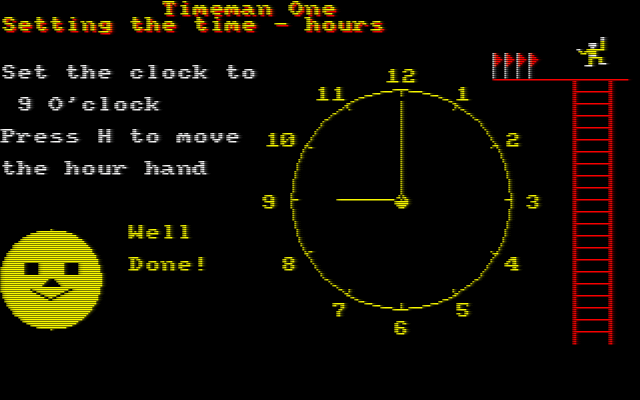
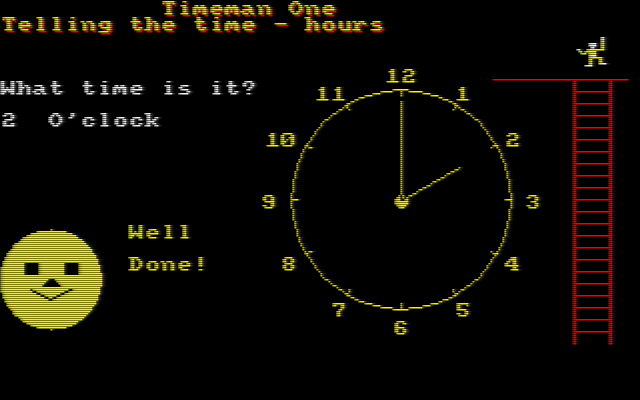
The first few questions make Timeman One‘s purpose immediately clear: look at a clock, give the time, and help a tiny man reach the top of a ladder. That modest bit of progress is a smart hook for young children. A correct answer moves him up two steps, an incorrect one drops him by one, so every question has just enough consequence to make paying attention matter without turning a wrong answer into a dead end.
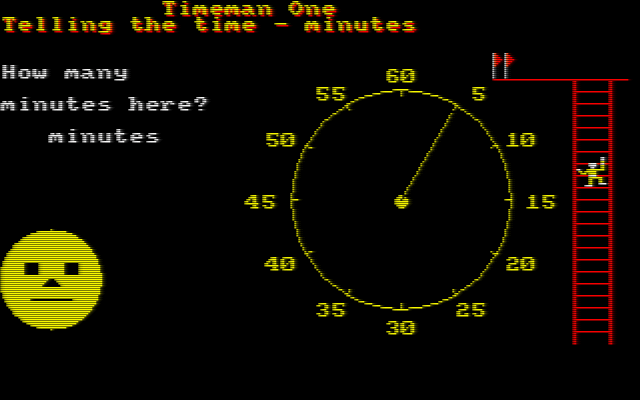
Its strongest decision is to break clock-reading into manageable pieces. Hours come first, then minutes with the minute hand and outer 5-to-60 markings, then the full combination of hours and minutes. The matching setting exercises reverse the task: instead of reading a displayed clock, you place the hour hand, minute hand, or both. That progression gives you a sensible way to find where a child is struggling rather than repeatedly throwing full clock faces at them.
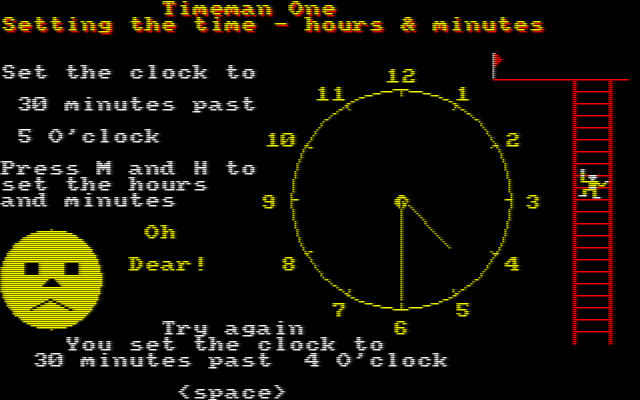
The retry rule is particularly good teaching. Get it wrong once and you have a chance to correct yourself; miss it again and the game shows the answer before moving on. That can become repetitive during a long session, especially because the central task never changes much, but repetition is the point here. Start with five-minute intervals, then use the one-minute setting only after the familiar positions stop causing hesitation.
There is a small but welcome finish line. Reaching the top brings happy music, a planted flag, and a dance, which gives a practice session an ending rather than leaving you in an endless quiz. Individual sign-in and saved achievement records also make it practical for more than one child to use. This is a focused teaching tool, not a game likely to hold attention once telling time is already second nature.
Graphics
The screen centers on a clock with a little man climbing a ladder beside it. Smiley and sad faces give instant feedback, while the final flag-planting dance offers a clear reward a child can understand at a glance. The minute exercise’s extra 5-to-60 numbers around the clock are also a useful picture, directly tying the hand position to the answer being learned.
Story
There is no story to follow in the usual sense. The climber’s trip up the ladder is the whole tiny scenario: answer questions, climb, reach the top, plant a flag, and dance.
That bare framing is enough for its audience because it turns abstract time practice into a visible goal. The little man is not a character with a larger adventure, but he gives each correct answer a pleasing, immediate result.
Older children will likely see through the reward loop quickly, yet that is not a serious flaw. Timeman One is built around short, purposeful sessions, and the ladder supplies just enough momentum to carry those sessions along.
Overall Experience
Timeman One is at its best when used as a patient bridge between being told how an analogue clock works and being able to answer without prompting. Its six modes avoid lumping every skill together, and the move from five-minute increments to one-minute intervals gives the program room to grow with the learner.
Frustration can set in if a child is asked to tackle the combined hours-and-minutes exercises too early, since the ladder penalty makes uncertainty visible. Fortunately, the game does not simply punish mistakes: it permits another attempt and then explains the answer. That balance makes it more useful than a bare right-or-wrong quiz.
Give it a chance if the goal is straightforward, structured practice in telling and setting time for a young learner. Its rewards are small, its scope is narrow, and its repetition is deliberate, but the payoff is real: a child can work through the parts of analogue time at a manageable pace and see their progress climb rung by rung.



Reviews
There are no reviews yet.