 Retro Replay Retro Gaming History, Reviews & Emulation
Retro Replay Review
Gameplay
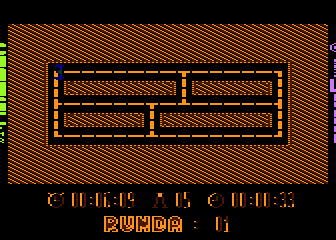
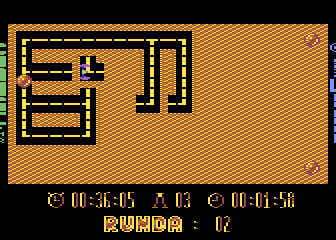
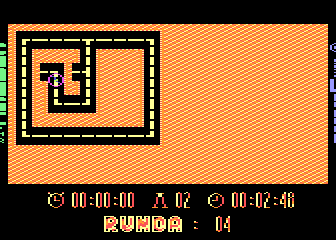
Change earns your attention quickly because its central puzzle is easy to grasp but awkward to master. Tuptacz moves around a maze of paths and occasional junctions, while you can rotate the square section he occupies by 90 degrees. Your job is to arrange the generator elements into a closed loop with no blind alleys. It sounds tidy on paper; in play, every turn can alter both the route you need and the route available to your enemy.
The roaming Sphere is what keeps the puzzle from becoming a relaxed pipe-fitting exercise. You need to think about the final loop, but you also need to keep moving and avoid a collision that kills immediately. The time limit presses harder still. A promising solution can collapse because you spent too long checking rotations, so the game rewards recognizing patterns and committing to a plan rather than endlessly testing possibilities.
There is a satisfying bit of rule-bending in Tuptacz being able to walk through thin walls. That freedom gives you ways to reach the position needed for a crucial rotation, yet it does not remove the pressure created by the paths, the Sphere, and the clock. Going off-screen is also fatal, making careless movement costly. Expect some sharp failures while learning how aggressively to move.
Across 48 levels, the straightforward premise has room to become properly demanding. Change is not for someone looking to coast through a puzzle game at their own pace. It is for you if a compact challenge sounds better when it asks you to solve, navigate, and survive at once.
Graphics
The game uses a top-down, fixed or flip-screen view centered on Tuptacz’s maze-like plantation paths and the generator pieces you must rotate. That overhead layout suits the problem well: you can see the local route, the crossroads, and the Sphere that needs to be avoided while deciding where the next turn should happen.
Story
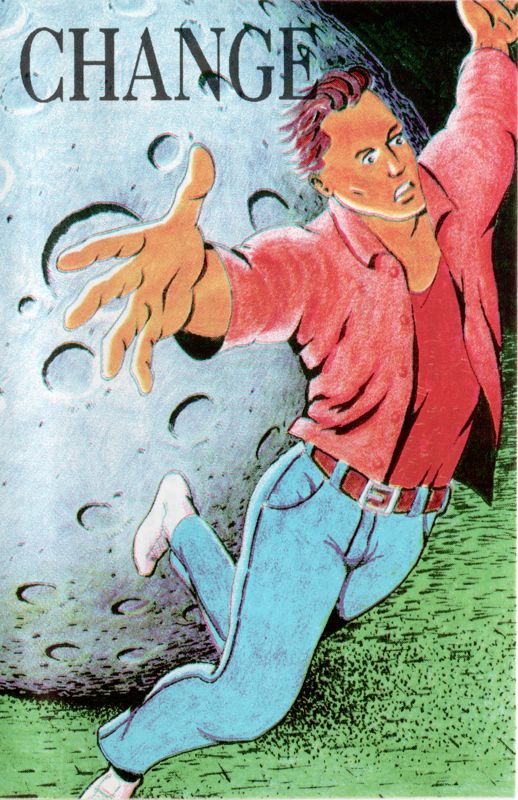
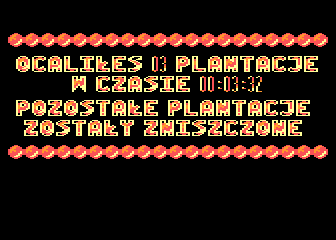
Change gives its arcade-puzzle action a light but clear stake. Tuptacz’s plantation has been invaded by alien Spheres, and repairing the forcefield is the only way to save the farm from destruction. It is a simple setup, but it immediately explains why every level is another emergency repair job.
The oddest touch is Tuptacz’s allergy to the plants on his own plantation. Because he can only use designated paths, the farm is not just a backdrop; it defines the movement restrictions that shape every puzzle. That is a neatly practical bit of fiction, even if the game is much more interested in the next maze than in elaborating its world.
Do not come to Change for a sprawling narrative. The aliens, the endangered farm, and the forcefield repair give the action a playful frame, then get out of the way. For this kind of game, that restraint works: the real drama comes from seeing whether you can finish the loop before the Sphere or timer finishes you.
Overall Experience
Change has the focused, slightly mean-spirited charm of an old-school arcade puzzle. Its best moments arrive when the correct arrangement starts to reveal itself just as the Sphere forces you to move, turning a static-looking logic problem into a scramble. When you finally close the loop, the relief feels earned because the game has been attacking your planning and your nerves at the same time.
Its frustrations are inseparable from that appeal. Instant death from contact, a timeout, or stepping off the screen leaves little room for sloppy recovery. If you dislike repeating a level after one bad decision, Change can feel harsher than clever. If you enjoy learning a board’s rhythm and shaving hesitation out of your solution, that severity becomes the point.
The 48-level run gives the idea enough breadth to recommend it to dedicated puzzle fans, especially anyone fond of Atari 8-bit games that make a few rules do a lot of work. Change is not trying to overwhelm you with complexity. It earns its place through a strong central twist: you must physically inhabit the maze you are trying to rearrange.



Reviews
There are no reviews yet.