 Retro Replay Retro Gaming History, Reviews & Emulation
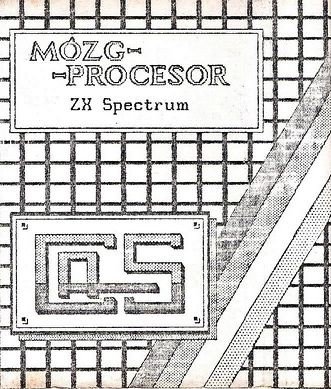
Retro Replay Review
Gameplay
The first few minutes make the central bargain clear: you are not here to leisurely poke through an island. A clock is counting down from four hours, Brian Thompson needs the brain processor implanted in time, and your task is to find it and get out. That immediate deadline gives even ordinary exploration a nervous edge. You will want to consult the island map early, orient yourself with the compass, and avoid treating each move as harmless experimentation.
Its parser-driven structure asks you to type commands, with roughly 40 supported and variations in wording. That puts the emphasis on careful phrasing and practical problem-solving rather than menu selection. Tools matter for particular actions, while the amount of equipment you can carry is limited. The result is a game where you need to decide what deserves a slot before heading into the next problem, not simply scoop up everything that looks useful.
The Geiger counter is more than flavor. Radiation can affect whether the mission succeeds, so the island’s hazards become another calculation beside the clock. Fatigue adds a further constraint, creating a compact survival-minded puzzle loop: judge your route, watch your condition, bring the right object, and do not waste time. When these pressures line up, Mózg Procesor sounds admirably demanding.
It can also be unforgiving in a very traditional way. A failed route, an unnecessary action, or leaving behind the needed tool may cost time you cannot recover. If you enjoy mapping, note-taking, and working through a stubborn text-adventure obstacle one command at a time, that friction is likely the point. If a strict timer makes you feel hurried rather than engaged, the mission’s four-hour limit may turn its strongest idea into a source of irritation.
Graphics
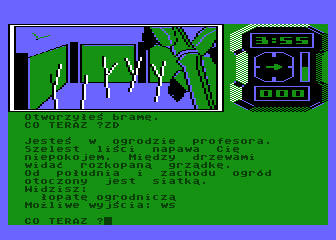
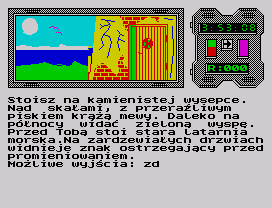
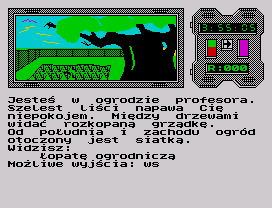
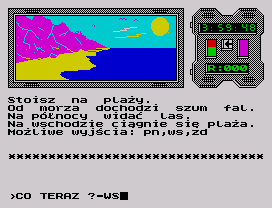
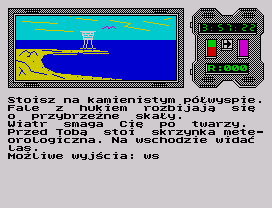
Illustrations accompany the text, giving the island adventure more visual texture than a purely text-only parser game. They are a useful break between command prompts and help keep the journey from feeling like a wall of prose, while the map serves as a practical reference for navigating the island.
Story
The story is direct but effective: genius academic Brian Thompson has been injured on the way to a conference where he intended to unveil his biological computer, and only a brain processor can save him. You are the agent assigned to retrieve that device from an island before time expires. It is a clean sci-fi rescue premise with a personal consequence attached to failure.
Setting the mission in 2016 gives the futuristic idea a near-future frame rather than sending it into distant space opera. The biological-computer angle is the most intriguing part of the setup, because it makes the sought-after object feel like more than a generic prize. You are chasing the one thing that might preserve the mind of the person who created it.
Don’t expect the premise to remove the need for legwork. The story’s urgency comes through the mission conditions—the ticking clock, the dangerous radiation, and the possibility that Thompson cannot be saved—not through a relaxed narrative pace. That suits the format: each practical delay becomes part of the rescue drama.
Overall Experience
Mózg Procesor is a compact, high-pressure text adventure built around consequences. The clock’s ticking, the sound accompaniment, and the stack of survival constraints turn a search mission into something more anxious than a standard inventory puzzle. It asks you to pay attention, plan ahead, and accept that a good solution needs to be both correct and efficient.
Its best moments are likely to come when the map, compass, tools, inventory limit, fatigue, and radiation concerns finally start fitting together in your head. At that point, the island stops being a series of locations and becomes a route you need to master. That is a rewarding shift for anyone who likes classic interactive fiction with real stakes.
The trade-off is obvious: this is not a forgiving adventure for casual trial-and-error. You need patience with typed commands and a willingness to replay or rethink a plan when the timer exposes a bad decision. For veteran parser-adventure fans, that severity is a recommendation. For everyone else, it is a game to try only if the idea of a tense, methodical rescue operation sounds more exciting than exhausting.



Reviews
There are no reviews yet.