 Retro Replay Retro Gaming History, Reviews & Emulation

Retro Replay Review
Gameplay
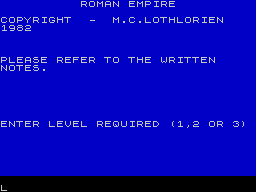
The first hour of Roman Empire is mostly spent learning to respect a decision that looks small in a text menu. You are not steering individual units through a battlefield. Instead, each year asks you to assemble armies from your legions, appoint generals, and commit to campaigns against neighboring countries. That distance from the action is either the point or the deal-breaker: victory comes from making sound imperial judgments before the computer resolves the next turn of fighting.
There is more to weigh than raw troop numbers. Army quality, morale, and fatigue turn a campaign into a continuing concern, especially because wars can run for more than one turn. Reinforcing an army can preserve a push; withdrawing can save what remains for a more favorable moment. Once that rhythm clicks, the game gains a pleasingly anxious pulse. You are trying to expand, but every army sent abroad leaves you exposed to barbarians.
The lack of direct battle control can frustrate you if you want to outmaneuver an opponent tactically on the field. Roman Empire asks for confidence in broader choices, then makes you live with the outcome. Its three difficulty settings help, but the central test remains the same: judge the state of your forces, commit without overreaching, and protect the empire while chasing another conquest.
Graphics
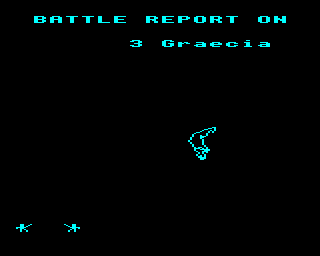
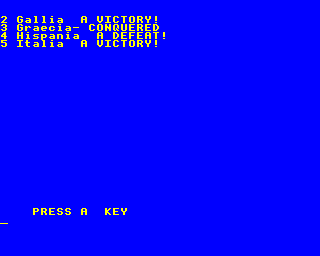
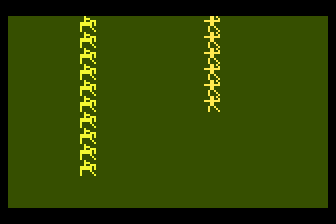
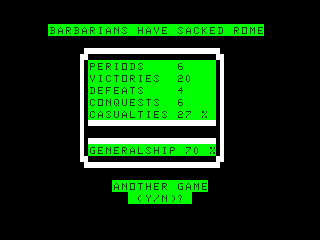
Roman Empire is chiefly a text-menu strategy game, so most of your time is spent reading decisions and results rather than watching elaborate military scenes. Atari versions add maps, giving the empire and its neighboring targets a more concrete shape on screen.
Story
You take the role of Rome’s emperor in the first century BCE, with a clear imperial mandate: occupy neighboring countries and expand the realm. It is a strong strategic frame because every decision is naturally loaded with responsibility. A failed campaign is not merely a lost turn; it is an emperor spending soldiers and attention where the empire may not be able to spare either.
The game finds its drama in the collision between ambition and defense. Campaigns pull forces outward, while barbarians threaten from the other direction. That simple pressure gives your annual choices a believable Roman flavor without slowing the game down with lengthy narrative detours.
Do not come in expecting a character-driven historical tale. The story is the one you produce through appointments, campaigns, reinforcements, retreats, and conquests. For a game built around terse decisions, that is enough to make a successful expansion feel earned and a bad military commitment feel suitably costly.
Overall Experience
Roman Empire is a compact, demanding strategy game that trusts you to find excitement in preparation and consequence. The computer handles each turn’s battles, but that does not make your role passive; it makes your earlier choices matter more. You will either enjoy watching a plan survive contact with fatigue and falling morale, or resent not being able to intervene once the fighting starts.
Its age shows in the spare, menu-driven interface, yet the core loop still has bite. The need to build armies, choose commanders, sustain multi-turn campaigns, and remain alert to barbarians creates a useful chain of pressures. It never needs a huge ruleset to make expansion feel risky.
Give it a chance if you like early turn-based strategy that treats war as a sequence of high-level commitments rather than a tactical puzzle. Skip it if direct battle control is essential to you. For the patient armchair emperor, Roman Empire delivers a solid campaign of calculated risks and occasional painful lessons.



Reviews
There are no reviews yet.