 Retro Replay Retro Gaming History, Reviews & Emulation
Retro Replay Review
Gameplay
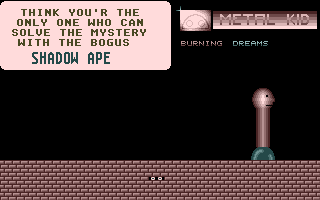
Shadow Ape starts from a pleasingly direct place: enter the mysterious house and start poking at it. Playing as a five-year-old gives the search a different flavor from the usual hard-boiled detective routine. You are not saving the world or untangling a huge conspiracy; you are chasing proof of something adults dismiss. That small-scale motivation is immediate, and it gives even basic exploration a nice sense of childish determination.
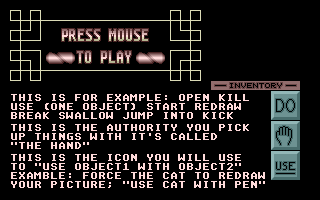
The interaction model is almost aggressively simple. You choose between do, take, and use, then apply those commands to the house and the items you collect. That limitation is a virtue at first, because you spend less time wrestling with a pile of verbs and more time considering what an object might be for. If you enjoy adventure games that ask you to inspect a space carefully and make connections from a small inventory, Shadow Ape gets to that core quickly.
The downside is equally clear: with so few ways to interact, progress depends heavily on finding the intended object-and-action combination. When you are on the right track, the uncluttered command set feels tidy. When you are not, trying the same handful of possibilities can become stubborn rather than clever. Go in ready to read the feedback text closely; it is not decoration, but part of the puzzle-solving process.
Graphics
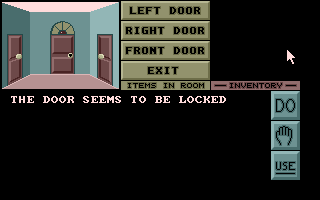
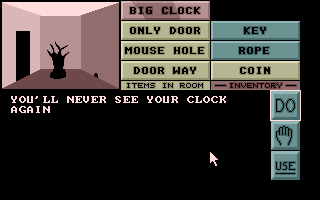
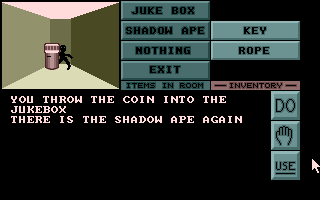
The game uses a first-person view of the house, with the environment occupying the visual portion of the screen while direction buttons, inventory items, commands, and a large text area sit around it. It is a clearly compartmentalized adventure-game layout: you look at a room, choose an action, and read the result. The large written feedback area makes the game feel more text-led than image-led, which suits its puzzle focus but gives the screen a distinctly old-school density.
Story
The story’s best idea is its refusal to overcomplicate the central question. Is the shadow ape real, or is it the sort of thing a five-year-old would believe when everyone else has stopped listening? That uncertainty gives the house some natural tension before the game needs to explain anything more.
Having a child at the center also makes the premise more inviting than a generic haunted-house setup. The mythical creature is not merely a monster to confront; it is the object of a personal investigation. You keep moving because you want the boy to be right, or at least to find out what is actually hiding in the house.
This is a premise-driven adventure rather than a sprawling narrative epic. Its story works best if you enjoy a focused mystery and are willing to let exploration carry the momentum. The payoff is the pursuit of that one unanswered question, not the promise of a giant cast or a maze of plot threads.
Overall Experience
Shadow Ape has the kind of concentrated design that can be refreshing after more bloated adventures. It gives you a house, a peculiar legend, a small command set, and a reason to start experimenting. There is little distance between the premise and the play, which is exactly where this game is strongest.
Its friction is the familiar friction of vintage item puzzles. You will either appreciate the discipline of working within three verbs or feel boxed in when the next step is unclear. The game is more likely to reward a patient, methodical mood than a desire for fast momentum.
Give it a chance if a compact first-person mystery with a child’s-eye premise sounds more appealing than a feature-heavy adventure. Shadow Ape does not need a complicated toolkit to create curiosity; it needs you to accept its simple rules and follow the strange question at the center of the house. For the right kind of puzzle-adventure fan, that is enough to make the search worthwhile.


Reviews
There are no reviews yet.