 Retro Replay Retro Gaming History, Reviews & Emulation
Retro Replay Review
Gameplay
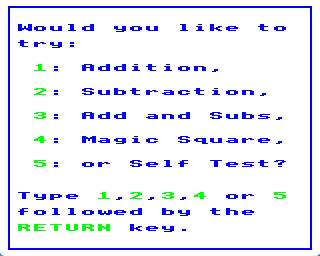
The first few turns make Number Puzzler sound almost too simple: do a little arithmetic, claim a square, make a line of three. Then you notice that every answer is also a board position, and the best numerical answer is not always the move you need. That small tactical wrinkle gives the three Noughts-and-Crosses-style games a welcome bite, especially with another person across from you.
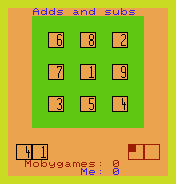
Addition is the cleanest entry point. Two numbers appear, and you can take either number or their total, so a 4 and 5 let you choose 4, 5, or 9. Subtraction opens things up differently by letting a number stand for itself or a pair of components; 9 can become 9, 1 and 8, 2 and 7, and so on. Adds & Subs combines those options, making the calculation less of a hurdle and the board-reading more important.
That progression works because it teaches the underlying idea without burying you in rules. Addition is easy to grasp, Subtraction asks you to think in number pairs, and Adds & Subs is the mode where you have to scan for several possible moves before committing. A stronger math student may outpace the arithmetic quickly, but the contest can still stay lively if both sides are watching for threats and setups.
Magic Square is the outlier, and wisely so. You choose a target from 3 to 20, then fill the missing spots in a partly completed 3×3 square until every horizontal, vertical, and diagonal line hits that target. It lacks the direct tug-of-war of the other modes, but it is the more satisfying choice when you want to settle into a compact logic problem rather than race an opponent to a line.
Graphics
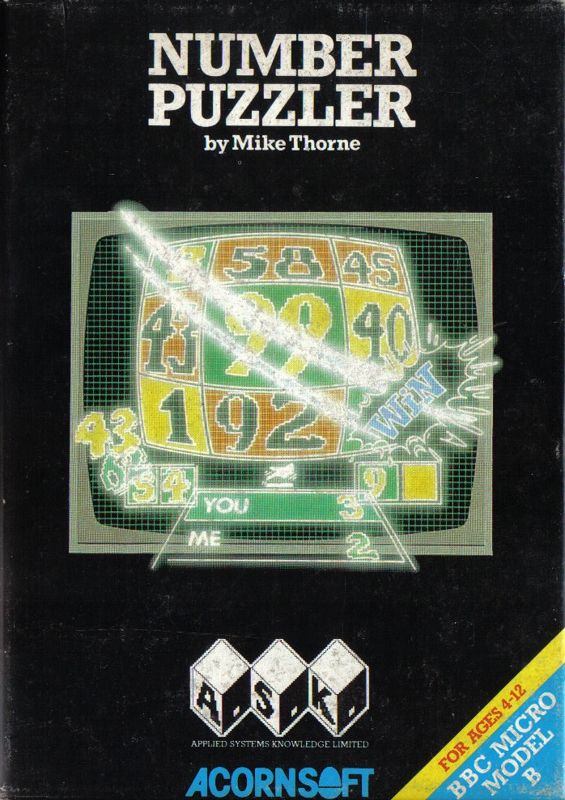
The game’s board-focused display is built around numbered grids and coloured claimed cells. In the three competitive modes, that colour change makes ownership of each square easy to follow; in Magic Square, the 3×3 layout keeps the unfinished number puzzle plainly in view.
Story
There is no narrative detour here. Number Puzzler puts all of its energy into arithmetic questions, grid choices, and the next turn.
That directness suits the material. You are not being asked to follow a lesson wrapped in characters or a premise; you are challenged to see numbers as flexible pieces in a small tactical contest.
Magic Square supplies its own little sense of resolution when the final value makes every row, column, and diagonal work. It is a mathematical finish rather than a story payoff, but it is enough for this kind of collection.
Overall Experience
Number Puzzler is at its best as a two-player brain teaser for someone who likes the familiar shape of Tic-Tac-Toe but wants every move to come with a quick mental calculation. The rules are approachable enough for younger learners, while the choice among several valid number-based moves stops the competitive modes from becoming pure drill work.
Its limits are equally clear: these are small grid games, and the core pattern arrives quickly. If you want elaborate strategy, a long campaign, or a broad set of puzzle types, the repetition will set in. The payoff comes from short rematches, where a missed block or overlooked total gives the other side an opening.
Give it a chance if you enjoy arithmetic puzzles with a little head-to-head pressure, or if you want an old-school way to practice sums and number relationships without making them feel entirely like homework. Magic Square adds useful variety, but the three line-making modes are the reason to return: they turn simple calculations into decisions that can genuinely swing a round.


Reviews
There are no reviews yet.