 Retro Replay Retro Gaming History, Reviews & Emulation

Retro Replay Review
Gameplay
The first few jumps in Alligator Moeras feel almost carefree. Your monkey bounces automatically, you nudge it left or right in mid-air with the number keys, and the immediate aim is simply to collide with the coconuts hanging from the two palm trees. That directness is its strength: there is no warm-up period between you and the point of the game.
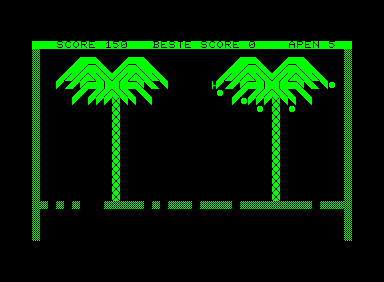
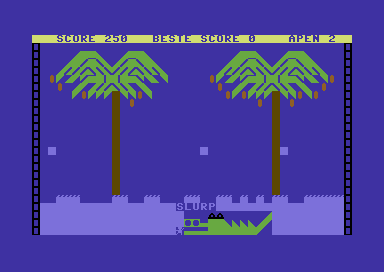
Then the swamp floor starts disappearing beneath every landing, and the game reveals its sharp little twist. A spot that held you once becomes a hole waiting to swallow you on the next pass; land there again and an alligator ends the monkey’s run. You are not just lining up coconuts anymore. You are trying to preserve enough usable floor to keep the next bounce alive, while the space for error steadily shrinks.
The number-key control scheme is likely the sticking point. Having several left and right speeds gives you meaningful control over an automatically bouncing character, but it asks for deliberate inputs rather than casual button mashing. Once the timing clicks, it becomes satisfying to correct a drift and steer into a coconut. When it does not click, a missed adjustment can send a monkey into the very swamp trap you created moments earlier.
Clearing both trees refills the coconuts, but not the floor. That is a cruel and smart rule: success extends the scoring opportunity while making the board permanently more dangerous. Several lives soften the blow, yet this remains a compact score-chasing game where each run is ultimately about how long you can manage a worsening situation.

Graphics
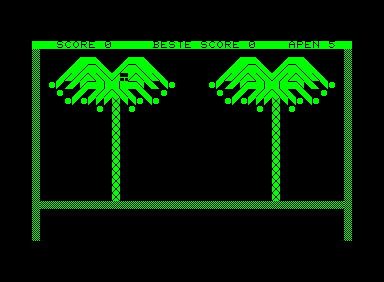
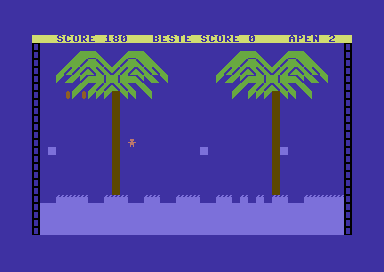
The side-view swamp layout keeps the important pieces in plain sight: the bouncing monkey, the two palm trees and their coconuts, the floor, and the alligator danger below it. As holes spread across the ground, the playfield itself visibly records your mistakes, making it easy to see why a once-safe landing has become lethal.
Story
There is no story campaign pulling you forward. Alligator Moeras is built around an immediate cartoon premise: a monkey wants coconuts, and a swamp full of alligators punishes bad landings.
That lack of narrative suits the game’s brisk arcade structure. You do not need setup or character motivation to understand why the next jump matters; the bare palms offer the reward, while the vanishing floor supplies the threat.
If you need a plot, progression between locations, or a finale beyond improving your run, this will feel thin. Its tiny scenario exists to frame the action, not to give the action a larger destination.
Overall Experience
Alligator Moeras earns attention through one strong escalating idea rather than breadth. The automatic bounce makes movement feel immediately active, and the dissolving floor ensures that the same basic task gets more tense instead of merely repeating. It is easy to understand, difficult to sustain, and neatly suited to short attempts.
The frustration is real. A run can unravel because your mid-air correction was too strong, too weak, or simply too late, and the permanent damage to the floor means recovery is not always possible. That harshness is part of the point, though: every lost monkey teaches you something concrete about where not to land and how cautiously to chase the next coconut.
Give it a chance if you enjoy old-school arcade games that turn a single screen into a mounting survival puzzle. Skip it if you want variety, a relaxed pace, or more than a focused score attack. For the patient player willing to learn its unusual controls, the payoff is the tense satisfaction of keeping a self-destructing arena playable just a little longer.


Reviews
There are no reviews yet.