 Retro Replay Retro Gaming History, Reviews & Emulation
Retro Replay Review
Gameplay
Crillion starts from a familiar place, then immediately removes the safety net. Instead of sliding a paddle beneath the ball, you control the ball’s horizontal movement directly while it continues its vertical bounce. That sounds like a small adjustment, but it changes the feel from reactive paddle defense to constant course correction. In the opening moments, you are simply trying to understand the rhythm; soon, you are lining up color matches and worrying about where the next rebound will carry you.
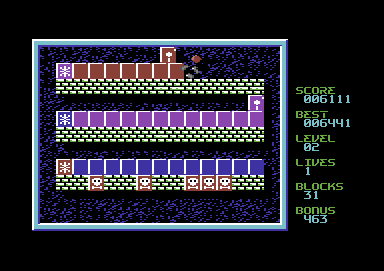
Color is the heart of the puzzle. A block dissolves only when the ball hits it in the same color, while asterisk-marked color changers alter what the ball can destroy next. That makes each board more than a matter of hitting everything eventually. You need to route the ball toward useful targets, avoid wasting its current color on a bad angle, and account for unbreakable walls that can turn a clean line into a trap.
Slider blocks add another welcome complication. They can be moved only when the ball matches their color, so the right color can mean either clearing a block or opening up the board. The best moments come from recognizing that a color change is not just a key for destruction; it can be the chance to rearrange the level and reach blocks that were previously awkward or inaccessible.
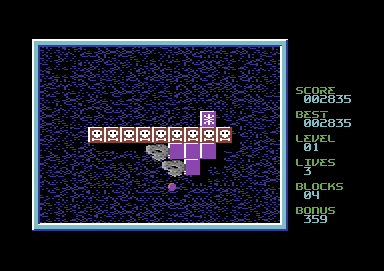
The harshness is the skull blocks. Touch one and you lose a life, restart the level, and lose all progress made on that board. That rule gives Crillion real tension, but it can also make the game feel punishing when a late mistake wipes out a nearly completed layout. If you enjoy arcade games that demand concentration and a willingness to replay a level until its dangers become second nature, that pressure is part of the point. If full-level resets make you angry, Crillion will test your patience fast.

Graphics
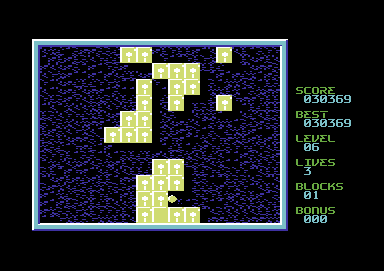
On Commodore 64, Crillion’s boards are built around easily recognized play pieces: colored blocks, asterisk-marked color changers, skull hazards, solid walls, and sliders. The side-view arcade layout keeps attention on the ball’s path and makes the important distinctions clear, especially when matching the ball’s current color to the blocks ahead.
Story
Crillion puts its stakes directly on the board rather than in a narrated plot. The immediate goal is always clear: remove every breakable block without striking a skull. That suits the game’s quick, concentrated arcade format.
Its closest thing to drama comes from the changing condition of a level. A color changer can make a new set of blocks vulnerable, a slider can shift the board, and an unbreakable wall can preserve a dangerous route. You are not following characters or plot turns; you are reading the consequences of each bounce.
The restart rule supplies the tension that a more conventional story might otherwise carry. A nearly cleared board feels valuable because a single skull hit sends you back to its original state. For this kind of game, that clean, unsentimental loop works better than extra framing would: every level tells a small story of control, recovery, and sometimes a painful collapse.
Overall Experience
Crillion is a lean arcade puzzle-action game with one strong idea and enough board elements to keep that idea interesting. Direct ball control makes it immediately distinct from Breakout, while the color-matching rules give you something more deliberate to think about than simple reflexes. It is easy to understand, but it does not hand over its clears casually.
The deciding factor is your tolerance for failure. Losing all progress in a level after hitting a skull creates memorable last-second disasters, and it asks you to treat every route with care. That can be thrilling when you are locked in, especially when the proper color lets you dissolve a cluster or move a slider into a more useful position. It can also be exhausting when one misjudged horizontal adjustment undoes several minutes of good play.
Give Crillion a chance if you like old-school arcade design that turns a handful of rules into repeatable, demanding boards. Its payoff is not a sprawling campaign or a pile of systems; it is the satisfaction of finally threading the ball through a level you have learned the hard way. For the right gamer, that is plenty.



Reviews
There are no reviews yet.