 Retro Replay Retro Replay gaming reviews, news, emulation, geek stuff and more!
Retro Replay Review
Gameplay
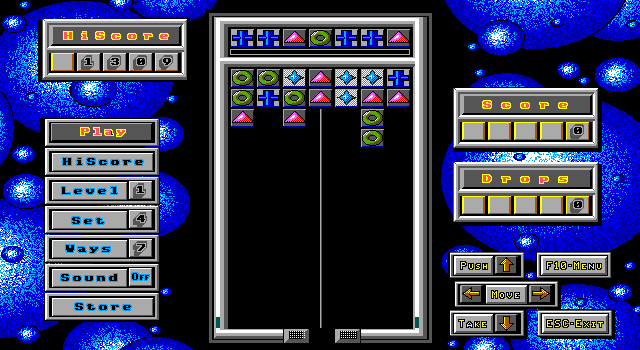
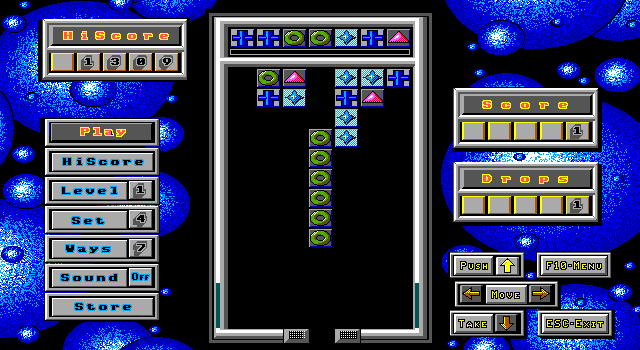
Drop-Drop starts slowly enough that you can immediately understand the danger: blocks creep down the rectangular field, and a column hitting the bottom ends the run. The interesting part is that you are not locked into reacting where a block happens to land. Your bottom cursor lets you take blocks from a selected column, shift them to another column, and send them back to the top. That turns the board into something you can actively reorganize rather than merely endure.
The restriction that a carried group must contain blocks of the same type is where the puzzle earns its teeth. You cannot casually scoop up a messy stack and fix everything in one motion. Instead, you are looking for useful matching runs, deciding which column can spare them, and choosing where that group will help build a chain of five or more. When a group annihilates and opens breathing room, it feels earned because you created the arrangement yourself.
There is a nice tension between clearing space now and preparing a larger move for later. A modest match can stop an urgent column from ending the game, while a more patient transfer may set up a stronger clean-up elsewhere. The slow arrival of new blocks gives you time to think, but the bottom edge keeps that thinking from becoming too comfortable. If you enjoy puzzle games that reward board-reading over twitch reflexes, this is a compact, clever variation on the falling-block formula.
Graphics
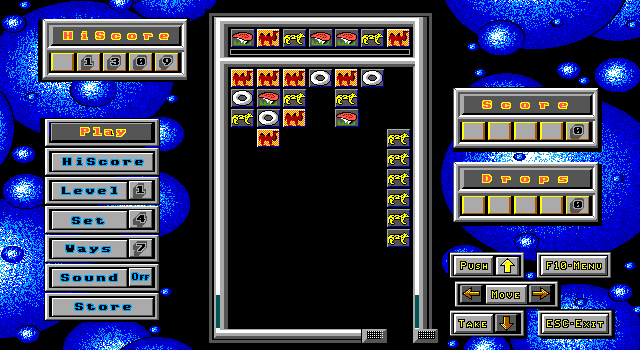
The view stays focused on a rectangular playfield filled with descending block types, with the cursor positioned along the bottom. It is a plain, functional board view, but that direct layout suits a game built around tracking column height and spotting groups of matching blocks.
Story
Drop-Drop is an arcade puzzle game first and foremost, and its drama comes from the board rather than a narrative. Each session creates its own small arc: early columns are manageable, clutter accumulates, and a bad arrangement can become an immediate crisis.
That lack of detour works in its favor. You are never waiting to return to the actual point of the game, which is finding a clean transfer before the field closes in. The stakes are simple, but clear enough to make a near-bottom column feel threatening.
Its best moments are the little stories made by your decisions: the column you saved at the last moment, the matching stack you finally assembled, or the plan that collapsed because the wrong type was trapped in the wrong place. For a game this spare, that is enough context to keep a run engaging.
Overall Experience
Drop-Drop has the kind of idea that sounds modest until you play around with it. Moving blocks upward and sideways through a bottom cursor changes how you scan the board, and it gives the game a more deliberate, hands-on rhythm than simply rotating and dropping pieces. The first successful five-block clear is likely to make the rules click.
Its narrow focus is also its strength. There is one central problem—stop columns reaching the bottom by gathering matching blocks—and the game keeps returning you to it without distraction. That makes it a good fit for short sessions, especially if you like trying to improve your judgment of a single puzzle system.
Frustration arrives when several columns threaten the bottom at once and your useful matching blocks are buried or separated. Yet that pressure is not random busywork; it is the consequence of a board you have been shaping all along. Drop-Drop is worth a look for puzzle fans who want an old-school, real-time game with a genuinely distinctive way to rearrange a crowded field.

Reviews
There are no reviews yet.