 Retro Replay Retro Gaming History, Reviews & Emulation
Retro Replay Review
Gameplay
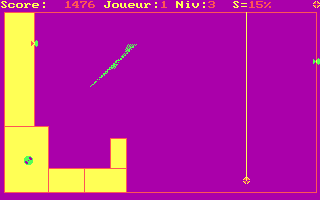
Kicks centers on a simple, demanding goal: capture 70% of the screen to advance. The appeal comes from the tension between making small, safe claims and attempting larger cuts that can secure territory more quickly.
Enemies occupy the open game zone, so drawing out a new boundary is never merely a matter of filling space. A successful route reduces the dangerous area, while a poorly timed attempt leaves the player exposed to the moving threats.
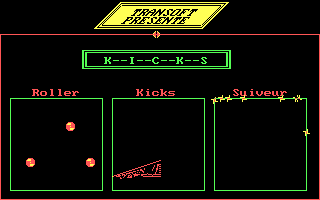
Rollers, Kicks, and Suiveurs provide the game with three named enemy types to contend with across its levels. Players who enjoy arcade games with puzzle elements will appreciate how a single percentage target creates a direct reason to weigh caution against ambition.
Graphics
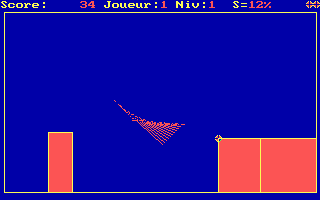
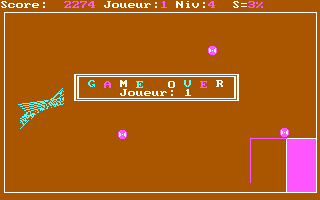
Kicks uses a top-down screen layout that keeps the playfield and its captured portions at the center of attention. That perspective is well matched to a game whose core challenge is reading available space and deciding where to draw the next dividing line.
The visual presentation is functional by design: the important distinction is between claimed territory, open territory, and the enemies travelling through the active zone. This clarity supports the game’s real-time demands better than a busier presentation would.
As a 1989 DOS release, Kicks belongs to an era in which immediate visual legibility was essential to arcade pacing. Its concept does not require elaborate scenery to communicate its stakes; the changing shape of the board is the key visual feedback.
Story
Kicks is not presented as a narrative-driven game. Its structure is based on progressing through levels by meeting the required capture percentage rather than on telling a character-focused story.
The game’s momentum therefore comes from the state of the board: how much territory remains unclaimed, where enemies are moving, and whether the next cut can safely close. That gives each level a self-contained arcade objective.
Players looking for plot, dialogue, or a developed setting will find the emphasis elsewhere. Kicks puts its identity in rules, escalating level progression, and the pressure of territory control.
Overall Experience
Kicks is a focused Qix-style arcade puzzle game that makes territorial capture its entire proposition. Reaching 70% is an easy goal to understand, but the presence of enemies in the open zone gives every expansion attempt meaningful risk.
The game is best approached by players who enjoy score-minded, real-time challenges where steady improvement matters. Its top-down format and single-screen objectives make it especially suited to short, concentrated sessions.
It is a modest but purposeful DOS interpretation of the territory-capture formula. The lack of narrative complexity is not a drawback for its intended audience: Kicks succeeds or fails on the appeal of its central risk-reward loop, and that loop remains inherently compelling.


Reviews
There are no reviews yet.