 Retro Replay Retro Gaming History, Reviews & Emulation
Retro Replay Review
Gameplay
Lasermania gets straight to the good part: you enter a compact puzzle room, study the laser’s starting line, and begin shifting polished steel elements to bend that beam toward every alarm sensor. It is the kind of setup that makes the first few solutions feel obvious in retrospect, which is usually a sign that the rules have been explained well. You can see the goal, you can see the pieces that matter, and the pleasure comes from finding the order and positioning that makes the whole chain work.
That clarity does not mean the game stays easy. Once a room adds laser switches that can detonate the ray generator, careless experimentation becomes expensive. The strongest moments will likely come from pausing before you move anything: trace the beam, identify which sensor needs to go first, and make sure a redirect will not turn a useful line into a disaster. Lasermania asks for patience more than speed, and it rewards the player who treats each screen like a small mechanical puzzle rather than a reflex challenge.
Clearing the sensors is not always the final task, either. You must then accompany a vehicle to the lock, giving successful setups a second consideration beyond simply hitting every target. That extra requirement keeps you from thinking of the laser as a one-note solution tool. With more than 50 levels, the game has enough room to turn a clean central idea into a sustained test of spatial reasoning. Frustration can set in when one bad switch interaction ruins a promising attempt, but that tension is part of what gives a solved room its payoff.
Graphics
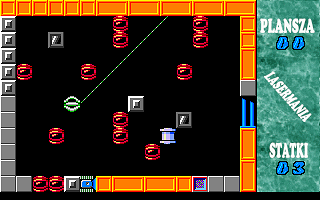
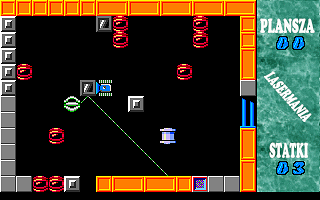
Lasermania uses a top-down, fixed-screen view suited to its puzzle rooms. The important objects are practical and easy to parse in concept: laser paths, polished steel elements, alarm sensors, switches, the vehicle, and the lock all need to be read as parts of a single routing problem.

Story
This is a puzzle game built around objectives, not a narrative journey. Each room frames its own immediate mission: eliminate the alarm sensors, avoid detonating the ray generator, and get the vehicle to the lock.
That sparse setup works because it does not distract from the puzzle. You are given a clear reason to care about the room in front of you, then left to work out the solution without story interruptions or extra baggage.
Do not come to Lasermania expecting characters or plot turns to carry you through its 50-plus stages. Its momentum comes from the sequence of problems: one more room, one more laser route, one more satisfying escape from a layout that initially looked impossible.
Overall Experience
Lasermania is a focused DOS-era logic game with a strong core: redirect a laser, destroy every sensor, and finish the room safely. Its appeal rests on how much mileage it gets from that simple beam-routing premise. When you find the correct arrangement of steel elements and watch the route finally make sense, the game delivers the crisp satisfaction puzzle fans chase.
You should give it a chance if you enjoy top-down, single-screen puzzles that reward thought and tolerate a little trial and error. It is especially suited to short sessions, since each room offers a self-contained challenge, though the large level count also gives persistent problem-solvers plenty to chew on.
The main caveat is temperament. If hazardous switches and failed experiments make you impatient, Lasermania may feel punishing when the layouts tighten up. But if you like taking a breath, tracing possibilities, and earning progress through a genuine solution rather than fast hands, its laser puzzles have the right kind of bite.



Reviews
There are no reviews yet.