 Retro Replay Retro Gaming History, Reviews & Emulation
Retro Replay Review
Gameplay
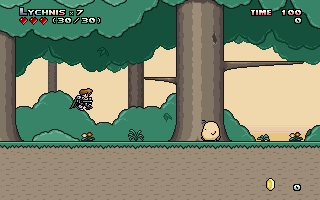
Lychnis starts with its best idea right in your hands. Lychnis and Iris are not cosmetic choices: the knight attacks with a sword and can wall-jump, while Iris fires from range and double-jumps. In the first hour, that distinction should make you settle naturally into one style. Lychnis is the direct, close-quarters option for anyone who likes working through a platforming route with careful wall-jumps; Iris offers a little more breathing room against enemies and more freedom in the air.
The character-specific routes give the stages a reason to be searched rather than simply cleared. When you spot a place one hero can reach and the other cannot, the choice of protagonist has consequences beyond combat. Treasure chests and enemy drops add another layer of incentive. Coins, healing items, and power-ups make it worth engaging with enemies instead of treating every encounter as an obstacle to leap over.
The shop system is a smart reward loop, though getting into it requires collecting its special icon. Once available between stages, it lets you spend toward stronger weapons and more maximum health. That progression matters because the game does not lean on a parade of boss fights to break up its platforming; outside the final confrontation, there are no bosses at all. The stages have to carry the momentum themselves, and whether that works for you comes down to how much you enjoy repeated platforming, item hunting, and gradual upgrades.
The biggest frustration is the lack of any save or password feature. Every attempt asks for real commitment, and losing progress can turn a good stretch of play into a reason to step away. That limitation makes careful play and health upgrades more valuable, but it also makes Lychnis a harder recommendation for anyone with short gaming sessions. Give it time in one sitting, learn your chosen character’s movement, and its structure has a better chance to click.
Graphics
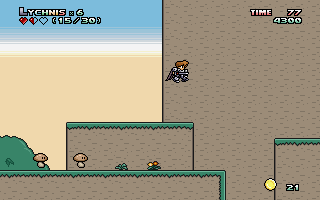
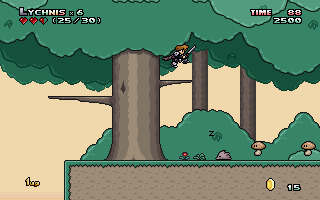
Lychnis uses a side-view fantasy format built around its two playable heroes, roaming enemies, platforms, and treasure chests. The important visual distinction is practical: Lychnis carries a sword, while Iris uses a staff, so it is easy to understand which combat style you have selected as you move through a stage.
Story
The story goes big immediately: a dragon that nearly destroyed the world was sealed a century earlier by Prince Grinstain and Princess Respina using the magical Hartinum equipment. Now the sorcerer Sakiski is trying to restore that dragon’s power through the sacrifice of Bamas’s princess. It is classic fantasy material, but it gives the quest a clear sense of urgency instead of leaving you to collect upgrades for no larger reason.
Lychnis and Iris make a sensible pair at the center of that mission. One is a young knight, the other an apprentice magician from Pars, and both are tied to the search for the hidden Hartinum arsenal. Their contrasting abilities fit the premise well: the adventure asks you to recover powerful magical tools, while your starting choice already frames the journey as martial skill versus spellcasting.
Do not expect the setup to become a complicated character drama. The plot is a direct rescue-and-save-the-world drive toward Sakiski and the restored dragon threat. For this kind of platformer, that clarity is a strength. You always know why the route ahead matters, even when the moment-to-moment focus is on reaching a chest or surviving the next run of enemies.
Overall Experience
Lychnis is an old-school platformer with a stronger hook than its straightforward structure first suggests. Choosing between wall-jumping swordplay and ranged, double-jump mobility changes the feel of the game enough that the character select is meaningful. Add hidden character-only areas, drops, and a modest upgrade shop, and there is more to chew on than a bare stage-by-stage action game.
Its discipline is also its limitation. With no recurring boss battles, the game lives or dies on how much you enjoy its basic movement and combat. More importantly, the total absence of saves or passwords is punishing in a way that modern players will feel immediately. The payoff is better for someone who can devote a longer uninterrupted session and enjoys the tension of protecting a run.
Give Lychnis a chance if you have patience for 1994 DOS platforming and want a fantasy quest where your protagonist choice genuinely affects traversal. Iris is the easier starting point if you value ranged attacks and aerial flexibility; Lychnis will suit you better if wall-jumping and sword range are part of the challenge you came for. It is not generous, but its two-hero design gives it a memorable core.


Reviews
There are no reviews yet.