 Retro Replay Retro Gaming History, Reviews & Emulation


Retro Replay Review
Gameplay
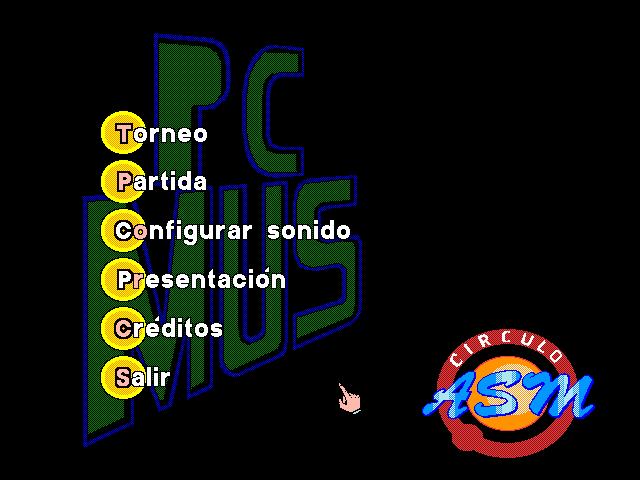
The first hour of PC Mus is less about spectacle than finding your seat at the table. You choose whether to play a single game or commit to a championship, pick a partner, and then settle into mus against another pair. It is a narrow setup, but an honest one: this is a computer adaptation built around repeatedly playing a popular Spanish card game rather than dressing that activity up with unrelated distractions.
Choosing a partner is a smart touch because it makes each session feel a little less anonymous. You are not merely selecting an opponent level; you are joining a pair, then trying to make that partnership function. The limitation is equally important: your teammate is controlled by the CPU. That can make a bad hand feel doubly frustrating when you wish you could coordinate more directly, but it also gives the matches some personality.
The occasional signal system is the feature that pushes PC Mus beyond a bare rules implementation. When the game allows you to tell your partner that you have a good play, you get a small but meaningful sense of shared table talk. It will not turn the CPU into a human friend who understands every gamble, yet it creates a useful thread of cooperation. That matters most in championship play, where the longer format gives the partnerships room to feel consequential.
You should give PC Mus a chance if mus itself is the draw, or if you have affection for compact DOS card games with a local cultural angle. Newcomers can still enjoy the basic rhythm of choosing a partner and facing another couple, but they need patience for a game whose satisfaction lives in card decisions and partner coordination. The championship option is the better bet once the table flow starts to click; a single game is the sensible place to see whether it does.

Graphics
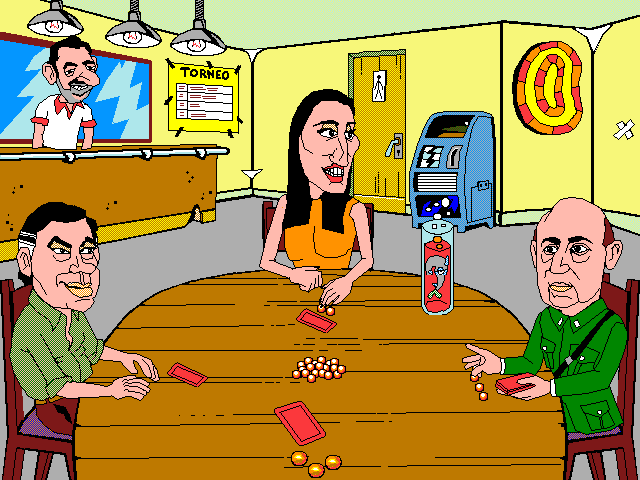
PC Mus frames its card table as the Amarraco Feroz bar in Villa Mus, with cartoon caricatures of politicians, television presenters, actresses, controversial entrepreneurs, and other public figures serving as the company. That gives the game a more playful face than a generic deck-on-felt card program. The caricature idea is the main visual hook, and it suits a game built around sitting across from familiar faces at a bar table.
Story
There is no sprawling plot to chase here. The closest thing to a story is the invitation itself: enter a bar in Villa Mus and take part in a card game among exaggerated versions of celebrities from the period. It is a light premise, but it is more characterful than simply dropping you into an unadorned match.
The caricatures give the matches a bit of comic context without asking you to invest in a narrative. You are there to play mus, size up your tablemates, and see how far a selected partnership can go. That restraint fits the subject. A card game does not need a forced adventure wrapped around it when the social setting already supplies a reason to sit down.
Its period-specific cast is also likely to land differently depending on your familiarity with the people being spoofed. If the references mean something to you, the barroom setup gains an extra grin. If they do not, the game still has a clear enough situation: quirky cartoon opponents, a partner at your side, and a match to win.
Overall Experience
PC Mus is a modest, focused card game whose personality comes from where it chooses to play and who it puts at the table. The Amarraco Feroz setting and celebrity caricatures are not a substitute for enjoying mus, but they keep the repeated matches from feeling completely sterile. It has the cozy, slightly odd flavor of a game made for people who wanted this particular pastime on their DOS machine.
The CPU partner is both the game’s best wrinkle and its most likely source of irritation. Being able to send signals, even only sometimes, makes you feel involved in a partnership rather than alone against the program. At the same time, you must accept that the other half of your pair is not under your control. Your tolerance for that arrangement will heavily shape how much fun you have.
For mus fans, the payoff is easy to see: quick individual games when you want a hand or two, plus a championship when you want a longer run. For everyone else, PC Mus is mainly a curious cultural artifact with a pleasant comic wrapper. It earns a recommendation as a specialized card game with real flavor, not as a universal entry point to DOS gaming.



Reviews
There are no reviews yet.