 Retro Replay Retro Replay gaming reviews, news, emulation, geek stuff and more!
Retro Replay Review
Gameplay
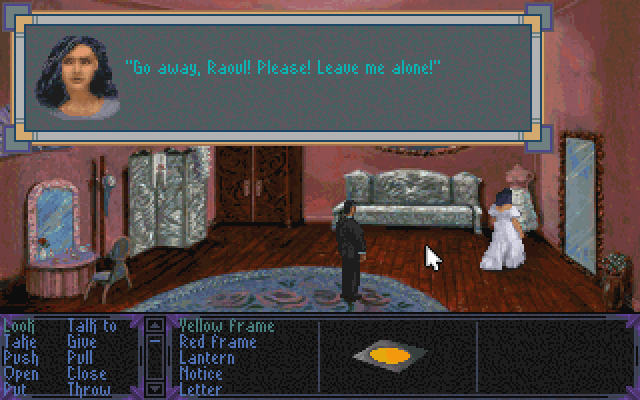
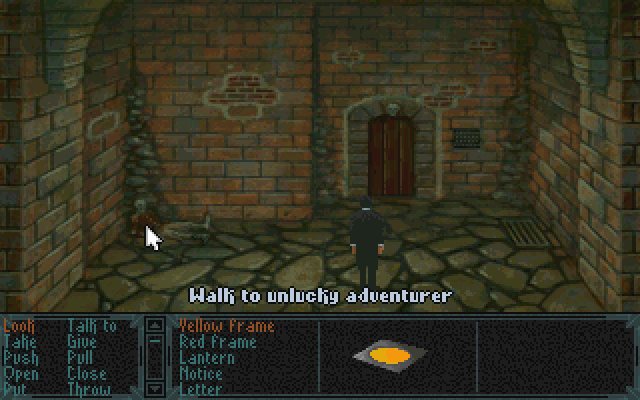
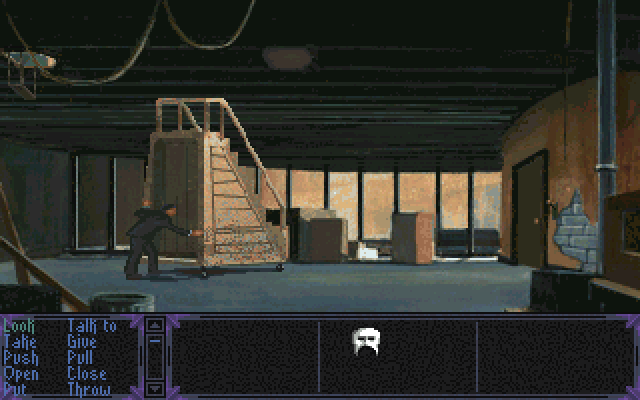
Return of the Phantom embraces the classic third-person adventure formula of the early ’90s, tasking players with guiding detective Raoul Montand through the haunted corridors of the Palais Garnier. You interact with the world by selecting verbs—Look, Talk, Take, Push, and so on—from a menu and combining them with on-screen objects. This familiar point-and-click approach makes exploration straightforward, letting you concentrate on unraveling clues rather than wrestling with complex controls.
(HEY YOU!! We hope you enjoy! We try not to run ads. So basically, this is a very expensive hobby running this site. Please consider joining us for updates, forums, and more. Network w/ us to make some cash or friends while retro gaming, and you can win some free retro games for posting. Okay, carry on 👍)
The puzzles range from simple inventory swaps to more intricate multi-step conundrums that require careful note-taking and back-tracking. Some challenges hinge on overheard conversations or subtle visual cues—examining a torn costume piece or remembering a line from an NPC’s dialogue can unlock new paths. While a few brain-teasers teeter on the brink of frustration, most feel fair and rewarding once you spot the link between disparate items or rooms.
Voice-over dialogue in the CD version brings NPCs to life, adding dramatic flair to your interrogations of opera staff, patrons, and phantom sightings. The branching conversations can yield vital leads or red herrings, so choosing when to press a suspect or simply move on becomes part of the detective’s craft. Quick-save functionality is generous, allowing you to experiment and recover from dead-end solutions without redoing entire sections.
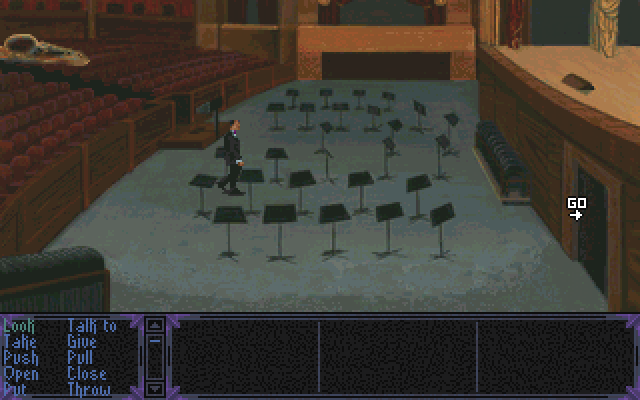
Navigation is generally smooth, thanks to a clearly segmented map of the opera house and its secret tunnels. However, the pixel-precise hotspot detection occasionally causes mild annoyance—especially in dimly lit backstage areas where you must click on tiny props or levers. Overall, the gameplay loop of exploring, interrogating, and puzzling out the Phantom’s schemes holds up well, providing a steady sense of progression and mystery.
Graphics
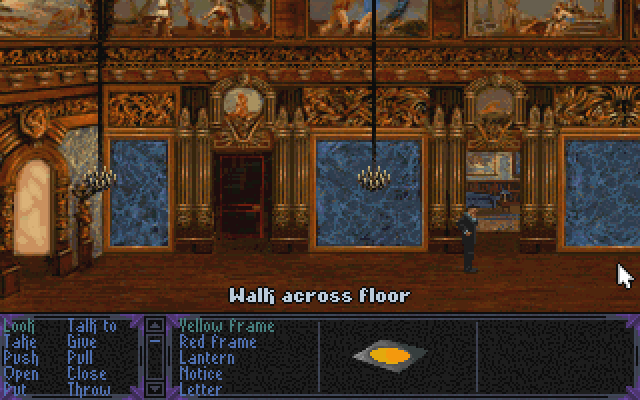
Visually, Return of the Phantom showcases richly detailed 2D pixel art that captures the grandeur and decay of the Paris Opera House. Lavish ballrooms, ornate balconies, and shadow-cloaked corridors are rendered with enough color depth to convey both elegance and menace. The dramatic moment when the chandelier crashes—an iconic set piece—packs real punch, with shards scattering across the audience and a bath of crimson hues that linger in memory.
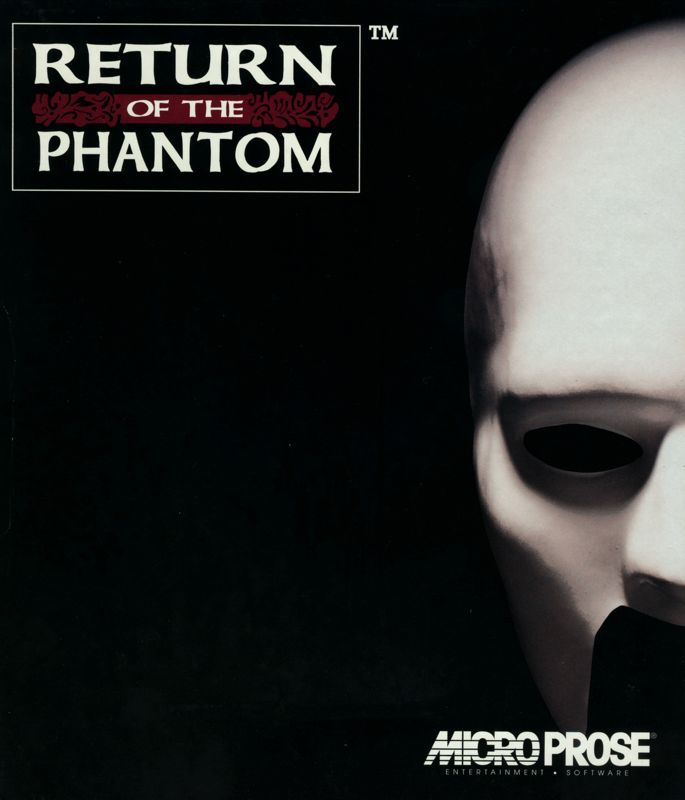
Character sprites are fairly well animated for their era, with distinct silhouettes that help you identify allies, suspects, and spectral figures from a distance. Facial expressions during dialogue are limited but effective: a raised eyebrow or narrowed gaze can signal suspicion, while the Phantom’s ghastly mask and flowing cloak evoke genuine unease. Backgrounds often change dynamically as you transition between day and night scenes, reinforcing the sense of time passing as Raoul digs deeper.
Cinematic cut-ins amplify key narrative moments, like descending into the catacombs or discovering a bloodied mask in a dusty alcove. These sequences pause the action and present enlarged art frames that resemble graphic novel panels—an atmospheric touch that punctuates your breakthroughs. Despite the technical constraints of 1993 hardware, the overall presentation remains evocative, drawing you into the opera’s haunted aura rather than pulling you out of it.
One caveat: on lower-resolution screens, some details—especially tiny levers, hidden doors, or faint inscriptions—can blur into the background. If you’re playing the floppy-disk version without CD audio, you’ll miss out on voice-over queues that might have hinted at puzzle solutions. Nonetheless, the game’s art direction and moody lighting ensure that even in monochrome contexts, the environment tells its own story.
Story
Set in 1993 with flashbacks to 1881, Return of the Phantom weaves a dual-timeline thriller around the legendary Phantom of the Opera. The opening prologue—where the chandelier crashes upon an unsuspecting audience during Don Juan Triumphant—immediately casts a pall of dread over the palace. This traumatic event propels Raoul Montand into a labyrinth of opera lore, superstition, and long-buried secrets.
Drawing heavily on Gaston Leroux’s original novel, the narrative stays faithful to core themes of obsession, betrayal, and the redemptive power of music. Yet the game isn’t afraid to expand the legend, introducing new characters like Monsieur Brie, the opera manager and Raoul’s old friend, whose motivations are never quite what they seem. Secondary NPCs—from prima donnas to stagehands—each carry fragments of backstory that deepen your understanding of the Phantom’s tragic past.
Voice acting in the CD edition elevates key interactions, with mournful cello underscoring the Phantom’s soliloquies and hushed whispers echoing through damp passageways. Even without voice clips, the written dialogue conveys tension through well-paced reveals and cliffhangers at the end of each act. Time-travel sequences to 1881 are particularly well timed, granting you fleeting glimpses of Erik’s artistic brilliance and personal torment before tragedy strikes.
The balance between detective procedural and gothic horror keeps the stakes high, while occasional moments of levity—snappy retorts from Raoul or comedic relief from a flamboyant soprano—prevent the mood from becoming oppressively grim. By the final denouement, all the narrative threads converge in a tense confrontation high above the opera stage, ensuring a satisfying payoff for players who’ve persisted through every dusty corridor.
Overall Experience
Return of the Phantom stands as a compelling bridge between literary adaptation and point-and-click mystery, offering both atmospheric immersion and cerebral puzzle-solving. Its deliberate pacing may feel leisurely to modern gamers, but fans of classic adventure titles will find comfort in methodical clue gathering and extended exploration. The dual era structure keeps the story fresh, rewarding players who appreciate narrative depth alongside environmental interactivity.
While the interface occasionally demands surgical precision and some puzzles verge on obtuse, these challenges also serve as badges of honor for dedicated sleuths. The CD version’s voiceovers and musical score enhance immersion significantly, making it the recommended format for newcomers. If you’re playing the diskette edition, be prepared to read closely and use frequent saves to dodge any dead ends.
For enthusiasts of gothic tales, opera history, or detective adventures, Return of the Phantom delivers a rich, memorable journey beneath the stage and into the Phantom’s tortured soul. Its evocative settings, layered narrative, and satisfying puzzle design combine to form an experience that transcends its age. Even today, the game’s blend of suspense and storytelling can hold its own against later adventure classics.
Whether you’re drawn by the lore of Gaston Leroux’s masterpiece or seeking a moody puzzle adventure steeped in 19th-century intrigue, Return of the Phantom remains a worthy addition to any collection. Step into the shadows of the opera house and prepare to confront both living conspirators and the spectral echo of a genius wronged—this is an adventure that lingers long after the final curtain falls.



Reviews
There are no reviews yet.