 Retro Replay Retro Gaming History, Reviews & Emulation
Retro Replay Review
Gameplay
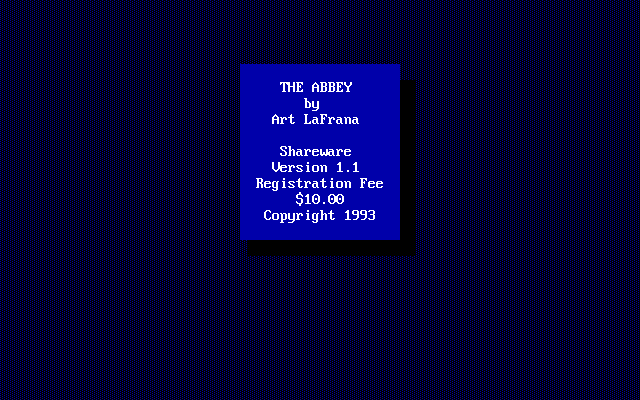
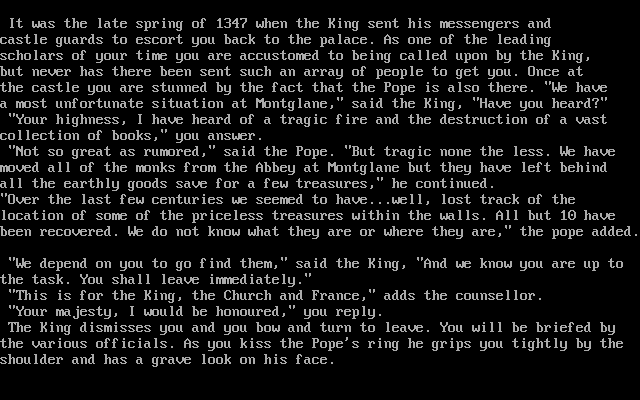
The first hour has an immediate purpose: find ten treasures lost in the aftermath of a fire at the Abbey of Montglane. Rather than dropping you into a vague fantasy quest, The Abbey gives you a scholar’s investigation with a countable objective and a place already charged with trouble. You are there on authority from the king and pope, but the atmosphere quickly points beyond routine recovery work.
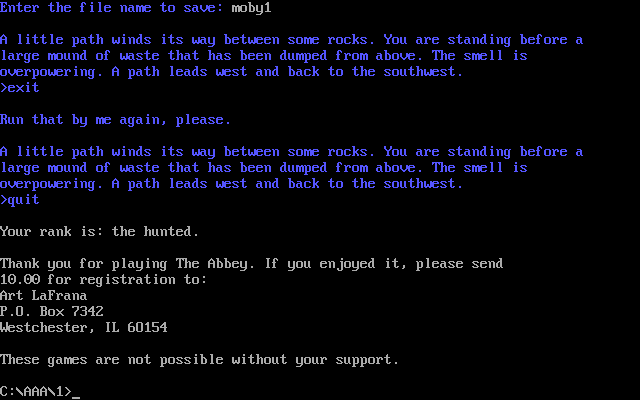
This is interactive fiction in the old DOS tradition, using a simple parser and asking you to type your way through the abbey’s secrets. That makes the pace deliberate. You will get more out of it if you like pausing to consider what an object, a document, or an unsettling detail might mean, rather than expecting a rapid stream of guided discoveries. The ability to save is particularly welcome in a game that invites methodical progress.
Instead of a customary numerical score, The Abbey tracks your standing with a rank that reflects how far you have progressed. It is a fitting touch for a scholarly mission, and it gives the investigation a little more personality than a bare point total. The trade-off is inherent to parser adventures: you need patience, a willingness to experiment with written commands, and tolerance for a slower path through the mystery.
Graphics
The Abbey is text-led, leaving the fire-damaged abbey, old manuscripts, and medieval dread largely to your imagination. If richly illustrated locations are essential to your horror games, this will feel spare; if a well-placed description can do the work, the format suits its secretive setting.
Story
A scholar sent into fourteenth-century France’s Abbey of Montglane is a strong protagonist for this kind of mystery. You are not arriving as a swordsman or a chosen hero, but as someone expected to examine evidence and recover what was lost. That shift makes the ten missing treasures feel like clues as much as collectibles.
The fire is the right kind of opening wound: it has physically damaged the abbey and destroyed manuscripts, while the unexplained panic around it suggests that somebody knows more than they are saying. The story’s hook comes from that gap between the official task and the lurking horror. You begin by counting losses, then start wondering what the fire uncovered or concealed.
The medieval setting also fits the material naturally. Church authority, scholarship, lost texts, and an isolated abbey all belong together without needing a complicated setup. The Abbey earns interest through intrigue and unease rather than spectacle, so it works best when you are in the mood to read closely and let suspicion build at its own pace.
Overall Experience
The Abbey has the particular charm of a focused mystery from an era when text adventures expected you to participate with your own attention. Its central task is clear, its location is immediately evocative, and its horror angle gives the search for treasures a more unsettling edge than a standard recovery mission.
It will not win over anyone who needs a fast pace or a visually driven adventure. The parser-based structure can feel demanding when you just want the next answer, and the game asks you to accept that investigation means stopping, thinking, and trying another line of inquiry. That friction is either part of the fun or the point where you bounce off.
Give it a chance if you enjoy vintage interactive fiction, medieval mysteries, and horror that begins with questions instead of action. The payoff is the slow conversion of a straightforward scholarly assignment into a more ominous puzzle. It is a modest but appealing trip into a burned-out abbey where every recovered treasure may matter for more than the mission report.



Reviews
There are no reviews yet.