 Retro Replay Retro Replay gaming reviews, news, emulation, geek stuff and more!


Retro Replay Review
Gameplay
The Bard’s Tale III: Thief of Fate builds on the familiar first-person, grid-based exploration of its predecessors, inviting players to lead a party of heroes through twisting corridors, vast wildernesses, and intricate dungeons. Combat remains turn-based and tactical, requiring thoughtful spell selection, clever use of character abilities, and frequent healing. Unlike many later CRPGs, encounters here can be unforgiving—an ill-timed fireball or poorly planned formation can quickly lead to a party wipe, so judicious use of resources is paramount.
(HEY YOU!! We hope you enjoy! We try not to run ads. So basically, this is a very expensive hobby running this site. Please consider joining us for updates, forums, and more. Network w/ us to make some cash or friends while retro gaming, and you can win some free retro games for posting. Okay, carry on 👍)
One of the most welcome additions to this chapter is the auto-mapping feature, which automatically fills in the map as you traverse each new area. This spares you tediously sketching layouts on graph paper and allows you to focus on puzzle-solving and combat. Speaking of puzzles, you’ll find cleverly designed riddles and hidden secrets scattered across each realm, often requiring you to backtrack, decipher lore, or employ obscure spells. These challenges keep exploration fresh and reward patient, detail-oriented playstyles.
Character customization also gains new depth with the introduction of two fresh classes: Geomancer and Chronomancer. Geomancers wield earth-based magic to reshape the battlefield—raising walls or creating sinkholes—while Chronomancers manipulate time to hasten allies or slow enemies. Their unique spells encourage inventive party builds and strategies, opening up more viable approaches than the straightforward warrior-mage hybrids of earlier titles. Balancing these new archetypes alongside stalwarts like Paladins and Bards makes for engaging party dynamics.
Graphics
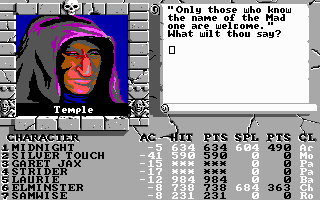
For a mid-’80s release, The Bard’s Tale III showcases surprisingly detailed tile graphics in its EGA version. Towns, dungeons, and wilderness areas each sport distinct palettes and textures that help orient the player even in a primarily grid-based engine. Walls bear ornate patterns, floors shift from wood to stone, and environmental details—like pillars, tapestries, and furniture—lend character to otherwise claustrophobic corridors.
Character portraits and monster sprites are modestly sized but carry enough personality to distinguish foes at a glance. Fire-breathing drakes, armored knights, and androgynous wraiths all look suitably menacing, despite the limited color palette. Cut scenes are minimal, but the title screens and menu graphics exude a classic fantasy vibe that harkens back to tabletop adventures.
One of the graphical highlights is the visual differentiation between realms. When you activate a time warp and emerge in ancient Rome, the environment shifts to columns, marble floors, and toga-clad statues. A jump to World War II Berlin plunges you into bombed-out streets and military installations. Each realm’s distinct aesthetic not only prevents visual monotony but also reinforces the thrill of exploring alternate realities in your quest to confront the Mad God Tarjan.
Story
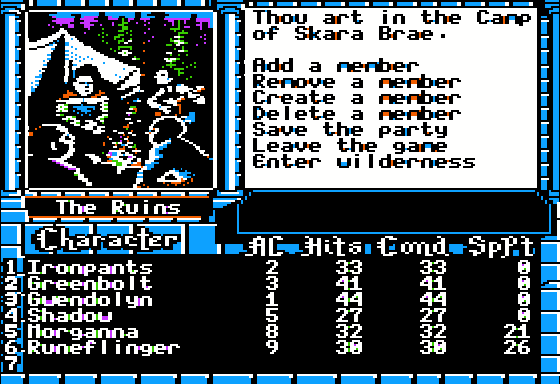
The narrative picks up immediately after the fall of Mangar, the evil wizard vanquished in The Destiny Knight. As your party celebrates, word arrives that Mangar’s secret master, the Mad God Tarjan, has unleashed a cataclysm upon Skara Brae, leveling the city and scattering survivors across the region. This inciting incident drives the heroes into a refugee camp, where they rally to restore hope and track down Tarjan’s hidden lair.
From there, the storyline unfolds through letters, inscriptions, and NPC dialogue rather than lengthy cutscenes. You’ll gather scraps of lore in ruined temples, cryptic verses in deserted dungeons, and eyewitness accounts at campfires. The game trusts you to piece together the Mad God’s motives—his hunger for divine power—and to interpret runic clues that point to the various time-warp portals he’s scattered across realms.
Traveling through famous historical settings—ancient Rome, medieval Jerusalem, and even 20th-century Berlin—adds layers to the plot. Each realm offers a self-contained thread of side quests that tie back to Tarjan’s grand design: siphoning divine energy from bygone eras. Ultimately, your journey is less about rescuing one town and more about preventing a cosmic calamity that could unmake reality itself. The epic scope provides just enough narrative meat to justify the many hours spent mapping and fighting.
Overall Experience
The Bard’s Tale III: Thief of Fate stands as a bold evolution of the classic dungeon crawl. Its combination of grid-based exploration, punishing combat, and intricate puzzles may feel archaic to modern sensibilities, yet there’s a rewarding depth to mastering its systems. Auto-mapping and new character classes alleviate some tedium, while time-warp realms inject variety rarely seen in contemporaries.
Fans of old-school CRPGs will appreciate the sense of discovery and accomplishment that comes from charting unknown territory, unlocking secret doors, and deciphering cryptic riddles. The story, though lightly delivered, carries enough drama and mystery to keep you invested as you chase Tarjan through history. For those willing to embrace its trial-and-error learning curve, Thief of Fate delivers a satisfying—if occasionally unforgiving—adventure.
Ultimately, this third installment is an ambitious send-off to the original Bard’s Tale trilogy. It refines core mechanics, expands world-building through time travel, and offers hours of challenging gameplay. Prospective buyers seeking a deep, retro RPG experience will find Thief of Fate both engaging and memorable, provided they’re prepared to don the mantle of scholar and strategist as much as hero.


Reviews
There are no reviews yet.