 Retro Replay Retro Gaming History, Reviews & Emulation

Retro Replay Review
Gameplay
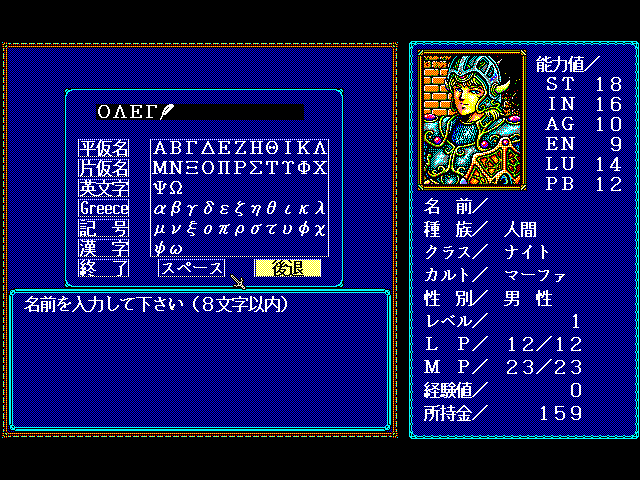
The first hour makes a strong case for treating Haiiro no Majo as a proper party RPG rather than simply a Lodoss license. You create an entire group, choose among Humans, Elves, Dwarves, and Halflings, and assign roles including Warriors, Shamans, Priests, Scouts, and Knights. The five bonus points you place across six attributes are a small but welcome invitation to shape a party instead of accepting a predetermined cast.
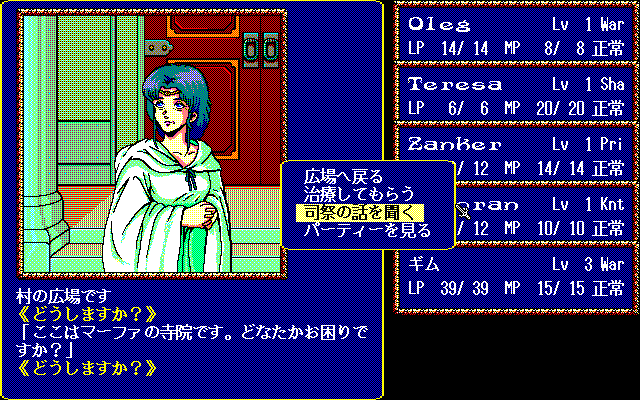
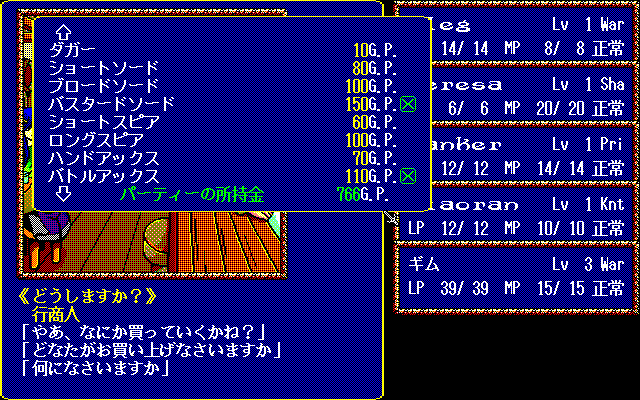
Its structure is pleasantly broad. You begin in town, head across a top-down world map, and decide where your group goes rather than being pushed through one lead character’s itinerary. The towns themselves are functional stops for inns, temples, and markets, selected from menus rather than freely walked through. They do the job, but their identical or near-identical location visuals make the travel hubs blur together quickly.
Combat asks more of you when you leave auto battle behind. Manual encounters are round-based and let you move characters around the battlefield, then choose physical attacks or spells when targets are in range. That gives party position and range real weight. Auto combat is handy for reducing repetition, but it also turns a potentially tactical fight into a calculation based on the combatants’ parameters, so manual control is where the game has more personality.
The dungeon shift is the sharpest change of pace: exploration moves into pseudo-3D first-person corridors, and torches are necessary to see your way. That is exactly the sort of deliberate, resource-conscious adventuring that will either hook you or test your patience. Random encounters and location-triggered battles mean progress can be interrupted often, but the constant transition between overworld planning, tactical battles, and dungeon delving keeps the game from feeling like one-note grinding.
Graphics
The visual style is anime-rooted, but the game changes its viewpoint to fit the task at hand. Overworld movement and battles use a top-down view, while dungeons put you in a pseudo-3D first-person perspective. In fights, the overhead battlefield makes it easier to follow where characters and enemies stand before you commit to an attack or spell.
Towns are the rougher side of the package. Inns, temples, markets, and other locations use identical or closely similar visuals from town to town, so they feel more like practical menu stops than distinctive places.
Story
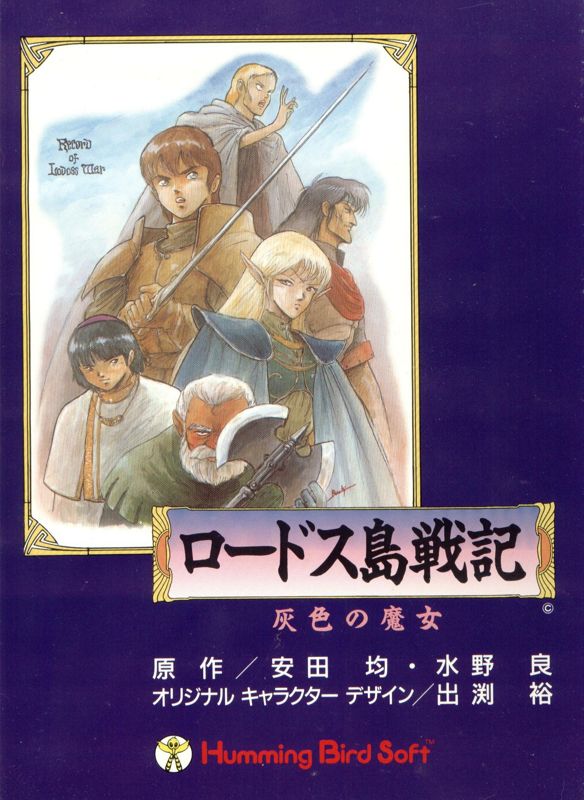
Haiiro no Majo loosely follows the first Lodoss novel, The Grey Witch, with the enigmatic Karla and her political influence at the center of the larger conflict. That is a good foundation for a Lodoss game: the stakes reach beyond one dungeon or one party, and Karla’s presence gives the journey a clear thread even as you chart your own course.
The important caveat is that this is not a tightly authored role-playing story built around a fixed protagonist. Your created party occupies the foreground, which makes the game feel more like an expedition through Lodoss than a direct reenactment of one character’s tale. That choice suits the Wizardry- and Ultima-like format, though it means the narrative pull comes from the setting and its figures rather than from a single hero’s arc.
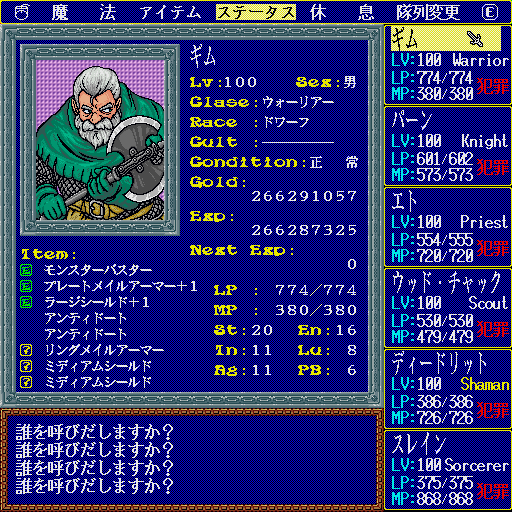
Familiar faces help bridge that gap. Ghim can be recruited early, and other recognizable characters from the cycle appear along the way. If you know the novels or anime material, those encounters add warmth to what might otherwise be a fairly austere party-crawler. If you do not know Lodoss, the central political intrigue still gives the adventure a fantasy context worth following.
Overall Experience
This is a game for the part of you that likes making a party, distributing attributes, and accepting that a dungeon crawl may demand caution rather than momentum. It earns goodwill by letting you choose races and classes, by mixing viewpoints instead of locking into one exploration mode, and by making manual combat more involved than simply selecting a target.
Patience is mandatory. Menu-based towns have limited character, repeated location visuals weaken the sense of a broad world, and random battles can turn travel into a stop-start affair. The torch requirement in dungeons is another intentionally old-fashioned constraint. None of that is fatal, but it makes the game a poor fit if you want a brisk, character-led Lodoss adaptation.
For fans of classic computer-style RPGs, though, the payoff is substantial enough: a flexible Lodoss journey with recognizable companions, tactical choices in battle, and a more open party-driven structure than the license might suggest. Give it a chance if the idea of Wizardry-style adventuring in Lodoss sounds better than a linear anime retelling. If you want another take on the setting, this related Record of Lodoss War release is worth comparing.


Reviews
There are no reviews yet.