 Retro Replay Retro Gaming History, Reviews & Emulation


Retro Replay Review
Gameplay
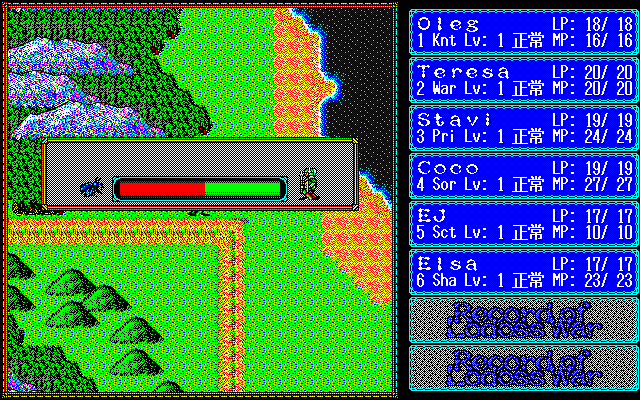
The first hour has a pleasingly practical hook: make a party, choose from four races and seven classes, and decide what sort of expedition you want to lead. With room for up to six active heroes, party-building is not just a bit of character-sheet ceremony; it is the foundation for everything that follows. The option to hire NPCs in the first town also gives you an early way to round out a group rather than treating your initial lineup as sacred.
Once you get out into Lodoss, the game leans hard into player-led exploration. You can range across much of the continent, stop in towns, seek out guilds, and take on sub-quests instead of simply marching down one prescribed road. That broader overworld and the larger supply of dungeons make this sequel feel like it wants you to inhabit the setting, not merely pass through it.
The trade-off is that its dungeons are pseudo-3D, first-person mazes. If you enjoy the slow, deliberate rhythm of probing corridors and keeping your bearings, that is a large part of the fun. If getting turned around in maze-like dungeon layouts drains your patience, frustration can set in quickly. Combat carries over unchanged from the previous game, so this is very much an iteration rather than a reinvention; fans of the first game will know what they are getting, while newcomers should come for the party-building and freedom rather than novelty.
Graphics
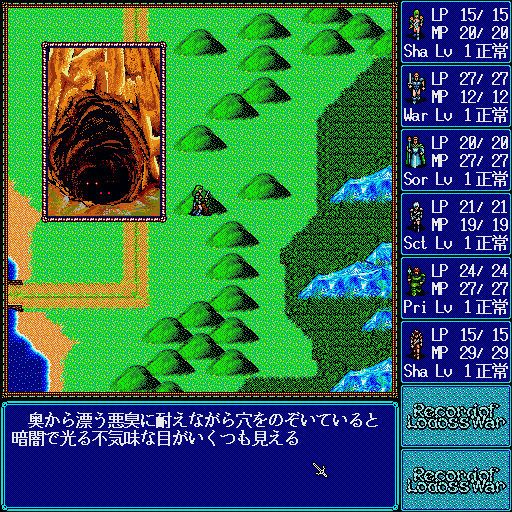
Goshiki no Maryū keeps the anime look associated with Lodoss while using a mix of top-down exploration and pseudo-3D first-person dungeon views. The town and continent perspective gives travel a different shape from the close-in dungeon mazes, and the changing camera viewpoint makes it clear whether you are roaming the world or feeling your way through a corridor.

Story
The game begins roughly a decade after the War of Heroes, in a Lodoss that has enjoyed a stretch of relative calm since the conflict between King Fahn of Valis and Emperor Beld of Marmo. That is useful context for anyone coming in for the license: this is not a story set in the immediate aftermath of that famous struggle, but in a world trying to live after it.
Peace does not hold. Armed disputes between countries and turmoil inside Marmo form the backdrop, giving the adventure a continent-wide tension that fits the game’s broad exploratory structure. Moving between places feels appropriate when the setting itself is defined by competing regions and instability rather than a single isolated crisis.
You do not need to treat prior familiarity as a barrier, but fans of the earlier entry have the clearest route in. This is explicitly a follow-up to Haiiro no Majo, and its shared systems make the connection more than a name on the box. For another Lodoss series stop, see Record of Lodoss War II.
Overall Experience
This is the kind of sequel that earns its time through more space to adventure in rather than through a dramatic mechanical overhaul. More overworld, more dungeons, more guilds, and more optional work are meaningful additions because they feed the game’s strongest idea: assembling a party and choosing where to go next.
Its age is felt in the commitment it asks from you. The dungeon crawling is maze-oriented, the combat is inherited intact, and the game’s pleasures are measured rather than immediate. But if those elements sound comforting instead of exhausting, the payoff is a substantial fantasy journey with room for detours and self-directed progress.
Give Goshiki no Maryū a chance if you want a licensed RPG that behaves like a classic Western party crawler, not a streamlined anime adventure. Lodoss fans and veteran dungeon explorers are the best fit. Anyone looking for rapid pacing or a radically updated sequel may find that its strongest virtues are also its most stubborn habits.


Reviews
There are no reviews yet.