 Retro Replay Retro Replay gaming reviews, news, emulation, geek stuff and more!




Retro Replay Review
Gameplay
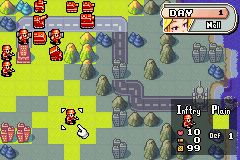
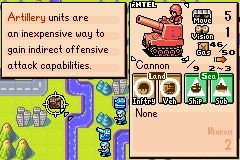
Advance Wars excels as a turn-based strategy game by delivering tight, accessible mechanics that encourage both careful planning and adaptive thinking. Each mission unfolds on a grid-based map where players alternately move and attack with a diverse roster of units—everything from infantry and tanks to helicopters, warships, and submarines. The interplay between unit types and terrain creates a rock-paper-scissors dynamic: tanks fare well against ground troops, artillery punishes long-range targets but is vulnerable up close, and aircraft can bypass obstacles but must watch out for anti‐air units.
(HEY YOU!! We hope you enjoy! We try not to run ads. So basically, this is a very expensive hobby running this site. Please consider joining us for updates, forums, and more. Network w/ us to make some cash or friends while retro gaming, and you can win some free retro games for posting. Okay, carry on 👍)
The campaign introduces new challenges at a steady pace. Early missions guide players through capturing cities and factories for income, teaching the importance of economic control. As rival nations deploy more sophisticated hardware and coordinate multi-pronged attacks, you’ll need to balance aggression with defense, repositioning units to cover flanks and secure key choke points. Neutral cities become hotly contested objectives, and losing them can quickly tip the balance of power.
One of the most engaging facets of Advance Wars is the Commanding Officer (CO) system. Each CO possesses unique powers—some bolster attack strength, others grant extra movement or restore unit health. Deciding when to unleash a power can turn the tide of a desperate engagement, forcing you to weigh immediate gains against future opportunities. In multiplayer, this layer of strategy deepens as you vie with human opponents who may exploit different CO strengths and specialty tactics.
Graphics
While Advance Wars first launched on the Game Boy Advance, its visuals remain striking thanks to clean, colorful sprite work and well-designed maps. Each unit type is instantly recognizable, with crisp animations that convey movement and combat without confusion. Whether you’re advancing through forested hills or laying siege to enemy strongholds in snowy tundra, the environments feel varied and purposeful.
The user interface complements the art style perfectly. Menus are intuitive and nonintrusive, with clear icons for unit stats, terrain effects, and income sources. Informational overlays, such as movement ranges and attack zones, appear at the click of a button, helping newcomers understand complex interactions. Small touches—like animated flags rising over captured cities or smoke plumes over damaged tanks—add personality without cluttering the battlefield.
On the technical side, Advance Wars runs smoothly with minimal slowdown, even when dozens of units engage across sprawling maps. Occasional frame freezes during large-scale bombardments are rare and brief. Overall, the graphical presentation strikes a fine balance between retro charm and functional clarity, ensuring that tactical decisions are always based on precise information.
Story
The single-player campaign casts you as an Orange Star commanding officer in a modern military world at war. From the outset, you’ll navigate a geopolitical landscape marked by shifting alliances among several rival nations. Early missions focus on quelling a sudden invasion, while later chapters reveal deeper conspiracies and the motivations driving each army’s CO. The narrative pacing keeps tension high without overwhelming the player with cutscenes.
Character interactions are delivered through brief dialogue boxes, but they manage to inject personality into otherwise faceless units. Your CO’s dry wit or resolute determination provides context for each operation, and rival commanders’ banter adds a layer of rivalry that carries over into multiplayer matches. Though the story doesn’t aspire to literary depth, it does a commendable job of framing tactical scenarios in a believable, cohesive world.
Side modes such as War Room and map creation shed further light on the conflict’s scale. Challenges in War Room mode often reference canonical battles from the campaign, allowing you to revisit favorite encounters with new objectives. Meanwhile, user-created maps can introduce custom narratives and battlefield conditions, letting creative players craft their own strategic stories.
Overall Experience
Advance Wars delivers a polished, endlessly replayable package that caters to both strategy veterans and newcomers. The core campaign offers dozens of well-paced missions, while versus mode and wireless multiplayer (where supported) unleash nearly limitless competitive potential. Passing a single Game Boy Advance among friends or linking systems together extends the fun far beyond solo play.
Replay value is further boosted by the map design tool, which encourages experimentation and sharing of custom scenarios. Whether you’re squeezing maximum efficiency from a three-turn victory or staging a dramatic comeback on a sprawling battlefield, the satisfaction of outmaneuvering an opponent remains consistently high. Challenge runs in War Room mode add another layer of depth for those seeking perfect scores.
For anyone seeking an approachable yet deep strategy experience on a handheld console, Advance Wars stands out as a genre-defining classic. Its combination of tight mechanics, charming presentation, and robust content makes it a must-own title. Even years after its release, the game’s elegant design and tactical richness continue to inspire players to come back and wage war time and again.


Reviews
There are no reviews yet.