 Retro Replay Retro Gaming History, Reviews & Emulation
Retro Replay Review
Gameplay
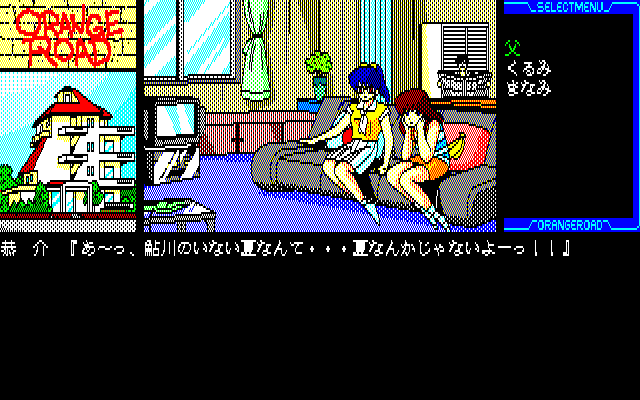
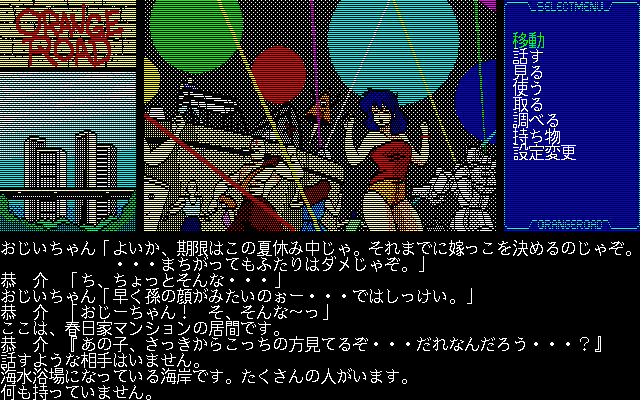
The first thing you need to accept is that Natsu no Mirage runs on adventure-game patience. You move through its first-person perspective and choose verbs and objects from a constant menu, using familiar commands such as Examine, Talk, and Move to work through Kyosuke’s situation. That makes the opening easy to understand even if you are not used to older Japanese adventures: look around, speak to people, and test what the environment will let you do.
The friction comes from the commands that demand more exact intent. Take and Use are not decorative additions; they can be necessary to trigger the next event. When the game’s logic clicks, that feels appropriately hands-on: you are not merely reading Kyosuke’s troubles, but poking at the right object or carrying the right item into a conversation. When it does not click, the same structure can turn into a hunt through menu choices.
That trade-off is central to the recommendation. If you enjoy slowly exhausting possibilities in a menu-driven adventure, the game’s pace gives its romantic and supernatural premise room to breathe. If you want constant momentum or dislike being stopped by a required item interaction, you may find the progress more stubborn than rewarding. Treat every verb as meaningful, especially once ordinary conversation and examination stop moving things forward.
Graphics
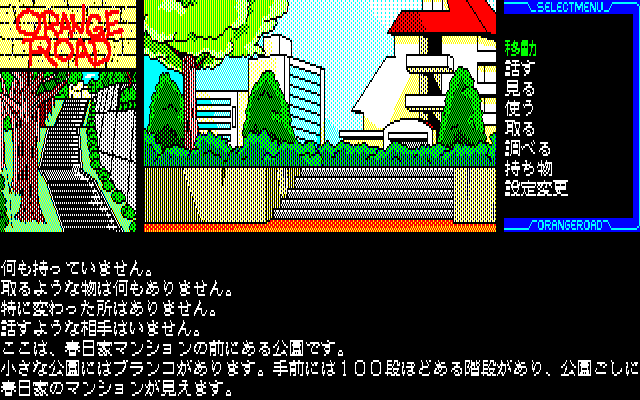
The first-person viewpoint places you in Kyosuke’s position rather than following him from a detached overhead view. It suits a story built on private choices and the risk of revealing a secret, keeping your attention on where you are looking and what you decide to interact with.
Story
Kyosuke’s predicament is a good foundation for an adventure game because the stakes are personal before they are grand. He and his twin sisters can use telekinesis, teleportation, and time-shifting abilities, but their family must relocate whenever those gifts become public. That rule gives even a youthful crush a sharper edge: using power to solve an embarrassing problem could cost everyone their home.
The romantic triangle adds the right kind of temptation. Kyosuke has met a girl he cares about, while another boy is already courting her, and that makes the family’s prohibition feel less like background lore than a source of pressure. You can immediately understand why he might consider taking a dangerous shortcut, even if he knows better.
Fans of Kimagure Orange Road should get the most out of this setup, since the game is rooted directly in the manga and anime’s characters and supernatural family premise. Even without that attachment, the story has a clean, relatable hook: wanting something badly enough to risk exposing the one secret you cannot afford to lose.
Overall Experience
Kimagure Orange Road: Natsu no Mirage is a compactly focused licensed adventure rather than a broad reinvention of its source material. Its strongest quality is the way the interaction matches the premise: Kyosuke’s life is full of small decisions, awkward conversations, and potential consequences, so a measured verb-menu format makes sense.
The catch is that its best quality and its biggest obstacle are inseparable. Methodical players can enjoy testing Examine, Talk, Take, and Use until a situation opens up. Anyone with little tolerance for old-school adventure gating may feel that the game asks for persistence more often than inspiration.
Give it a chance if you want an MSX-era anime adventure with a personal supernatural dilemma at its center and you do not mind carefully working through command choices. It is not the sort of game that wins you over through speed; it earns its value when you settle into its slower rhythm and let Kyosuke’s forbidden advantage complicate every choice.


Reviews
There are no reviews yet.