 Retro Replay Retro Replay gaming reviews, news, emulation, geek stuff and more!
Retro Replay Review
Gameplay
F-117A Stealth Fighter on the NES offers a surprisingly deep flight simulation experience given the console’s hardware limitations. Players are seated in a cockpit view, managing their stealth bomber through a series of punitive strike missions. Each sortie demands careful planning: you must navigate waypoints, avoid radar detection, and engage ground targets with precision. The mission structure is straightforward yet challenging, as you only get one shot at destroying key installations before you run low on fuel or draw too much enemy attention.
(HEY YOU!! We hope you enjoy! We try not to run ads. So basically, this is a very expensive hobby running this site. Please consider joining us for updates, forums, and more. Network w/ us to make some cash or friends while retro gaming, and you can win some free retro games for posting. Okay, carry on 👍)
The input scheme relies heavily on the NES controller’s limited buttons, meaning many complex actions are mapped to combination presses. Launching flares, adjusting altitude, switching targeting systems, and managing weapons payloads all require memorizing and executing multi-button commands. While this can feel daunting at first, the control scheme rewards persistence by giving you direct control over virtually every aspect of the aircraft’s operation.
Dogfighting is not the primary focus, but enemy interceptors will still breach your airspace. Successfully engaging hostile jets requires toggling radar modes, engaging afterburners, or deploying chaff to evade missiles. These encounters add a welcome layer of tension to each mission. Without a dedicated multiplayer mode, your only competition is the game’s own difficulty curve, which steadily ramps up as you progress from Sicily–based training runs to deeper strikes in hostile territory.
One standout feature is the fuel and ordinance management system. You must decide whether to carry extra fuel tanks for extended range or additional bombs and missiles for increased firepower. Balancing these loadouts changes the game’s dynamics—lighter loadouts make the jet more maneuverable but limit your strike options, while heavier configurations slow you down but let you press deeper into enemy defenses without risking a mid-air fuel shortage.
Graphics
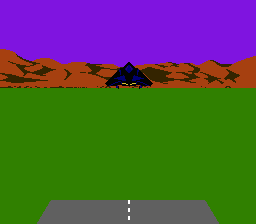
Graphically, F-117A Stealth Fighter is a testament to the ingenuity of NES developers working within tight constraints. The game presents a cockpit dashboard with rudimentary gauges and indicators, using simple sprites to represent instruments like altitude, speed, and radar sweep. While the details may seem sparse compared to 16-bit titles, the color palette and sprite work cleverly convey essential flight information without cluttering the screen.
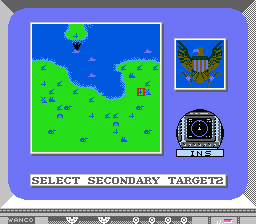
The overhead terrain and base layouts are rendered using basic tile graphics, but they manage to capture the essence of desert runways, mountain passes, and urban compounds. Targets such as SAM sites, airstrips, and command buildings are clearly distinguishable, allowing you to plan your attack runs with confidence. Occasional flickering or slowdown can occur when there’s a lot happening on screen, but it rarely detracts from the overall immersion.
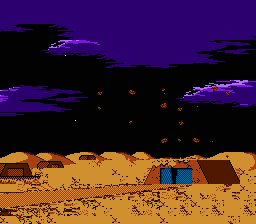
Enemy jets and missiles are represented by small but identifiable sprites that turn and bank to indicate their trajectories. Explosions and weapon effects are likewise simple bursts of color and shapes, yet they provide satisfying visual feedback when you score a direct hit. The limited draw distance can make long-range navigation feel abstract, but the radar readout compensates by guiding you to distant waypoints.
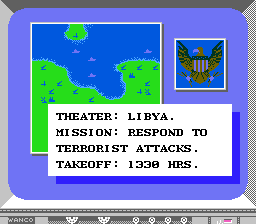
Cutscenes and mission briefings are delivered through static screens with text overlays, accented by the game’s energetic 8-bit soundtrack. While the visuals don’t push the NES to its limits, they maintain clarity and functionality in a way that keeps you focused on the thrill of each stealth strike rather than on flashy effects.
Story
The narrative of F-117A Stealth Fighter is minimal but effective. You play as the pilot of the cutting-edge F-117A stealth bomber, tasked by your superiors to neutralize threats in various rogue states. The game doesn’t dwell on personalities or political backstories; instead, it provides concise mission briefings that outline objectives, target locations, and potential defenses. This direct approach lets you jump into the action without wading through lengthy dialogue sequences.
Each mission’s setting—from the Mediterranean launch point in Sicily to the desert expanses of North Africa—comes with its own set of operational challenges. The stark mission descriptions highlight the strategic importance of each strike and underscore the gravity of flying deep into hostile airspace alone. While the story may lack cutscenes or character development, the mission structure creates a sense of progression and purpose that keeps you engaged.
The absence of in-mission chatter or pilot commentary can feel austere, but it actually enhances the solitary nature of the stealth bomber role. You are the lone operative capable of slipping past enemy radars, and the game’s sparse narrative reinforces that feeling of isolation and responsibility. Post-mission debriefs simply list your successes and any damage sustained, offering just enough feedback to prepare you for the next operation.
Overall, the story framework does its job admirably: it sets the stage for tense solo missions without overcomplicating the experience. Fans of simulation titles who prefer action over exposition will appreciate how the game lets the cockpit instruments and mission objectives tell the story for themselves.
Overall Experience
F-117A Stealth Fighter delivers a compelling blend of strategy, skill, and simulation—all on an 8-bit console. The challenge of learning complex control combinations, managing fuel and weapon loads, and executing precision strikes against well-defended targets makes each successful mission deeply satisfying. While modern gamers might find the pace deliberate and the visuals dated, early NES flight-sim enthusiasts will likely appreciate the depth this title offers.
The learning curve is steep, and the lack of save states means you may need to dedicate extended play sessions to master the controls and memorize mission routes. However, this difficulty is part of the game’s charm—there’s nothing quite like the adrenaline rush of slipping past enemy radar, laying waste to a target, and returning to base with your aircraft intact.
One downside is the absence of replay variety; once you’ve memorized the missions, the surprise factor diminishes. Still, the game encourages experimentation with different bomb splits, fuel configurations, and approach angles to keep you thinking tactically. Even without a robust narrative or multiplayer component, F-117A Stealth Fighter stands as an impressive technical achievement on the NES.
In summary, if you’re drawn to the idea of flying America’s most secretive jet in stealth missions across hostile territories, and you don’t mind putting in the time to learn its nuances, F-117A Stealth Fighter remains a rewarding experience. It strikes a fine balance between simulation depth and console accessibility, offering a unique taste of Cold War–era covert operations right in your living room.


Reviews
There are no reviews yet.