 Retro Replay Retro Gaming History, Reviews & Emulation
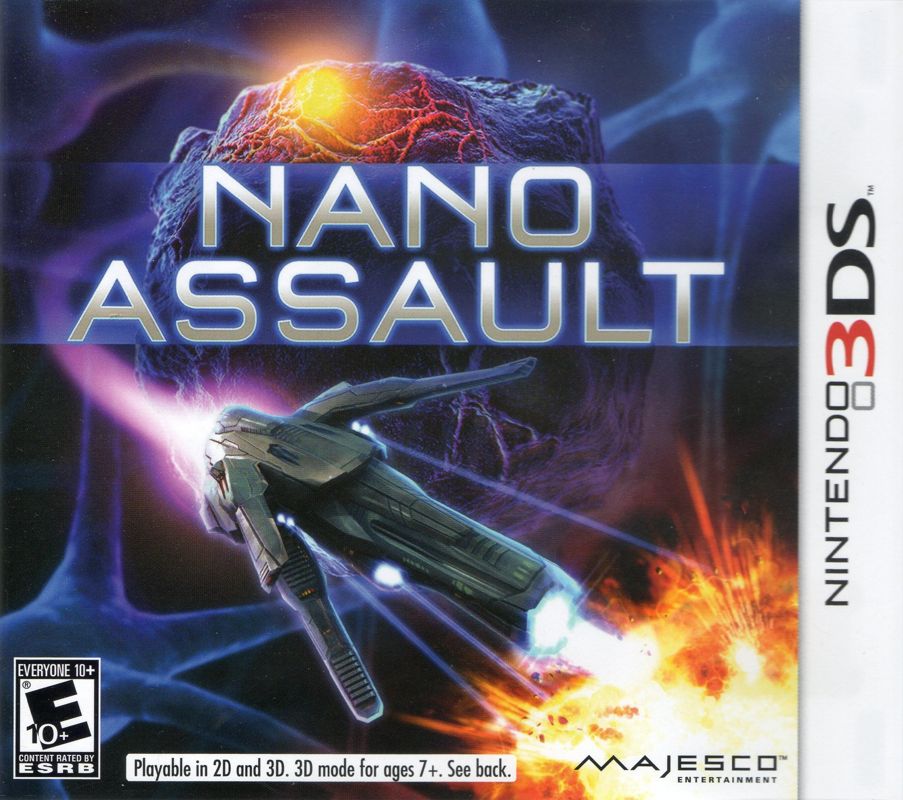
Retro Replay Review
Gameplay
The first hour of Nano Assault is spent teaching your thumbs an unusual but effective language. You steer the Nanite with the 3DS analog nub and fire in eight directions with ABXY, essentially making the handheld’s buttons stand in for a second stick. Once it clicks, the Ground missions become satisfyingly busy little arenas: you orbit clusters of enemies, vacuum up DNA sequences, and try to wipe the board before the infection boxes you in.
This is where the game is strongest. The Nanite fires a three-bullet spread, the L button alters that spread, and the R button triggers one of four secondary weapons. That is enough equipment to make positioning matter without turning a short arcade stage into a loadout exercise. Going for every DNA strand while keeping the enemy count under control gives these missions a nice compulsive rhythm. You can survive sloppily, but the game constantly tempts you to play more cleanly.
Shin’en does not let that rhythm settle for long. Flying missions move behind the ship and send you through 3D organic corridors, where destroying infections matters but avoiding obstacles suddenly becomes crucial. They have the familiar forward-drive of a scrolling shooter, and the switch to single shots changes the feel of combat more than you might expect. The circular boss encounters change things again, restricting you to left-right movement while you fire toward a boss in the background and fend off attacks from the sides.
That three-part structure is both Nano Assault’s strength and its main irritation. The Ground missions have the clearest control fit and the deepest replay pull; the other formats add welcome breaks but can feel like interruptions when you are eager to get back to the twin-stick action. Still, 32 Cell stages and 10 boss battles give the campaign a proper arcade-game cadence rather than stretching one idea beyond its limits.
Graphics
Nano Assault puts you inside an organic body, with the small Nanite ship skimming over giant cells in the overhead stages and racing through biological corridors in the behind-the-ship missions. The changing camera views do more than vary the controls: overhead battles emphasize swarming infections around the ship, while Flying missions make incoming obstacles part of the immediate picture.
The boss fights use a large circular arena with the boss centered in the background, leaving room for attacks and broken-off pieces to come at you from either side. It is a clear, gamey setup that makes the priority obvious even when the fight gets crowded.
Story
The story is lean on purpose. You pilot a nanite vehicle inside an organic body, fighting the Nanostray virus before it can spread through civilization. Nano Assault shares its universe and viral threat with the earlier Nanostray games, but it does not ask you to arrive with a deep investment in series lore before the shooting starts.
That makes the premise functional rather than memorable. Cells are grouped into Cell Clusters, and each cluster leads you through several self-contained stages toward more infected territory and boss encounters. The body-in-crisis framing gives the enemies and locations a coherent theme, even if the real reason to continue is mastering the next combat layout.
If you want more context around the game itself, the Nano Assault history and release information is a useful companion. In the game, though, the plot mostly stays out of your way, which suits an arcade shooter built around immediate pressure and repeat attempts.
Overall Experience
Nano Assault is a good shooter with a slightly uneven identity. Its central twin-stick-inspired mode feels right at home on the 3DS once you adapt to the button aiming, and the microscopic setting gives the action more character than another space-combat backdrop. When enemies pile up and DNA remains scattered across the arena, you get that pleasant arcade panic of having three urgent tasks at once.
The post-campaign structure is a meaningful part of the recommendation. Completed stages return in Arcade Mode for score chasing and stage-specific challenges, including no-death runs, runs without secondary weapons, and score targets. Those challenges earn Nano Coins for jukebox songs and Nanopedia enemy profiles; Boss Rush also opens after finishing the game. This is the kind of game that rewards learning a stage’s demands, not simply reaching the end once.
Its 7.2-level appeal comes down to your tolerance for format changes. Give it a chance if you like compact shooters, leaderboard-minded replays, and a control scheme that becomes more intuitive through use. Skip it only if you need every level to commit to the same viewpoint and rules. Nano Assault never matches its best Ground missions often enough to feel definitive, but it is energetic, inventive, and consistently worth another run.


Reviews
There are no reviews yet.