 Retro Replay Retro Gaming History, Reviews & Emulation
Game Overview
Gameplay
Best of Tests DS is at its most enjoyable when you treat it like a few minutes of mental calisthenics rather than a game you will settle into for an evening. The touchscreen tasks are immediately understandable: follow number or symbol sequences, retain the locations of blocks, find matching cards, or identify opposite words. That directness matters on the DS. You can pick it up, make a few quick decisions, and put it down without needing to relearn anything.
The three modes give the package a sensible rhythm. Intelligence and Memory are the more test-like options, while Training lets you practice without attaching a score to every attempt. That no-score training option is a welcome pressure release if you want to work through a particular type of puzzle instead of chasing a result.
Still, the game leans hard on repeating tests. Higher difficulties do unlock after you clear easier levels, so there is a basic reason to keep moving forward, but the climb can feel more like revisiting familiar exercises at a stricter setting than uncovering fresh ideas. If you enjoy measuring yourself against recurring mental drills, that structure is fine. If repetition makes you restless, the routine will set in fast.
Graphics
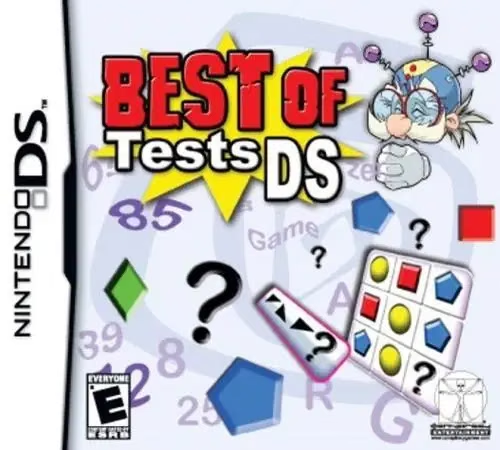
The screens keep things simple and functional: numbers, letters, small pictures, and clear icons carry the exercises, while a cartoon professor occupies the DS top screen. It is clean, plain artwork built for quick recognition rather than personality. The visuals suit matching cards and memory blocks well, even if they do little to make the repeated tests feel more lively.
Story
There is no grand hook pulling one challenge into the next. Instead, the game frames its progress through the steady business of completing tests and reaching harder versions of them. That puts all the weight on your own satisfaction in improving, not on a character arc or a larger destination.
The cartoon professor gives the exercises a light educational wrapper, but the real through-line is your performance from one set of questions to the next. You are essentially making your own tiny story out of remembered patterns, corrected mistakes, and a difficulty level that once seemed out of reach.
That stripped-down approach is honest, if not especially memorable. Best of Tests DS does not waste time dressing up its exercises, and it also does not give you much emotional momentum when the tasks start to blur together. The format works best when you want a clean distraction, not a reason to become invested.
Overall Experience
This is a modest mental-training cartridge with a clear use case. It works for a commute, a waiting room, or any spare ten minutes when you would rather do a compact puzzle than commit to something larger. The touchscreen focus and quick-to-grasp prompts make getting started painless.
Its limitations are just as clear. Repeated tests mean your interest depends heavily on whether you enjoy performing familiar exercises at increasing difficulty. The Training mode softens the score-chasing side of the package, but it does not change the fact that the core loop stays narrow.
Give it a chance if you like old-school brain teasers and want an uncomplicated DS diversion. Skip it if you need variety, character, or a stronger sense of discovery to stay engaged. For additional period perspective, this contemporaneous DS review is useful, but the central verdict remains simple: competent drills, limited spark.
Reviews
There are no reviews yet.