 Retro Replay Retro Gaming History, Reviews & Emulation
Retro Replay Review
Gameplay
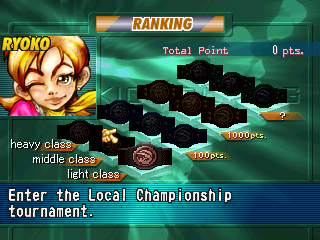
Kickboxing has the kind of immediate arcade-fighter pull that makes the first few matches easy to understand: choose a kickboxer and start climbing. Ranking mode is the no-nonsense route, asking you to face a succession of opponents on the way to champion status. If you want a fighting game with a clear goal rather than a lot of surrounding clutter, that directness is welcome.
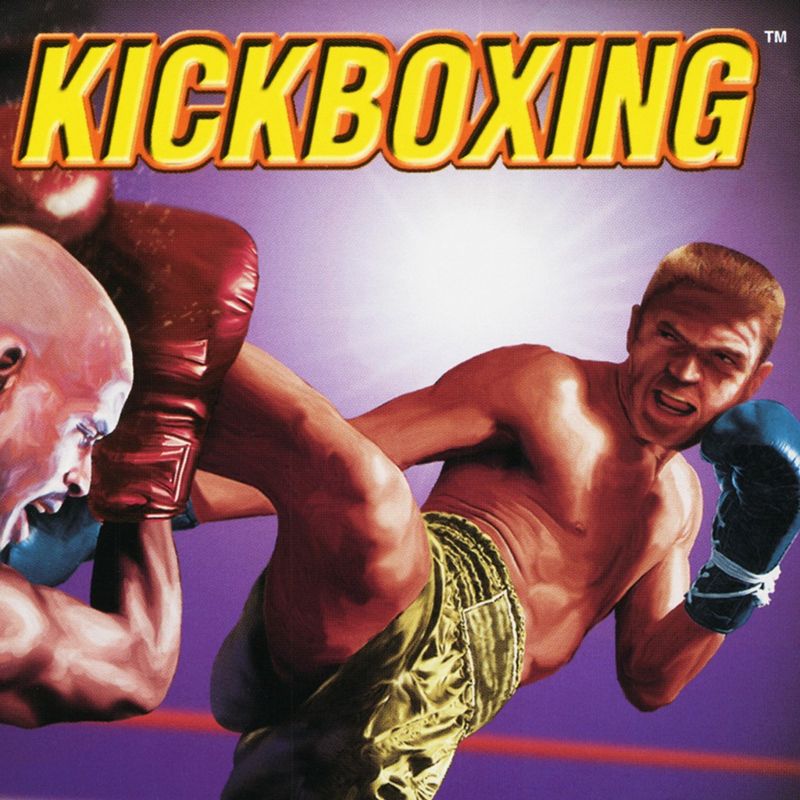
The important distinction from its closely related boxing counterpart is right in the name: kicks join punches. That sounds like a modest change, but it gives Kickboxing a more appropriate martial-arts flavor than a straight boxing game and makes it the better pick if you want that broader striking focus. It still shares much of its character pool and its foundation with Boxing, so do not expect a radical reinvention.
What keeps the roster from being purely cosmetic is the spread of speed, accuracy, strength, and stamina ratings. You can pick based on the kind of fighter you want to use rather than treating every selection as identical. The trade-off is that the game’s core loop remains deliberately narrow: fight opponents, improve your standing, and try another character. That can be satisfying in short sessions, though repetition is likely to set in if you need lots of modes or a deep competitive framework.
Two-player VS. is a worthwhile inclusion because it lets the differences between fighters matter against a human opponent. Ranking is the better fit for solo play; VS. is the reason to keep the game around when someone else is in the room. Neither asks much of you beyond an interest in straightforward kickboxing bouts.
Graphics
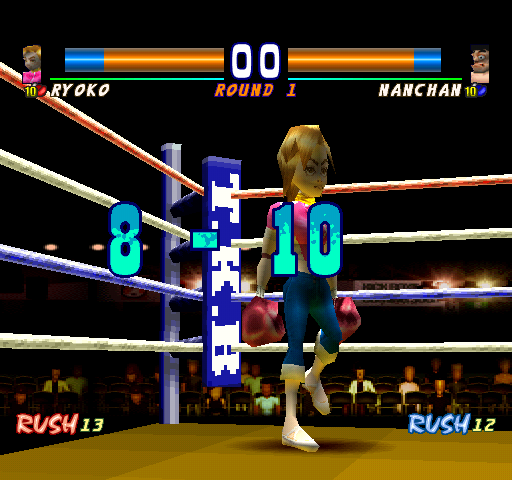
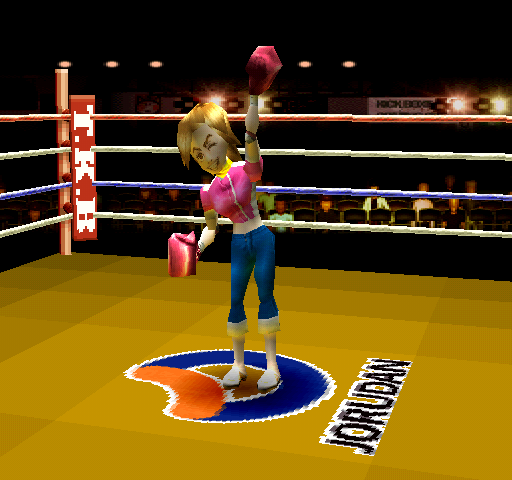
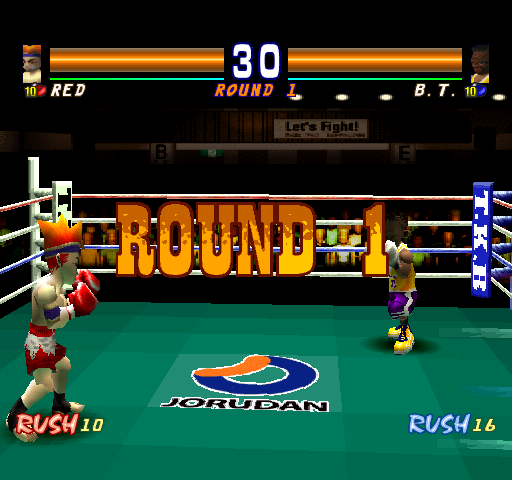
The third-person fights keep the kickboxers in view as the action unfolds, while Red, Sang, and the opponents give the roster a set of distinct on-screen combatants. This is a functional fighting-game view built around watching the match rather than a lavish visual showcase.
Story
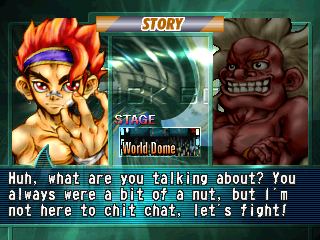
Story mode is modest, but it gives Kickboxing more personality than a simple ladder. You begin as either Red or Sang, then follow their respective paths through dialogue between matches. That structure gives your victories a little context without getting in the way of the fighting.
The stronger incentive is character unlocks. Beating fighters adds them to the available lineup, so progress has a practical reward beyond simply seeing the next conversation. If you enjoy gradually opening a roster, Story mode is the natural place to start.
Do not go in expecting an elaborate martial-arts drama. The dialogue is there to connect the bouts and distinguish the two starting routes, not to carry a large narrative. Its value is momentum: it gives you a reason to push past the next opponent when Ranking mode alone starts to feel too bare.
Overall Experience
Kickboxing is an uncomplicated early-2000s fighting game that works best when you meet it on its own modest terms. Its champion climb, two starting story fighters, unlockable roster, and local VS. mode form a coherent package. The ability to kick is enough to give it a clearer identity than the Boxing game it resembles, even if the shared foundation is obvious.
The payoff depends on what you want from the genre. You may enjoy it if you want quick, focused bouts and a small roster to unlock through play. You may tire of it if you need extensive variety, a detailed story, or a major departure from basic boxing-game structure. The ratings give the characters useful differences, but they do not turn the game into a deep long-term obsession.
Start with Story mode if unlocking fighters and seeing Red or Sang’s dialogue path sounds appealing, then move to Ranking for the pure champion run. Bring in a second person for VS. when you want the game’s simplest strengths to come through. Kickboxing is not ambitious, but it is clear about what it wants to be: a direct striking game with a little progression wrapped around the matches.


Reviews
There are no reviews yet.