 Retro Replay Retro Replay gaming reviews, news, emulation, geek stuff and more!


Retro Replay Review
Gameplay
LSD: Dream Emulator begins by asking you to accept a very unusual deal: walk through a dream and let the dream decide what happens next. You move in first person through strange spaces, and contact with a wall or object can instantly warp you elsewhere. There is no map to master, no objective marker to chase, and no victory condition beyond continuing to drift through its shifting logic. For the right mood, that is remarkably absorbing. You stop treating movement as a route toward progress and start treating every corner as a possible rupture.
The simple act of touching things gives exploration its tension. A collision might send you to another area and extend the dream’s wandering chain, while a fall through a floor or off a cliff can end the session early. Dreams can last up to ten minutes, so each one has the loose shape of a short, unpredictable excursion rather than a level you clear. The game’s randomized textures and rule against immediately repeating the same dream help preserve that uneasy sense that you are never quite returning to a stable place.
Its rhythm will frustrate you if you need clear feedback or purposeful challenges. Walking is the whole interaction, and the game can feel stubbornly empty when a particular dream does not catch your imagination. But that emptiness is deliberate enough to become compelling: you are not solving the dream, only passing through it. The graph at the end, which labels each experience Upper, Downer, Static, or Dynamic, adds a small after-the-fact ritual to something that otherwise refuses neat interpretation.
After 20 days, Flashback mode offers a useful counterpoint to all that impermanence. It lets you revisit the same areas and choose alternate paths, albeit for only three to five minutes. The Grey Man’s occasional appearance can take away your ability to remember a dream in Flashback mode, turning even the game’s limited archival tool into another source of instability. That is a clever fit for a game about dreams, though it will feel punishing rather than poetic if you were hoping to catalogue everything cleanly.

Graphics
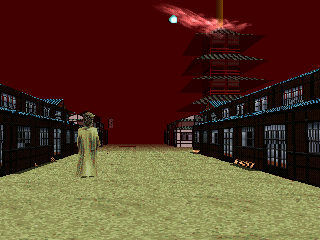
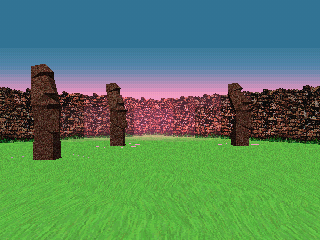
The view stays in first person, putting you directly inside locations that can swing from colorful and happy to dark and unsettling. Randomized textures make familiar spaces feel less dependable, and the abrupt warps do much of the work: one moment you are walking normally, the next you are somewhere with a completely different emotional temperature.
Its imagery matters more than polish. The rough, shifting dreamscapes have the disjointed quality of places your mind recognizes without being able to explain, which is exactly why the occasional arrival of the Grey Man can be so alarming.

Story
There is no traditional plot to carry you from scene to scene. Inspired by Hiroko Nishikawa’s dream journal, LSD: Dream Emulator treats each session as a fragment: disconnected places, sudden transformations, happy color beside darker imagery, and no authoritative explanation of what any of it means. You bring most of the interpretation yourself.
That makes the game closer to a collection of impressions than a narrative adventure. The classifications after each dream suggest emotional categories without pinning down a story, while Flashback mode turns remembered spaces into something you can revisit only briefly. Even the Grey Man works less as a character in a plot than as an intrusion into the act of remembering.
If you want character arcs, lore, or a final reveal, this will leave you cold. If you enjoy games that let a place linger in your head because it refuses to resolve into a tidy explanation, its dream-journal foundation gives the wandering more weight than pure randomness. For background on its history and releases, see LSD: Dream Emulator’s history.
Overall Experience
LSD: Dream Emulator is less a game you beat than a headspace you visit. Its strongest moments arrive when you surrender the need for progress and let an unexpected warp, a threatening encounter, or an odd stretch of scenery reshape your mood. The first few dreams may seem almost too simple, but repetition gradually teaches you to notice the game’s small differences and to value the fact that it will not behave like a normal adventure.
That same commitment to formlessness is its biggest limitation. There is only so much pleasure you can take from walking and being displaced if you do not respond to surreal spaces on their own terms. Sessions are best taken in short bursts, when the lack of goals feels freeing instead of thin. Trying to force a conventional campaign out of it is a fast route to disappointment.
For adventurous horror fans and anyone fascinated by games as mood machines, it remains a singular trip. The horror is not built around fighting or completing tasks; it comes from the uncertainty of what a harmless touch might do, and from the sense that even your memories of a place can be taken away. Its payoff is not an ending, but the rare feeling of having wandered through someone else’s half-remembered dream.


Reviews
There are no reviews yet.