 Retro Replay Retro Replay gaming reviews, news, emulation, geek stuff and more!
Retro Replay Review
Gameplay
Kaze Kiri opens with the kind of clean assignment that suits a brisk action game: get into Lord Hiei’s castle, cut through the ninja forces in your way, and bring Princess Shizuhime home. You move through linear side-scrolling areas, dealing with regular enemies before confronting bosses. That lack of detours is a strength if you want a game that commits to its mission rather than padding it out.
Kaze is more flexible than the usual one-note brawler hero. His sword handles close-range pressure, while shurikens let you answer enemies from a distance. More importantly, you can counter incoming projectiles with shurikens of your own. That turns ranged attacks into something to watch and respond to rather than merely endure. His jump, duck, somersaults, grabs, throws, and brief disappearance-and-reappearance move give you a reasonable set of answers when a crowd starts closing in.
The stage structure has a deliberate gate: before the boss appears, you must deplete a shared enemy HP total shown at the top of the screen. It gives each area a clear target, but it can also make progress feel prescribed. You are not simply rushing toward the end of the level; you are clearing the required opposition first. If you like an arcade-minded “finish the job” rhythm, it works. If repeated cleanup fights wear on you, that requirement may be where impatience starts to creep in.
Health regeneration softens the punishment as long as you avoid being hit repeatedly. That is a smart fit for a game built around staying mobile and choosing when to engage, since a bad moment does not necessarily doom the entire run. Completing the game unlocks Suzu as another playable character, giving committed players a concrete reason to return after Kaze’s rescue mission. For more background on the game, its Kaze Kiri history and release information is a useful companion.
Graphics
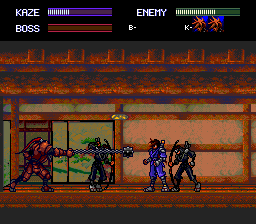
The action is shown from a side view, keeping Kaze, enemy groups, thrown shurikens, and the route through each linear area in the same straightforward frame. Its anime and manga flavor fits the ninja-fantasy setup, while the uncluttered layout keeps attention on immediate combat decisions.
Story
This is a classic rescue setup delivered without needless complication. Genbu’s ninja kidnap Princess Shizuhime and carry her to Lord Hiei’s castle; Lord Yoshikage calls on Kaze to retrieve her. You know exactly who needs saving, where you are headed, and why every encounter is in your way.
That simplicity helps the game rather than holding it back. The story gives the sword-and-shuriken action a clear destination, and the castle infiltration naturally matches the linear advance through hostile territory. It is a frame for action, not a drama that asks you to pause and untangle motives.
Suzu’s unlock gives the adventure a small after-the-credits reward in practical terms: a second playable ninja once you have seen Kaze’s campaign through. The narrative itself is unlikely to be the reason you stay, but it does its job of making the final rescue feel like a finish line rather than another arbitrary boss rush.
Overall Experience
Kaze Kiri is a compact brawler with enough ninja-specific wrinkles to stand apart from a pure button-mashing slog. Switching between sword range and shuriken range, returning fire against projectiles, and using Kaze’s movement tools make fights more active than their simple premise suggests. The best moments should come when you are using that whole kit instead of relying on one safe attack.
Its main limitation is also its clearest promise: this is a strictly linear march through enemies toward bosses. The shared enemy-HP requirement makes that structure explicit, and not every mood calls for clearing a quota before you can move on. Still, the regenerating health and varied defensive options keep the format from being needlessly punishing.
Give it a chance if you want a focused 1994 ninja brawler that values immediate combat over elaborate progression. It is especially easy to recommend to anyone who enjoys learning when to close in, when to throw a projectile, and when to recover their footing. The payoff is a concise rescue adventure with a second-character unlock waiting for players who want to go another round.


Reviews
There are no reviews yet.