 Retro Replay Retro Gaming History, Reviews & Emulation
Retro Replay Review
Gameplay
The first few minutes of Metamor Jupiter make a strong case for its transforming fighter. Side-scrolling shooters live or die by whether their weapons feel like more than a cosmetic swap, and this one gives each form a job. Vertical fire is useful when threats press from above or below, while bombs offer an answer when explosive force matters more than a quick forward shot. You are encouraged to read the immediate screen instead of settling into one comfortable loadout.
That choice becomes more valuable as regular enemies, environmental hazards, and bosses ask for different responses. The limitation is that no form sounds like a complete solution: the vertical-fire configuration gives up strong explosives, and the bombing form pays for its payload with a slow forward beam. That trade-off can be satisfying once it clicks. Success comes less from simply holding fire than from anticipating what kind of pressure is about to arrive and changing shape before you are pinned down.
The hit-point system gives the game a different rhythm from the harsher, life-based shooters of its era. Taking a hit hurts without instantly ending a run, and health-restoring power-ups offer a way to stabilize after a mistake. That breathing room is welcome, especially when the action gets busy, but it should not be mistaken for permission to drift carelessly. You still have finite health, and a bad sequence can leave you vulnerable long before the next restorative pickup appears.
Power-ups strengthen the conventional weapons in each form, adding another reason to stay engaged with the level rather than treating transformation as the only meaningful decision. The temporary wingmen add a nice hint of a larger human counterattack, but their tendency to fall to the robotic assault leaves you alone with the work that matters. In practice, that underlines the game’s central pleasure: it is your craft, your weapon choice, and your survival.

Graphics
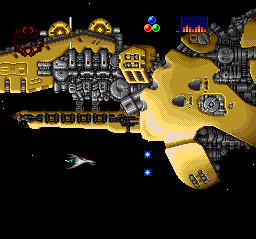
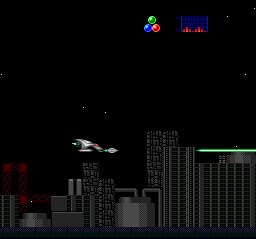
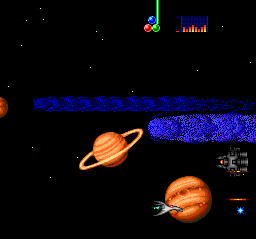
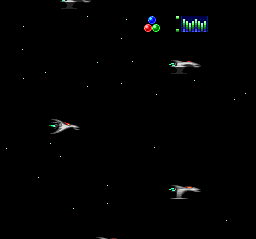
The action is shown from a side view, keeping the fighter, incoming machines, and hazards on the same scrolling plane. The transforming craft is the key image here, since its three shapes make your weapon changes visible instead of leaving them as an abstract status change.
Story
This is a clean, old-school sci-fi setup: a biological mutation has unleashed an alien race across the galaxy, and their machines and robots are now fighting humanity. Humans answer with crystal energy and transformable fighter craft. It is direct enough to establish the stakes without interrupting the shooting.
The crystal-energy angle is more than background flavor because it explains why your ship can instantly adapt between forms. That small connection helps the central gimmick feel native to the setting rather than bolted on for the sake of gameplay.
Do not expect the premise to carry the game through character drama. The accompanying fighters are defined mainly by their short-lived support in battle, and their losses reinforce the lone-pilot tone. The story works because it gets you into the cockpit quickly and leaves the screen clear for the conflict with the alien machines.
Overall Experience
Metamor Jupiter is worth trying if you like side-scrolling shooters that ask for more thought than finding a safe spot and firing forward. Its best idea is simple but effective: every form is useful, and every form gives something up. That friction gives the shooting a tactical pulse.
The game’s health bar makes it friendlier than an immediate-death format, particularly for anyone who wants room to learn boss patterns and hazard placement without constantly restarting. At the same time, the need to recover health means mistakes remain cumulative. You can survive a collision, but you cannot afford to make a habit of it.
Its payoff is in mastering the transformation cycle. If swapping between vertical fire, bombs, and other weapon pairings sounds more exciting than committing to a single all-purpose gun, this is a solid sci-fi shooter with a distinct hook. If you want a pure reflex test with minimal weapon-management, its central idea may feel like one decision too many. For everyone else, it offers a focused arcade challenge built around adapting under pressure.


Reviews
There are no reviews yet.