 Retro Replay Retro Gaming History, Reviews & Emulation


Retro Replay Review
Gameplay
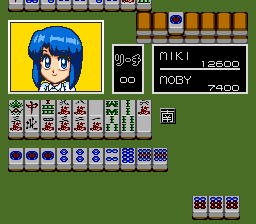
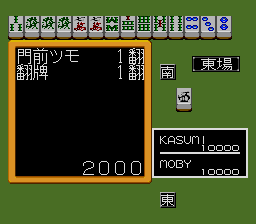
The first few rounds make the game’s priorities perfectly clear: select one of three opponents and play mahjong for money. There is no campaign framework to ease you in, no alternate diversion waiting after a loss, and no mode selection to dilute the central contest. You either enjoy returning to the table and making better decisions, or the whole package runs out of road quickly.
The money condition gives each match a welcome bit of pressure. You are not merely collecting isolated wins; you are trying to outlast the woman across from you before your own funds disappear. That lends the otherwise minimal structure a useful sense of stakes, especially when a run turns against you.
Victories unlock pictures of Mika, Kasumi, and Shōko, which makes progression easy to understand and gives committed players a concrete reason to continue. Still, the reward loop does not change the mahjong itself. Once you have settled into the rhythm, the game asks you to keep enjoying that same rhythm rather than offering fresh situations or a larger arc.
This is a niche recommendation. Come to it because you want mahjong first and a direct, old-school score-and-reward loop second. Anyone hoping for a strategy game with a broader range of tactical scenarios, or even a fuller selection of mahjong modes, will find the limits impossible to ignore.

Graphics
The game centers its imagery on the three named opponents and the pictures unlocked through repeated victories. Mika, Kasumi, and Shōko are the visual prizes attached to the matches, so the artwork has more weight here than any sense of place or story scene.
Story
There is no background story tying these matches together. Mika, Kasumi, and Shōko are opponents rather than characters carried through a plot, and the game is honest about putting the table ahead of narrative context.
That absence can be refreshing if you want to jump straight into a round. You never have to sit through setup before playing. But it also means your relationship to the cast depends almost entirely on choosing an opponent and unlocking her pictures.
As a result, the game has little narrative payoff beyond completion and accumulation. The title’s “memories” framing may suggest more, but the experience remains a sequence of mahjong confrontations rather than a tale with developments to discover.
Overall Experience
Super Real Mahjong Special is concise to the point of austerity. Its strongest quality is that it never disguises what it is: a one-on-one mahjong endurance test with character-image rewards. For the right mood, that clean focus can be satisfying.
Its weakness is equally plain. Three opponents do not create much variety when there are no additional modes or story material, and losing your money can turn the straightforward loop into a frustrating stop rather than an interesting setback. The payoff is worthwhile only if the core game already has you hooked.
Series fans may also want to compare this focused entry with Super Real Mahjong PV. For everyone else, treat this as a specialized artifact: a compact mahjong game whose rewards may keep you playing, but cannot substitute for depth around the table.


Reviews
There are no reviews yet.