 Retro Replay Retro Gaming History, Reviews & Emulation



Game Overview
Gameplay
The first few saucers establish the deal immediately: read the sum, type its answer, shoot down the invader. It is an uncomplicated loop, yet the descending enemy gives every calculation a consequence. You are not merely filling out answers; you are trying to prevent one specific mistake from becoming the end of the round.
What makes it work is that incorrect input does not simply get marked wrong and replaced with a fresh question. The alien keeps moving. That forces you to recover under pressure, and it gives basic addition more bite than a static drill. When you know the answer at a glance, knocking out a saucer feels clean and efficient. When you hesitate, the same tiny problem suddenly becomes a threat.
Difficulty selection matters because it adjusts both halves of the challenge: faster alien movement and harder problems. Start low if the game is for a child still building confidence; the faster settings are where the exercise stops feeling like practice and starts asking whether you can stay accurate with a timer bearing down. The two-minute win condition is a smart fit for the format, creating short attempts that are easy to repeat without overstaying their welcome.
Its limits are plain. Every encounter asks for the same response, and the entire experience hangs on how much you enjoy addition under time pressure. Still, this is more focused than many educational games that bury practice beneath distractions. Invaders Addition puts the math at the center and makes you earn the victory through speed and correctness.

Graphics
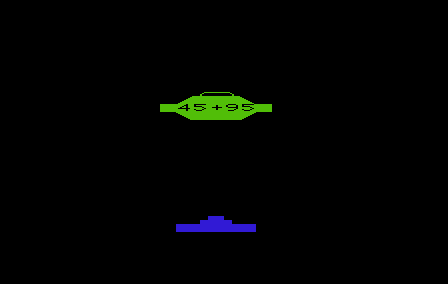
The action is easy to parse: your gun sits at the bottom of the screen while alien saucers arrive from above with their addition problems displayed on them. That direct layout keeps your eyes on the only thing that matters—reading the sum before the saucer reaches you.

Story
Earth is under alien attack, and your answers are its defense. That is the entire story, but it is exactly enough for this kind of game. The invasion premise turns each sum into an immediate problem rather than a detached classroom question.
There is no reason to expect a developing narrative over a two-minute defense. The saucers are obstacles, the gun is your last line, and the arithmetic determines whether Earth holds. It is a premise built for clarity, not drama.
For younger players, that simple framing may help the exercise land: correct answers are not just correct, they knock down invaders. Anyone wanting characters or sci-fi world-building will find almost nothing to hold onto, but the theme does its job without getting in the way.
Overall Experience
Invaders Addition is a small, stern educational game with a good instinct at its core: make the learner act quickly enough that memorized addition facts start to matter. The tension comes from the approaching saucer and the cost of a wrong answer, not from elaborate rules. That makes it immediately understandable and surprisingly honest about what it wants you to practice.
The payoff is modest but real. Surviving the full two minutes can feel satisfying because the game has spent that time testing accuracy under rising pressure, not because it has dressed the task up with a lot of extra activity. It works best in brief sessions, especially as a warm-up or a challenge between learners competing for clean runs.
Give it a chance if you want a stripped-down piece of early educational design or need an addition drill with more urgency than flash cards. Skip it if repetition and typing answers to descending sums sound exhausting from the outset. It does one thing, and it does that thing with enough tension to make basic math feel like a fight for survival.
Reviews
There are no reviews yet.