 Retro Replay Retro Gaming History, Reviews & Emulation
Retro Replay Review
Gameplay
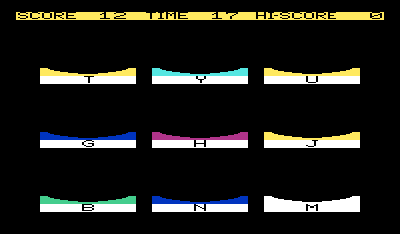
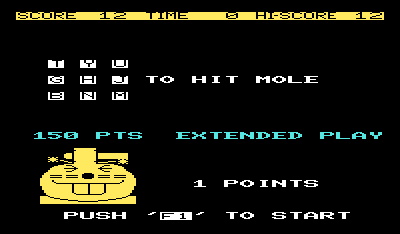
Mole Attack is wonderfully blunt. A mole pops from one of nine holes, you press the matching key, and the clock keeps draining toward the 60-second finish. There is no long runway before the game reveals itself; you are reacting from the opening moment, trying to make the keyboard feel like a physical mallet.
The strongest part is the scoring pressure. Faster hits on a mole’s head are worth more, so merely catching targets is not enough if you want a score worth replaying for. You have to build speed without letting accuracy collapse. That is a familiar arcade bargain, but it still works because every hesitation is immediately felt.
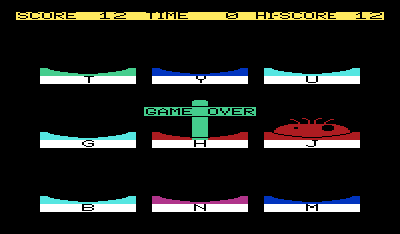
The backside-up mole is the rule that saves the game from becoming completely automatic. A rushed press can cost points, turning a good run into a flustered one. Frustration can set in when your fingers know the grid but your reflexes fire before your eyes confirm what is sticking out of the hole. For a one-minute game, though, that sting is exactly why another attempt is tempting.
It is a very narrow idea, and it does not pretend otherwise. If you enjoy early score-chasing games that demand quick recognition and a little self-control, Mole Attack remains a neat, concentrated challenge. If you need progression, variety, or a deeper arcade loop, its single joke will run out quickly.

Graphics
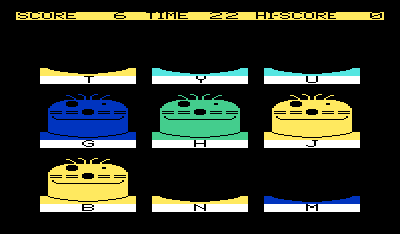
The action is built around a simple 3×3 set of holes and the immediately important difference between a mole’s head and its rear. That clear visual distinction matters more than decoration here: you need to identify the target correctly before committing to a key.
Story
There is no narrative detour between you and the score chase. You are not asked to learn characters or follow an escalating plot; the game’s entire drama comes from the rapidly shrinking minute.
That absence suits the format. A story would only slow down a game designed around instant recognition, quick punishment, and the urge to improve one number.
Its small place in arcade history is more interesting than any fictional setup. For release background, the Mole Attack history is worth a look after you have had a few attempts at the board.
Overall Experience
Mole Attack is best when treated like a quick reflex test you keep reopening because one sloppy hit spoiled the last score. The 60-second limit is a smart constraint: it keeps failures light, makes improvement easy to measure, and prevents the simple premise from overstaying its welcome in any single round.
Its age shows in how little sits around that core, but the core is solid. Learning the nine-key arrangement, spotting the dangerous target orientation, and deciding whether you can risk a faster response gives the game more bite than its basic setup suggests.
Give it a chance if you have patience for stark, early arcade design and like competing with your own previous result. The payoff is not a grand finale; it is the satisfying moment when the grid finally feels natural and you finish a minute knowing you reacted just a little better than before.


Reviews
There are no reviews yet.