 Retro Replay Retro Gaming History, Reviews & Emulation
Game Overview
Gameplay
The first hour has a strong hook: San Paro is open to drive around in, but its real purpose is to turn other people into your problem. A criminal robbery can call in Enforcers of comparable ability, putting both sides at similar distances from an objective. That simple structure makes a mission feel less like a canned multiplayer mode and more like an interruption in a city where somebody is always trying to get away with something.
The third-person shooting is built for street fights. You can aim more carefully and use the over-the-shoulder view to peek around corners, while regenerating health keeps a match moving instead of forcing a hunt for supplies. Criminals are looking to eliminate opponents; Enforcers can stun and arrest them for a bigger prestige reward, at the cost of taking criminals out longer. It is a smart asymmetry, because arresting someone feels more decisive than merely winning one firefight.
Teamwork is where APB starts to click. Assignments can be sent to a team leader for acceptance, and coordinated groups can handle multi-step objectives far better than scattered individuals. You can enter alone, but the game is plainly tilted toward organized play. Frustration sets in when you land with a weak group or face a disciplined enemy team: the same mission structure that makes a close contest exciting can make a one-sided loss feel merciless.
Its ranking system gives every performance some weight. Prestige or infamy rises and falls across five levels, and poor play, obstruction, or killing teammates can push it down. Reaching level 5 puts a bounty on your head and opens you to attacks from anyone on the server, faction aside. That is a terrific risk-reward idea: the best rewards arrive precisely when you become the most tempting target, and the status is unlikely to remain yours for long.
Progression is tied to completing missions and unlocking equipment through contacts rather than raising character stats in a conventional MMO ladder. New weapons, cars, clothing, and upgrades offer tangible goals, while higher-tier upgrades can alter health, speed, damage, or recoil. This makes the grind feel connected to the action, though it also means you need to keep competing if you want access to the more interesting tools. The original paid game-time model adds another layer of pressure; it is hard not to notice the clock when action-district access is sold by the hour or month.
Graphics
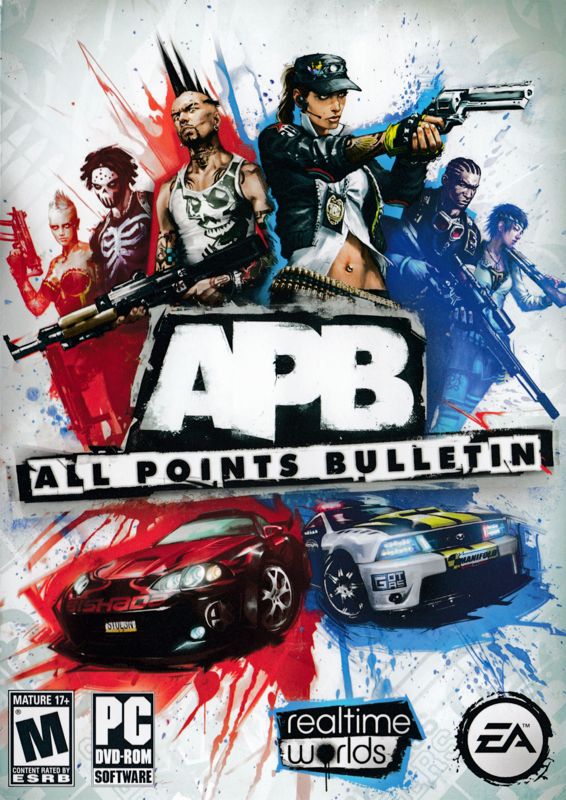
APB’s most distinctive sights are the people and cars other players have made. Characters can be shaped through facial features, age, makeup, body build, clothing, and tattoos, while vehicles support paint styles, decals, and attachments. In a game about chasing rivals through a city, spotting a customized car and recognizing its owner gives the streets some useful personality.
The behind-the-shoulder camera is also a practical fit for its urban gunfights, letting you watch corners while keeping your character and nearby vehicles in view. The customization carries much of the visual interest; the city is the stage for the player-made look of each confrontation.
Story
There is no authored campaign carrying you through San Paro. The basic fiction is deliberately broad: Criminals commit the crime, Enforcers respond, and both sides fight over the results. That puts the weight on the conflicts you create with other players rather than on named characters or predetermined plot turns.
The all-points-bulletin concept is the closest thing APB has to a story engine. A robbery or similar criminal act triggers a response, and a matched opposing group arrives to stop it. When the teams are evenly matched, you get a compact cops-and-robbers drama with a clear beginning, escalation, and outcome—even if nobody is delivering a speech about it.
Your character’s reputation provides the most personal thread. Rising toward a level-5 bounty turns you into a server-wide target, which can make a successful streak feel like a story other people are trying to end. If you need handcrafted missions and plot revelations, this will feel thin. If you enjoy making rivalries out of repeated multiplayer encounters, it has a sharper kind of narrative momentum.
Overall Experience
APB is at its best when it stops feeling like a checklist of objectives and becomes a messy, human chase. A team steals a lead, another team cuts them off, someone earns a bounty, and suddenly the district has an unscripted focal point. The mix of driving, shooting, faction duties, and heavy cosmetic ownership gives those moments more character than a standard arena shooter.
It is also a narrow recommendation. Free exploration exists, but the game’s content is PvP, and not every passerby can be attacked unless the assignment system has made them an opponent. That matchmaking rule prevents random interference from overwhelming missions, but it means the open city is not a lawless playground in the usual sense. Go in wanting competitive objectives, not a solo open-world adventure.
The strongest reason to try it is the chance to inhabit a custom-made criminal or Enforcer in a city shaped by other players’ decisions. The weakest is that the whole experience depends on matchmaking and group dynamics delivering fair, lively opposition. At its best, APB earns its 6.1 reputation as an inventive but uneven multiplayer experiment: a game with genuinely memorable emergent clashes, held back by how much it asks you to tolerate when those clashes are not going your way.


Reviews
There are no reviews yet.