 Retro Replay Retro Gaming History, Reviews & Emulation


Game Overview
Gameplay
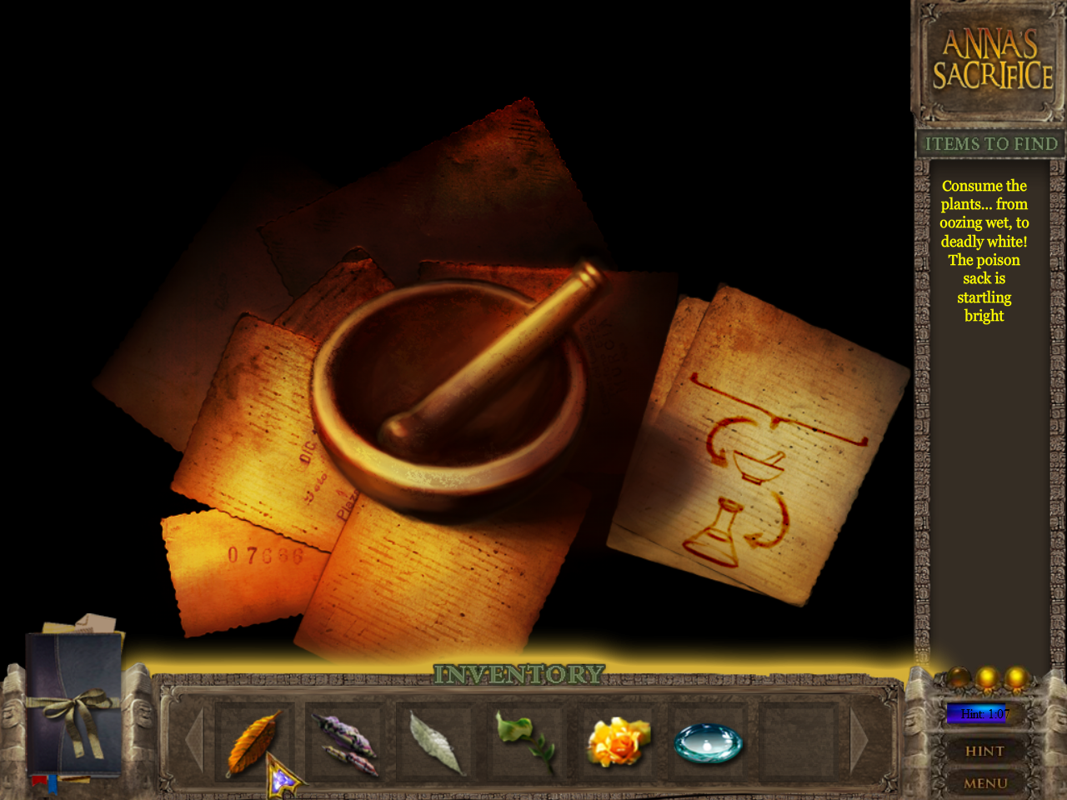
The first hour is immediately familiar if you have spent time with hidden-object games: arrive at a busy scene, scan the heaps of paraphernalia, and work through a list of items at the right of the screen. There is a modest pleasure in gradually training your eye to pick out a needed object from a crowded background. The game does not overcomplicate that loop, which can be welcome when you want a low-pressure evening mystery rather than an adventure game built around opaque logic.
Its variations matter because the basic searches can become a grind. Some scenes swap written item names for pictures, while others ask you to carry out a sequence of actions. That is a sensible change of pace, forcing you to look at the scene in a slightly different way instead of mechanically reading down a shopping list.
The separate mini-games are the stronger interruptions. Following twisted arrows across a snake drawing, using a magnifying glass to find symbols in a book, comparing an item with its photograph, and rebuilding a torn portrait all ask for different kinds of attention. None of this turns the game into a deep puzzle box, but the variety helps. Use hints when a scene has stopped being fun; the recharge delay prevents them from wiping away every challenge, yet avoids the worst hidden-object-game frustration of staring at one last item forever.
Graphics
The game is built around scenery crowded with scattered objects, so you will spend much of your time peering through dense arrangements of paraphernalia. Picture-based searches and the book-and-magnifying-glass puzzle give those objects a more direct visual role than a plain text list does.
Story
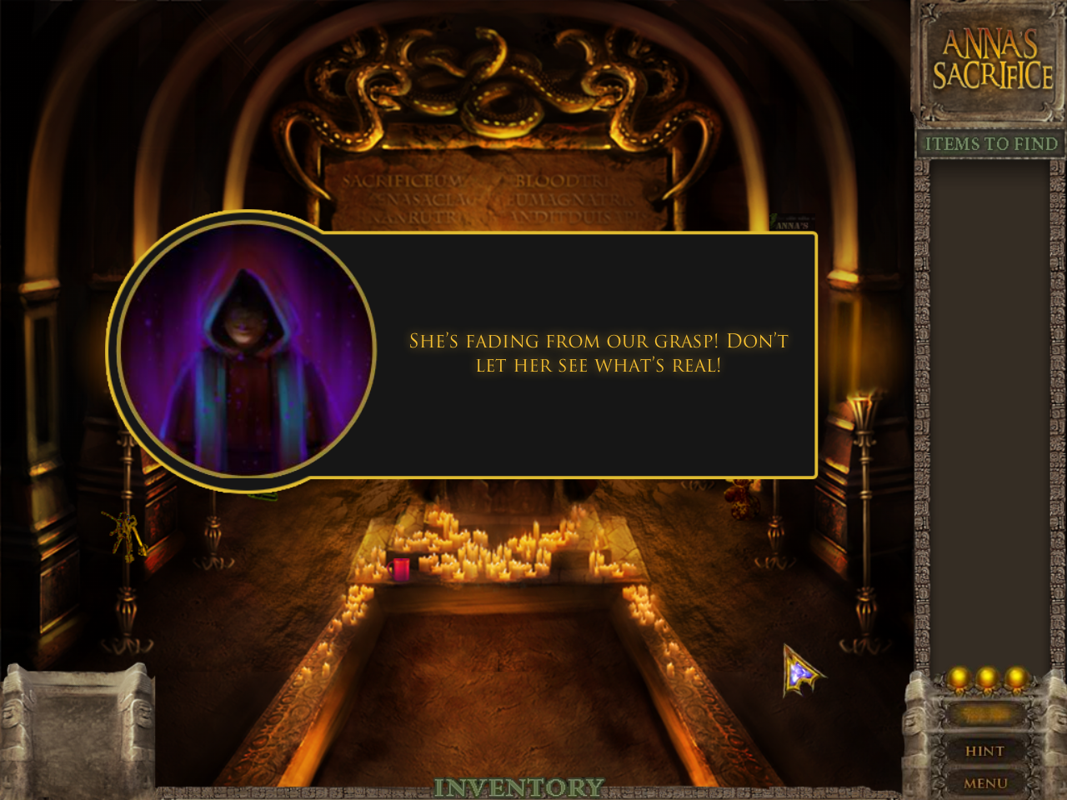
Anna’s personal stake gives the investigation more weight than a generic haunted-house premise. She writes about the dark sect her father once belonged to against his wishes, then has to reckon with his murder and recurring nightmares of cultists and rituals. That is solid horror-adventure material: the mystery is tied to family history, guilt, and a past somebody clearly wanted buried.
The investigation moves beyond a single location as Anna and two friends travel around the world looking into the cult. That broader search gives the story room to unfold as an inquiry rather than simply a series of spooky encounters. The strongest draw is not subtle horror but the urge to find out how Anna’s father, her nightmares, and the sect’s secrets connect.
Do not go in expecting the narrative to replace the object hunting; it is the thread pulling you from one search to the next. Still, the occult angle is a better fit for this format than a disconnected string of scenes. Each new clue has a clear reason to matter because Anna is digging into the danger surrounding her own family.
Overall Experience
Bloodline of the Fallen: Anna’s Sacrifice is a dependable genre piece with enough puzzle variety to keep its central scavenger-hunt loop from going completely stale. Its main limitation is also its promise: most of the experience is methodical searching through crowded scenes. If that rhythm relaxes you, the hints, picture searches, action lists, and mini-games make for a pleasant rotation.
The horror comes through its cult mystery and recurring nightmares rather than through demanding survival mechanics or action. That makes it a better pick for someone who wants an occult story without the pressure usually attached to horror games. You can settle in, investigate at your own pace, and let the next clue do the work of keeping you curious.
It will not convert anyone who already finds hidden-object lists tedious. But for genre regulars, especially those who enjoy family secrets and secret-society melodrama, Anna’s investigation has a worthwhile pull. The payoff is the steady unravelling of its mystery, supported by enough small diversions that the searches do not have to carry every minute alone.


Jade Handheld –
This sounds like a nice fit for short handheld sessions, especially with the picture searches and mini-games breaking up the standard item lists. I’d probably enjoy the family-cult mystery in small doses, but the crowded scenes and methodical searching could wear me down if I played for too long. The hint recharge sounds like a fair compromise: enough help to avoid pixel-hunting forever without removing the whole task.