 Retro Replay Retro Gaming History, Reviews & Emulation


Retro Replay Review
Gameplay
Bowlda Dash understands why Boulder Dash-style games remain so compelling. You enter a cave with a diamond quota and a time limit, then immediately start doing mental arithmetic: which gem is safe, which boulder will shift if you pass beneath it, and whether a detour around a monster costs more time than it saves. The first few moments of a level can feel almost calm. Then one careless move collapses your plan, and the cave suddenly looks much less friendly.
The obstacles give the game its bite. Boulders and complex formations demand patience, blocked passages force you to search for a workable route, and monsters and mucus prevent the caves from becoming simple collection exercises. Success comes from stopping long enough to understand the room, not from rushing at every visible diamond. That deliberate rhythm is satisfying when a route clicks, though the time pressure can make a failed attempt feel harsh.
Fifty levels is a solid amount of material for this kind of puzzle challenge, especially because the password system lets you return to a particular cave without treating the whole game as one uninterrupted marathon. The Ctrl command to take the nearest diamond is also a thoughtful little quality-of-life touch. It does not remove the need to plan; it just makes routine collection less fiddly.
Two people can play consecutively, which suits the game better than it might sound. Passing turns turns mistakes into conversation: you can watch the other person spot a route you missed, then try to outdo their score. The high-score table gives that competition a simple reason to continue after you have cleared a cave.
Graphics
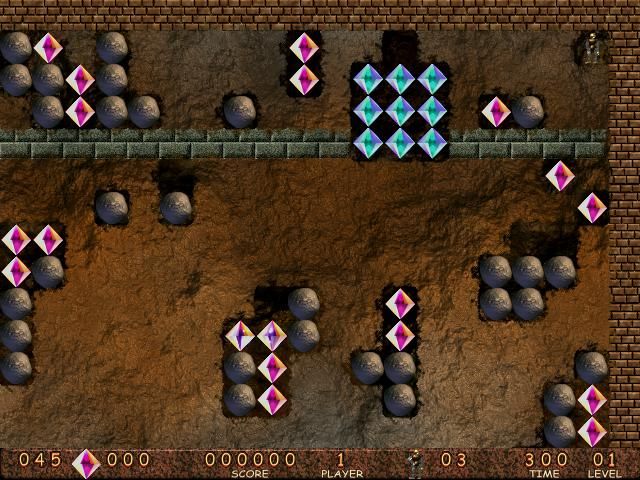
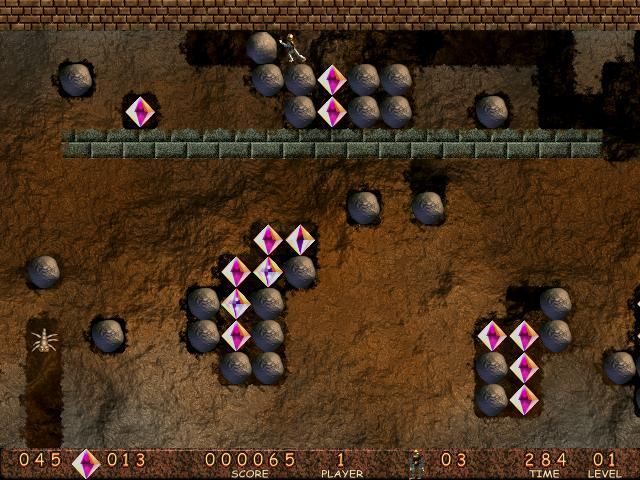
Bowlda Dash uses 2D scrolling cave play, with the action built around diamonds, boulders, monsters, and obstructed underground spaces. Its side-view and top-down elements keep the focus on navigating each cave and judging the hazards packed into it.
Story
Lou Verne’s journey beneath the Earth is framed as a tale he recounts after encountering treasures, horrors, and mysteries underground. It is a light premise, but it gives the succession of caves a bit more character than a bare sequence of puzzle boards.
Do not come in expecting an elaborate adventure narrative. The story mainly supplies the excuse for the descent and for the changing dangers Lou faces. In a game this focused on cave-by-cave survival, that is enough.
The stronger storytelling comes from your own run through a difficult chamber: the diamond you risked too early, the route that looked impossible until one boulder moved, and the last-second scramble to meet the quota before time expires. Lou Verne is the framing device; your decisions provide the drama.
Overall Experience
Bowlda Dash is a good fit when you want compact, demanding puzzle action with immediate consequences. Its best moments arrive when you survey a messy cave, resist the obvious route, and find the sequence that lets you collect enough diamonds without setting off a disaster. That kind of small-scale problem solving holds up well across a large level count.
It can frustrate you if you want loose, forgiving exploration. Time limits, hostile creatures, and boulder puzzles mean that experimentation has a cost, and the game asks for concentration rather than casual wandering. Still, the password system makes its challenge more manageable, while consecutive two-player turns and score chasing add replay value without complicating the core.
The selectable Audio CD tracks are an unusual bonus, letting you change the music during play. More importantly, the fundamentals are in place: clear goals, escalating cave hazards, and enough levels to reward anyone who enjoys learning a puzzle space one risky move at a time. It is not trying to transform the Boulder Dash formula, but it uses that formula well enough to earn a recommendation for genre fans.


Reviews
There are no reviews yet.