 Retro Replay Retro Gaming History, Reviews & Emulation
Retro Replay Review
Gameplay
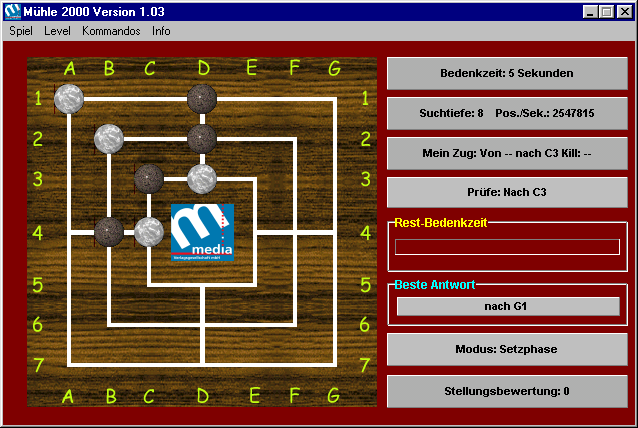
Computer Mühle starts quietly: an empty board, nine pieces each, and alternating placements on its 24 points. That opening is more important than it looks. You are not merely trying to complete a row of three; you are trying to place pieces so that later moves create two threats at once, while denying the same opportunities to your opponent.
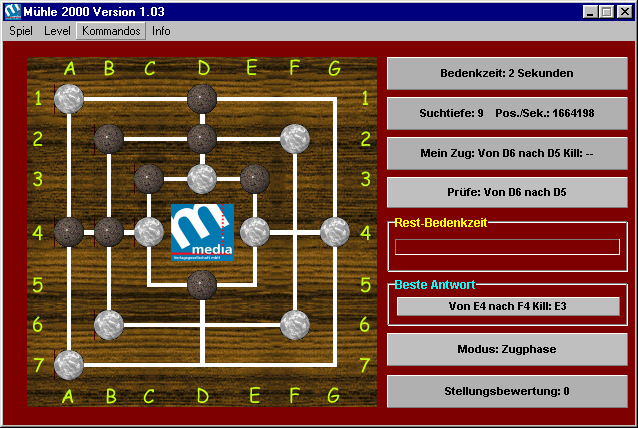
Once all 18 pieces are on the board, the game becomes much tighter. Pieces can only move to adjacent connected points, so an innocent-looking placement from several turns ago can leave you cramped, exposed, or unable to stop a mill. Forming a mill lets you remove an opposing piece, and the contest swings fast when one side starts losing material. The win conditions—reduce the opponent to two pieces or leave them unable to move—make every blocked route matter.
The jump phase is the rule that keeps a seemingly finished game alive. At three remaining pieces, a side can move to any open point rather than only an adjacent one. That can be thrilling when it lets you escape a trap or frustrating when the opponent repeatedly wriggles out of the position you thought you had sealed. It is faithful to the classic game’s back-and-forth, so patience matters as much as spotting a clever immediate move.
Thirteen difficulty levels give the computer opponent a useful range, especially if you are learning the board’s traps before challenging yourself. Voice output for the computer’s actions is a small but welcome touch in such a spare game: it keeps you aware of what happened without changing the deliberate, turn-by-turn pace.
Graphics
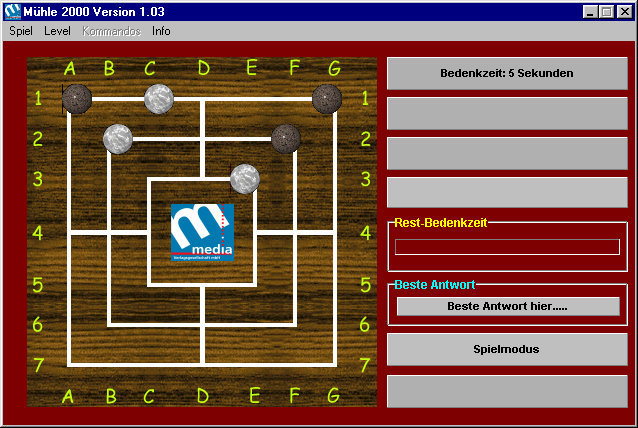
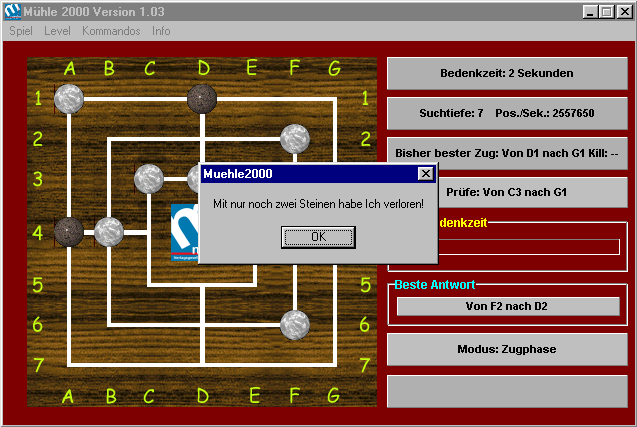
The view stays focused on the familiar Nine Men’s Morris board: three nested squares, connecting lines, and 24 nodes for the pieces. It is a fixed top-down board-game layout, and that is exactly what this game needs; you can quickly see open points, adjacent routes, and possible rows of three.
Story
There is no campaign or authored story here. Computer Mühle is a direct contest between you and the computer over a traditional board-game position.
Its drama comes from the changing state of the board. A mill that costs you one piece can turn a comfortable plan into a recovery job, while a blocked opponent can be as decisive as taking their pieces.
That lack of extra framing suits the game. You are here for the small grudges created by each captured piece and the satisfaction of finally seeing a route through a crowded board.
Overall Experience
Computer Mühle is strongest when you want a concentrated tactical game with almost no runway. The rules are easy to grasp, but the move phase rewards foresight, and the jump rule prevents you from assuming that a material lead automatically ends the match.
Its plainness is also its limitation. If you need a campaign, changing scenarios, or anything beyond repeated Nine Men’s Morris matches, this will feel narrow very quickly. But a straightforward version of a centuries-old board game does not need much ornament when the underlying duel is working.
Give it a chance if you like abstract turn-based games and want to learn or revisit Nine Men’s Morris against adjustable computer opposition. Start below the higher difficulty settings long enough to understand how often one exposed point can decide the entire board; then the tougher matches have a real bite.


Reviews
There are no reviews yet.