 Retro Replay Retro Gaming History, Reviews & Emulation
Retro Replay Review
Gameplay
The first few missions make a clear pitch: this is a third-person shooter where you need to do your own shooting, use cover intelligently, and stop treating every encounter as a race to empty a magazine. There is no auto-attack to smooth things over. When a fight goes well, it is because you and your group stayed alert, used the right abilities, and did not let the enemy dictate the engagement.
That emphasis makes the four-class structure more than a character-select screen. Each class comes with advantages and weaknesses, so a balanced group is central to success in both AI missions and player-versus-player fights. This can be genuinely rewarding once your regular squad learns how its roles fit together. It can also be the point where frustration sets in: a poorly assembled team is not merely less efficient, but a real handicap in a game built around coordinated action.
Progression gives the shooting a useful long-term hook. Completing matches earns experience for abilities, including weapons and technical devices, while money buys equipment. The class-bound nature of weapons and abilities keeps each role distinct, though it also limits experimentation if you hoped to freely build toward any combat style. Helmets and suits are a nice outlet for personal taste, but they are cosmetic rather than a hidden route to more power.
The agency-versus-agency mode is the most ambitious part of the package. Alliances contest a persistent map divided into zones and territories, build or destroy facilities, and manage the costs of holding what they own. Capture jobs expand influence; theft missions damage rivals without taking land. Daily taxes and rising operational costs mean expansion has consequences, turning territorial control into something your group has to sustain rather than casually collect.
Graphics
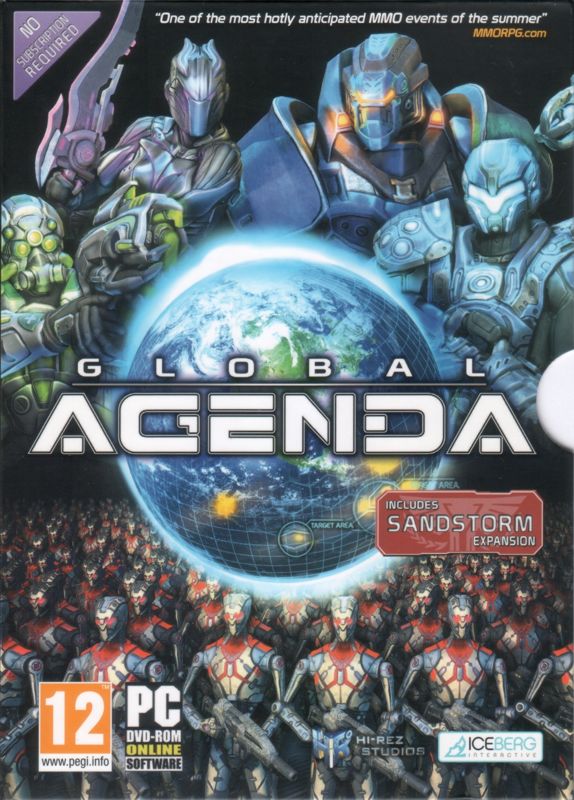
The third-person camera keeps the action focused on your high-tech agent and the cover around them, which suits combat that depends on manual aim and positioning. Cosmetic helmets and suits let squad members look different, even though that gear does not change their combat statistics.
Story
Set after World War III, Global Agenda sidesteps the usual wasteland angle for a conflict between the Commonwealth, an oppressive world government, and a rebel coalition of independent factions. That is a solid frame for a multiplayer action game: the world is damaged, but the fight has moved into organized, high-tech resistance rather than simple survival.
The faction divide gives the missions and PvP conflict a sense of political purpose, especially once agencies are competing over territory. Fighting for control of a zone means more when it belongs to an ongoing struggle instead of a disconnected match rotation.
Still, the story mostly functions as a setup for squad action and faction warfare. Come for the idea of joining a side in a postwar struggle, not for a densely authored single-player narrative. The real drama comes from whether your team can win the next engagement and protect what its alliance has claimed.
Overall Experience
Global Agenda is at its strongest when you approach it as a shooter that demands MMO-style teamwork rather than as a shooter with a few progression rewards bolted on. Landing shots and working cover remain important, but the bigger victories come from a party whose classes complement one another and whose members understand the objective.
The game’s persistent territorial mode adds a smart layer of responsibility to multiplayer competition. Facilities can defend territories or help break enemy defenses, and maintaining a growing network becomes increasingly expensive. That gives alliances reasons to plan, defend, raid, and occasionally choose restraint instead of treating every captured zone as a permanent trophy.
Its limitations are inseparable from its strengths. Class-defined weapons narrow your options, cosmetic armor will not transform a weak build, and success can depend heavily on having the right people beside you. But if you like shooters where your individual accuracy matters while coordinated group decisions matter even more, this is a worthwhile blend of action combat and faction-scale strategy. The 6.8 score fits: a capable, focused hybrid with a satisfying team-game core, even if it will not suit anyone seeking a flexible solo shooter.


Reviews
There are no reviews yet.