 Retro Replay Retro Gaming History, Reviews & Emulation


Retro Replay Review
Gameplay
Pippi begins with a simple but fitting goal: get through the door of Villa Villekulla and start exploring. Once inside, you move between the hall, kitchen, bureau, bedroom, and attic, looking for activities rather than pursuing a demanding adventure. That makes the opening immediately approachable for young children; there is no intimidating pile of rules between them and Pippi’s house.
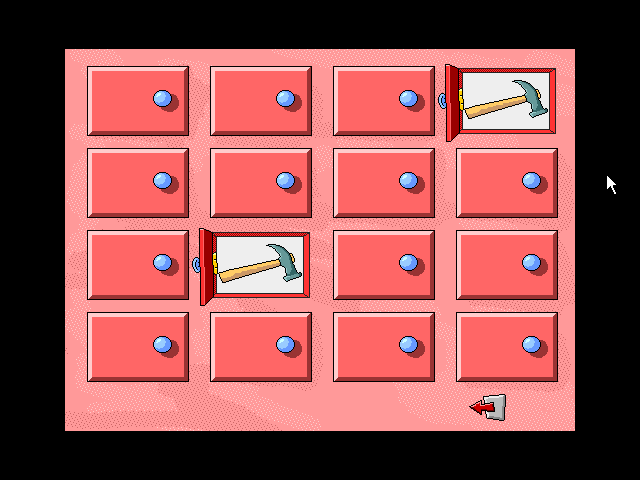
The puzzle selection is built around familiar early-computer activity staples, including jigsaws and memory challenges. These are easy to understand, which is exactly the point for the intended age group. A child can settle into a task without needing much explanation, though the trade-off is that an experienced player will quickly recognize how limited the challenge is.
The house gives the activities a nicer frame than a bare menu would. You are not just picking a puzzle from a list; you are visiting rooms in Pippi’s world and finding something to do there. Still, this is a short-form activity game, not a sprawling exploration game. It works best in brief sessions, with an adult nearby if needed, rather than as something that will hold a child’s attention for an entire afternoon.
Graphics
The game keeps its on-screen world centered on Villa Villekulla’s rooms—the hall, kitchen, bureau, bedroom, and attic—so children can connect each stop with a recognizable place in Pippi’s home. That room-by-room structure is a sensible fit for a game aimed at introducing her world.

Story
Pippi has a ready-made advantage: Astrid Lindgren’s famously independent heroine is already an inviting guide for children. The game does not need to manufacture a complicated conflict when the draw is simply spending time around Villa Villekulla, Pippi, her horse, and Mr. Nilsson.
The more substantial story material sits in the book activity. You can choose from three books and begin reading their stories on screen, making this less like a conventional narrative game and more like an interactive doorway into the source material.
The option to turn screen text on or off is particularly useful. It lets the books function either as shared reading material or as something a child can browse with less pressure. The twelve language choices are also a meaningful strength here, especially for families using Pippi as a reading or language-learning companion.
Overall Experience
Pippi understands its audience. It is gentle, simple, and rooted in a character children may already love, with puzzles that ask for recognition and patience rather than mastery. For a young Pippi fan, entering Villa Villekulla and moving from room to room is likely enough to create a little spark of ownership.
That simplicity also defines its limits. The jigsaw and memory activities are familiar rather than surprising, and the game’s small set of rooms and activities does not suggest much lasting depth once their novelty fades. If you are buying for yourself as an adult, nostalgia for Pippi will need to do most of the work.
As a children’s educational title, though, it has a clear niche. Give it a chance if you want a calm, low-stakes Pippi Longstocking activity collection with reading built into it, particularly for a younger child. Skip it if you want an involved puzzle adventure or a full retelling of Pippi’s stories.



Reviews
There are no reviews yet.