 Retro Replay Retro Gaming History, Reviews & Emulation


Retro Replay Review
Gameplay
Timmy and the Magic Pictures has the right instinct for a children’s educational game: get to the activity quickly, then keep changing the kind of thinking it asks for. Timmy discovers that the pictures on his bedroom wall can come to life, and that framing leads into labyrinths, matching games, jigsaw puzzles, reading-oriented activities, and a xylophone. For a young child, that variety matters. A maze can hold attention for one session, while a puzzle or music activity offers a different reason to come back next time.
The first hour is likely to work best as shared play. You can guide a child through the instructions, see which kinds of challenges catch their interest, and let the playful picture-world premise smooth over the fact that the game is building reading and thinking skills. Nothing in the setup suggests a deep adventure game; the educational activities are the point, and the storybook wrapper is there to make them inviting.
Three levels of play are a meaningful inclusion for this sort of game. Starting low lets younger children learn the rhythm of the activities without immediately running into a wall, while higher settings give the same collection some room to grow. The language options are equally practical. Still, the format will test a child’s patience if they want one long, connected quest rather than a sequence of self-contained challenges. This is a game to play in short bursts, not to disappear into for an afternoon.
Graphics
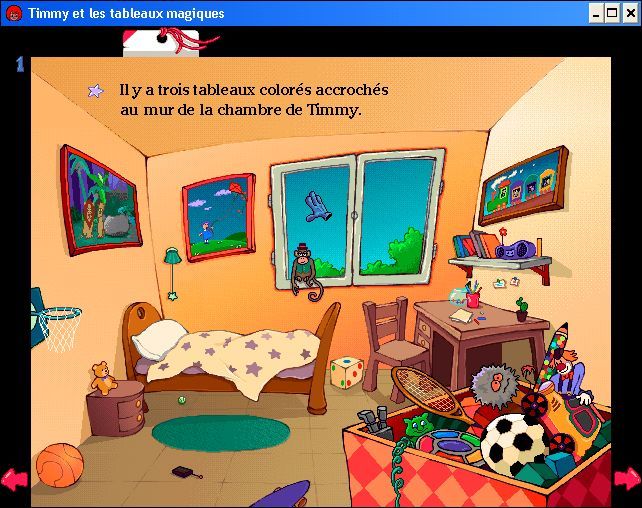
The clearest image is a child-friendly one: Timmy in his bedroom, with wall pictures that spring into life. That is a warm, easy-to-grasp visual starting point for young players, and it fits the interactive-story format better than a dry worksheet-style lesson would.
Story
The story is deliberately slight, but it has a useful spark. A bedroom wall becoming magical is exactly the kind of idea that makes ordinary learning exercises feel like part of a child’s own imaginative space. Timmy does not need an elaborate plot when the real purpose is to introduce the next game or activity.
As the second Timmy interactive story, following Timmy’s Sea Adventure, it seems designed to extend a familiar child-focused format rather than radically change it. That is a sensible choice for its audience. Young children often respond well to recognizable characters and a dependable structure, especially when they are still gaining confidence with reading and problem-solving.
Adults should judge the story on those modest terms. It creates a gentle reason to explore the activities, but the payoff is not narrative drama or a memorable mystery. The payoff is that the magical premise may make a child more willing to sit with a maze, a matching task, or a word-focused exercise.
Overall Experience
Timmy and the Magic Pictures is a focused educational game with a pleasant central idea and a sensible spread of activities. The xylophone is a particularly welcome change of pace beside logic and reading tasks, because it gives children something playful to do when they need a break from solving. Turning background music on or off is also a small but considerate option for homes where sound can become distracting.
Its limits are tied to its strengths. You are getting a guided set of early-learning minigames, not a sprawling puzzle adventure, and older or more experienced children may exhaust the challenge quickly. But for its intended age range, the mix of puzzles, reading practice, and simple music play sounds thoughtfully chosen rather than randomly bundled together.
Give it a chance if you want screen time that is structured, gentle, and easy to tailor with difficulty and language settings. It is best suited to a child who enjoys small goals and benefits from an adult nearby at first. The magic-picture framing will not transform every exercise into a thrill, but it gives the game enough charm to make its educational purpose feel less like work.


Reviews
There are no reviews yet.