 Retro Replay Retro Replay gaming reviews, news, emulation, geek stuff and more!
Retro Replay Review
Gameplay
The first few minutes are immediately understandable: connect adjacent letters, make a word, clear those tiles, and keep the hexagonal field from becoming a mess. The hex layout is the key. It creates more possible paths than a square grid, so you regularly spot a word, then notice a better route through the same cluster that uses more letters or picks up a useful tile. That makes each clear feel less like simple word hunting and more like board management.
Classic mode supplies the cleanest version of that tension. New letters keep falling while you work toward adding enough honey to a drop and sending it down to finish the level. It asks you to stay calm under pressure, but it also rewards looking beyond the first short word you see. Bonus words and length goals can trigger bigger rewards, so settling for easy three-letter clears may keep you alive while leaving valuable opportunities behind. The faster bonus rounds are a pointed test of whether your word recognition holds up once the board stops being polite.
Strategy mode is a welcome change of pace because it removes the clock. Starting from a full field, with a letter quota and limited number of words, turns every selection into a small optimization problem. You can take your time tracing long chains and deciding whether one ambitious word is worth sacrificing several practical clears. If Classic makes you quick, Strategy asks you to be clever.
Challenge mode gives the formula its sharpest competitive edge. Your words drop honey on the opposing hive, while rocks clog possibilities, bombs clear nearby letters, and pink tiles help push honey toward the opponent. Winning by filling the other hive before yours fills adds a tangible purpose to each word, and the eleven rounds build toward tougher AI opponents. This is the mode to choose when you want the game to push back rather than simply present another board.
Graphics
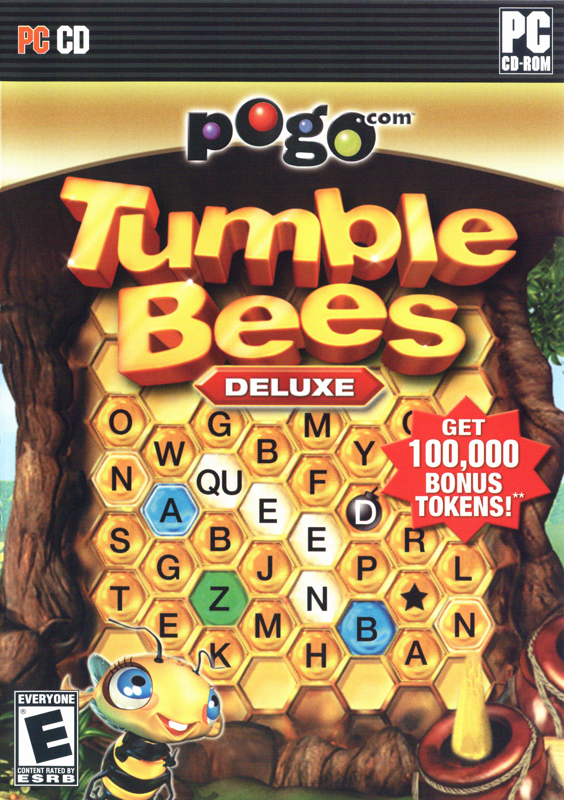
The game is built around a side-view hive framing a hexagonal letter field. The important pieces are easy to distinguish in play: ordinary letter tiles, colored bonus letters, stars, rocks, bombs, and pink tiles all have clear jobs on the board, while the falling honey gives Classic and Challenge a visible objective to work toward.
Story
There is no sweeping plot pulling you through Tumble Bees Deluxe. Its theme is a light honey-and-hive wrapper for the puzzles: make words, build or drop honey, and prevent your own hive from filling.
That simplicity suits the format. Classic uses honey drops as level progress, while Challenge turns the same idea into an attack on an AI opponent. The game does not need more narrative baggage when the board itself is constantly asking for your attention.
If you want character-driven context or a campaign with story turns, this will feel thin. If you are happy with a theme that gives the objectives a little flavor without slowing down the next puzzle, it does its job neatly.
Overall Experience
Tumble Bees Deluxe succeeds because its two halves genuinely improve one another. A word game can become passive when you have unlimited time to scan for answers, and a falling-tile game can become mechanical when every match is obvious. Here, the growing field makes vocabulary matter under pressure, while the word-building gives you more agency than simply rotating and dropping shapes.
The extra modes are not filler. Classic is the best fit for quick, escalating sessions, Strategy is ideal when you want to puzzle over one packed board at your own pace, and Challenge gives repeat play a more aggressive target. The offline, ad-free Deluxe package also fits a game designed for short bursts of concentrated play.
Frustration will set in if your word recall is slow or if you prefer word games that let you leisurely examine the board. The time pressure in Classic and the stronger AI later in Challenge are meant to make you scramble. But if that combination of language skill, spatial planning, and rising clutter sounds appealing, the payoff is a brisk puzzle game with more bite than its cheerful bee theme suggests.
Give it a chance if you enjoy finding words under pressure and want more to consider than a basic letter grid. Strategy mode also makes it worthwhile for anyone who prefers deliberate planning over a timer. It is a focused design rather than a sprawling one, and that focus is exactly why it remains satisfying.


Reviews
There are no reviews yet.