 Retro Replay Retro Gaming History, Reviews & Emulation


Retro Replay Review
Gameplay
The first hour of WW2: Time of Wrath is about getting your bearings across a 20 km hex map, then realizing that its basic demands are pleasantly plainspoken. Cities and resources produce the points that fund your war effort; those points become units or research; units move, attack, and try to take more cities. For a game covering so much territory and potentially running through 1948, that clarity is a genuine strength. You can get into the strategic rhythm quickly rather than spending an evening deciphering a mountain of specialized subsystems.
That simplicity does not mean your decisions are trivial. Production points create a persistent tension between expanding the army you need now and investing in research for the longer fight. Taking cities matters both for what they contribute to your position and for the Victory Points that decide a full-length campaign. The result is a game that repeatedly asks you to turn battlefield momentum into a wider economic advantage, not merely win the next exchange.
The campaign selection is one of the best reasons to return. The 1939 Grand Campaign offers the long haul, while Fall Gelb, Barbarossa, and Gotterdammerung let you enter the war at distinctly different stages. Fall Weiss and Overlord provide shorter ways to learn the flow before committing to a massive game, and the tutorial is worth using if hex-based WWII strategy is new to you. Being able to choose among 35 countries across Axis, Allied, and Comintern alignments also gives the map more range than a fixed two-side conflict.
Frustration can set in if you want every turn to feel like a cinematic battlefield puzzle. Time of Wrath is fundamentally concerned with territorial control, resources, production, and the slow conversion of captured ground into victory. Diplomatic actions and occasional historical choices, including land cessions, add variation, but they do not change the central discipline: plan your expansion, protect your valuable cities, and avoid falling behind in the economic war. Defeat can end a campaign early, so careless early commitments have consequences.

Graphics
The view is a top-down field of tightly packed hexes covering the European, Middle Eastern, and North African theaters. Unit icons, borders, and visibility range can all be customized, which is more useful than decorative when you are staring at a long front and want the map arranged in a way that makes sense to you.
It is a practical wargame map rather than a character-driven WWII spectacle. The visual pleasure comes from seeing fronts spread across the board and from tailoring the icons and borders to make your own campaign easier to parse.

Story
There is no single authored personal story pulling you from mission to mission. Instead, Time of Wrath uses the familiar arc of World War II as its framework, beginning at several key points between 1939 and 1944 and allowing the conflict to continue as late as 1948. That gives the campaigns a strong historical shape without forcing every game down one exact route.
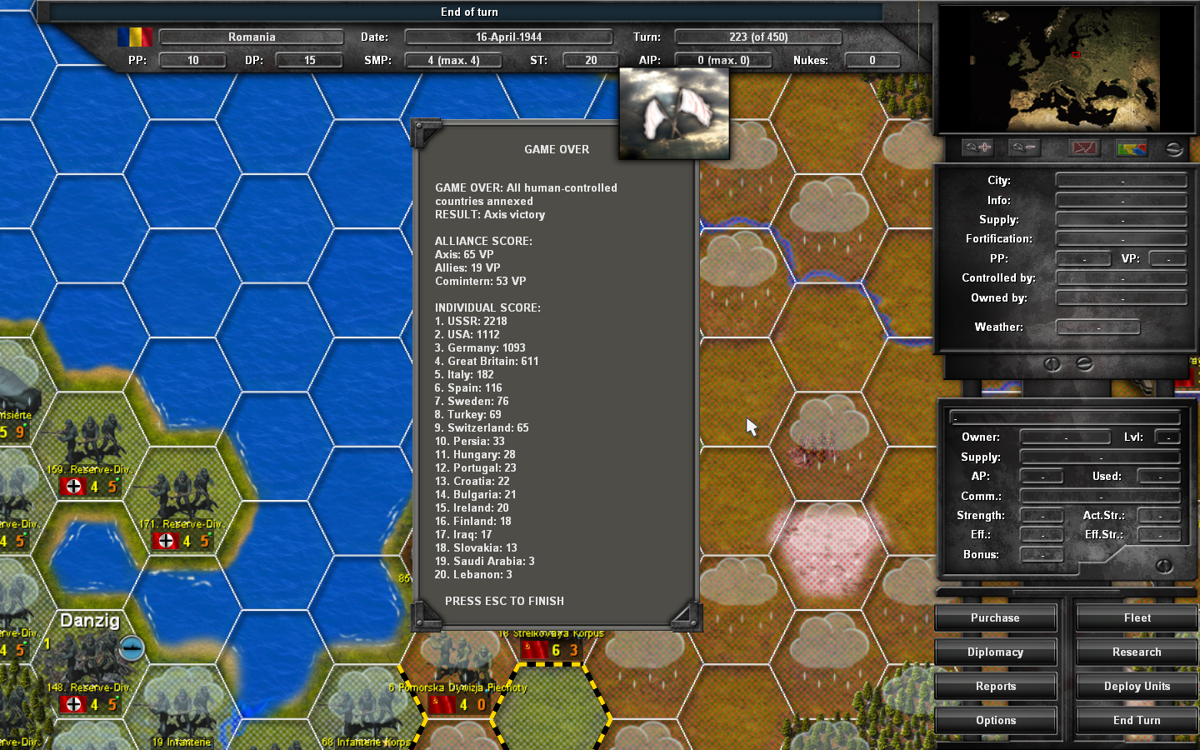
The most engaging narrative is the one you produce through the map. A city taken at the right time can change your economy and your score; a failed offensive can leave a country defeated and end its human-controlled campaign. The war becomes a record of accumulating decisions, where the border lines tell you whether your grand plan is working.
Historical decisions such as land cessions give the setting occasional moments of specific flavor, but this is not a game for anyone looking for deeply written characters or elaborate scenes between battles. Come for alternate military outcomes and the tension of reshaping a known conflict, not for a dramatic retelling of individual events.
Overall Experience
WW2: Time of Wrath earns its name by making the conflict feel broad and persistent without making its fundamentals obscure. The city-production-research loop is easy to understand, and that accessibility is valuable in a strategy game with a map this large. Once the turns begin to stack up, you start thinking less about a single attack and more about whether a campaign of conquest is financing itself.
Its biggest limitation is also its defining preference: it treats WWII chiefly as a contest for cities, resources, and Victory Points. If you want elaborate narrative context or a battle-by-battle simulation packed with exceptions, it may feel dry. If you enjoy looking at a strategic map, setting priorities, and accepting that the right investment now may not pay off for many turns, the leaner structure is refreshing.
Give it a chance if you want an approachable, long-form turn-based WWII strategy game with multiple historical starting points and plenty of national perspectives. Start with a short scenario or the tutorial, then move into the Grand Campaign once the production economy clicks. The payoff is not a flashy climax; it is the quiet satisfaction of watching a plan survive the long war.



Reviews
There are no reviews yet.