 Retro Replay Retro Gaming History, Reviews & Emulation
Retro Replay Review
Gameplay
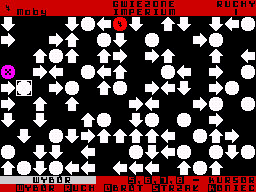
The first few turns of Gwiezdne Imperium can feel almost disarmingly simple. You begin with one colored planet while white, neutral planets and fleets surround you. Then the board starts asking sharper questions: do you spend an action creating a fleet, move one into position, rotate it for a capture, or remove an enemy arrow before it gets a line on something important? Because your number of actions rises with every planet you control, early expansion matters immediately.
What makes the game more interesting than a straightforward land grab is that direction is everything. A fleet takes over a planet or another fleet by pointing at it, while neighboring fleets and planets can destroy fleets. You are not merely counting units; you are managing where every arrow faces and what it leaves exposed. A fleet that looks safely positioned can be captured by a neutral fleet unless you keep one of your own pointed at the threatened space. That rule gives the neutral pieces real teeth instead of leaving them as passive map furniture.
The best tactical wrinkle is the way competing claims cancel each other out. When two sides point at the same object, it becomes neutral. This creates useful defensive plays and nasty reversals, since you can deny an opponent a clean capture even when you cannot claim the piece yourself. It also means the board state can change quickly after a few rotations and moves. If you enjoy turn-based games where a small positional mistake has consequences, that volatility is the point.
Frustration can set in if you want a gentler route into strategy. The rules are compact, but they demand attention to several adjacent squares and facing directions at once. A growing empire brings more actions, yet it also gives you more pieces to protect from white fleets and rival claims. Still, the game has a strong core: every action has a purpose, and victory—being the last side with any planets—keeps the objective clean.
Graphics
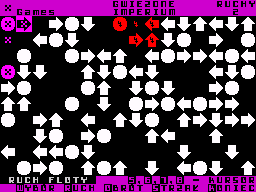
The board is built from square tiles occupied by planets, directional fleet arrows, or empty space. Colored planets identify the competing sides, while neutral planets and fleets are white, so the important information is visible directly on the map. The fleet arrows are especially important because their facing is the heart of combat and capture.
Story
There is no character-driven campaign pulling you from battle to battle here. Gwiezdne Imperium frames its conflict as an interstellar struggle for planets, then leaves the drama to the positions you create on the board.
That spare setup fits the game’s competitive nature. A neutral fleet suddenly threatening one of your worlds can feel like a crisis without any need for written plot, while a contested planet becoming neutral produces its own little story of two sides denying each other the prize.
As a result, the narrative payoff is entirely emergent. You will remember a match because you held a crucial planet under pressure or turned an opponent’s capture into a neutral piece, not because the game delivers a scripted space saga.
Overall Experience
Gwiezdne Imperium is a focused board-strategy design that gets a lot out of planets, fleets, and directional arrows. Its turn structure rewards expansion, but its capture rules make overextension dangerous. The game is at its strongest when you and an opponent are both trying to establish pointing control over the same few critical tiles.
Give it a chance if you like abstract turn-based contests with direct interaction and little wasted motion. The sci-fi setting is a clean wrapper for a game of angles, neighboring threats, and territorial survival. You do not need a huge ruleset to find depth here; you need the patience to read the board before committing an action.
The payoff is worth it for gamers who enjoy tactical games that punish casual moves and reward foresight. It will not suit anyone looking for elaborate world-building or a long solo adventure, but as a two-or-more-player struggle for board control, it has a crisp, occasionally ruthless charm.


Reviews
There are no reviews yet.