 Retro Replay Retro Gaming History, Reviews & Emulation
Retro Replay Review
Gameplay
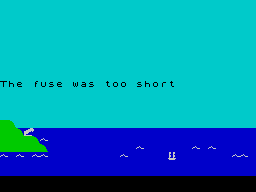
The opening battery duel is the strongest reason to try Privateer. You enter an elevation and a delayed-fuse setting, fire, then watch the projectile’s path reveal exactly how wrong—or nearly right—you were. A shell can burst harmlessly in mid-air, fall short, or explode high over the target. Once you land close enough to alert the battery, the situation turns nasty: it fires back, and the fight becomes a turn-based race to correct your numbers before it finishes your gunboat.
That makes the first stage more than a target-practice screen. You have to read each miss and make a useful adjustment rather than blindly throwing numbers at the problem. The randomly placed boat prevents a single memorized answer from carrying every attempt, while the three difficulty levels give the compact design some room to grow. If you enjoy working out an old artillery game’s logic through observation, this is where Privateer clicks.
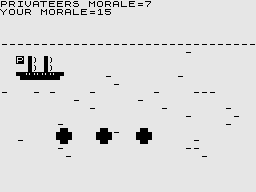
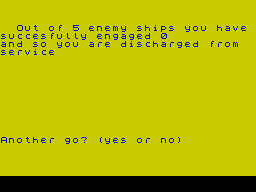
Stage two trades calculation for movement. Your red gunboat must use the arrow keys to get close to each privateer and remain in range for two or three seconds; ramming or simply catching up does not count. Wind changes from encounter to encounter, so the five chases cannot be handled as one repeated maneuver. The penalty is severe, though: fail to catch even one privateer and your captain is dismissed, ending the game.
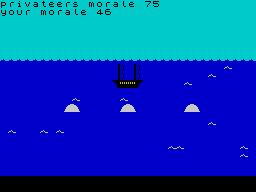
The final duel is deliberately uncomfortable. The privateer begins hitting your boat almost at once, while you must wait for first mate Mr Bush to report that the guns are ready. Only then can you aim with keys 1 through 9 and answer its fire. That wait gives the last stage a sharp sense of vulnerability, but it also means success depends on keeping calm after the earlier stages have already demanded precision.
Graphics
The visuals are spare but clear. The first stage frames a light blue sky above a dark blue sea, with the French battery perched on a cliff at the left; it is a simple image that makes the shell’s visible arc easy to judge. Later screens reduce the chase to your red ship at the top and privateers moving along the bottom, then place the enemy privateer on the horizon for the final exchange.

Story
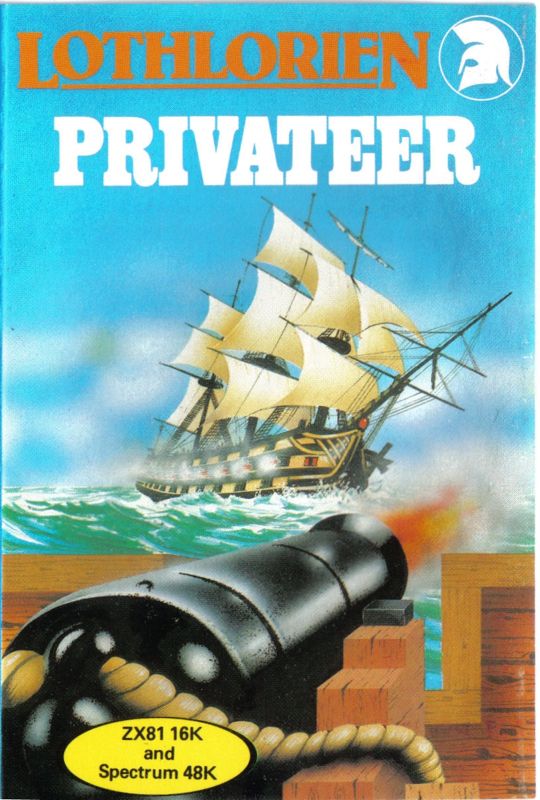
You are not cast as a privateer but as the captain of a British gunboat sent to hunt and sink them. That reversal gives the game a focused military objective from the moment the shore battery blocks your route.
The opening position is tied to Jutland, overlooking the passage between the Baltic and North Seas, where a French gun battery stands in the way. It is a thin historical frame, yet it explains why the first task is not pursuit but bombardment.
From there, the story is carried by escalation rather than character drama: silence the battery, close on five privateers, then endure a direct fight. Mr Bush’s readiness call is the one personal touch in the final stage, and it matters because it marks the instant you can stop absorbing hits and finally retaliate.
Overall Experience
Privateer is a small, demanding naval game built around three very different forms of pressure. Its best moments come when you turn a near miss into a corrected artillery shot, or hold your ship just close enough to a moving privateer without colliding with it. Each stage has a clear purpose, so the changes in play feel like a progression rather than a grab bag.
The friction is real. The game asks for careful numeric experimentation, controlled positioning under changing wind, and patience while an enemy shoots first. More punishing still, a loss can send you back to stage one or end the game outright. That structure will frustrate anyone who wants a forgiving arcade chase.
Give it a chance if you enjoy concise ZX Spectrum challenges that make every attempt count. The payoff is not a long campaign but the satisfaction of mastering a sequence that initially feels hostile: judge the fuse, manage the pursuit, wait for the guns, and make your return shot matter.


Reviews
There are no reviews yet.