 Retro Replay Retro Gaming History, Reviews & Emulation
PEOPLE IN EMULATION
Nobuaki Andou
Role: Emulator programmer and developer of ROM-dumping and cartridge-analysis tools

Biography
Nobuaki Andou occupies an unusually important but poorly photographed corner of early video game emulation history. He is the programmer behind Pasofami, a Famicom/NES emulator project whose surviving history stretches from an early FM TOWNS-era artifact into a long-running Windows shareware program, ROM-dumping tools and hardware services. Unlike several early emulator authors whose projects vanished after a handful of experimental builds, Andou continued developing the Pasofami ecosystem for years, eventually treating emulation, cartridge dumping, disk handling, ROM analysis and hardware adapters as parts of the same larger problem.The difficulty is that Pasofami's earliest chronology is not perfectly clean. Preservation-oriented histories report an FM TOWNS package carrying a May 1, 1993 date, while Andou's own later official Pasofami retrospective says the program “debuted” in 1995 as a domestically produced Famicom emulator. Rather than forcing those statements into a false certainty, Retro Replay treats them as evidence of different stages in the same lineage: an earlier FM TOWNS-era branch or predecessor preserved by collectors, followed by the much better documented Windows-era Pasofami product Andou himself remembered as the public debut.Role: Emulator programmer and developer of ROM-dumping and cartridge-analysis tools
Best known for: Pasofami, one of the earliest documented Famicom/NES emulator lineages
Earliest preserved milestone: An FM TOWNS Pasofami package is widely reported with a May 1, 1993 date
Developer's own public chronology: Andou's later official site describes Pasofami as debuting in 1995
Why he matters: Pasofami helped establish early NES ROM-image conventions and grew into a broader preservation workflow connecting emulator software with physical cartridge and disk dumping.
Before the Windows Emulator Boom
To understand why Pasofami matters, it helps to return to the Japanese computer environment in which the earliest artifact survives. Fujitsu's FM TOWNS was far more expensive and multimedia-oriented than a typical game console. It combined an x86-family processor with advanced graphics, CD-ROM hardware and a software environment capable of supporting technical experiments that would have been difficult on lower-end personal computers. It had already hosted Haruhisa Udagawa's Family Computer Emulator, making the machine part of a small but significant Japanese tradition of trying to reproduce Famicom behavior in software.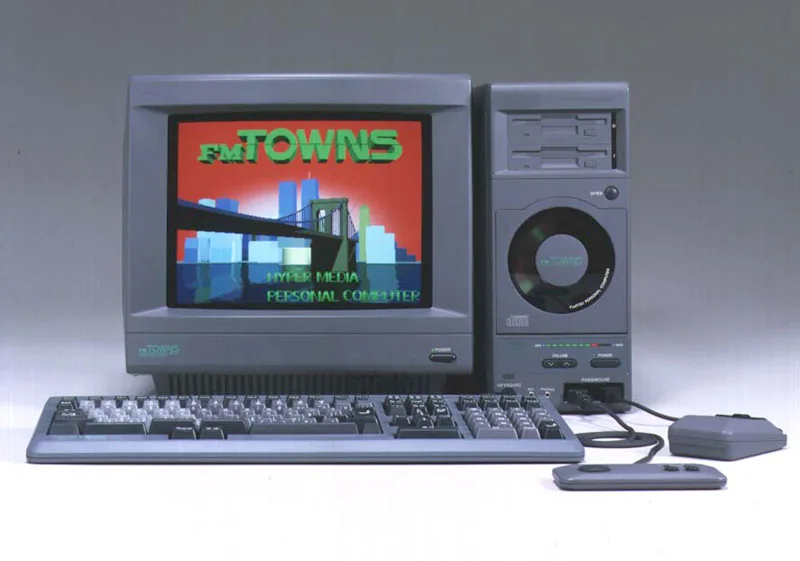
The Chronology Problem Is Part of the History
Early emulator history often tempts writers into choosing the cleanest date and moving on. Software does not always cooperate. A filename timestamp can survive after the original release note disappears. A developer can later remember the beginning of a project from the point at which it reached a meaningful public audience rather than the first internal or platform-specific build. A program can be rewritten for another operating system while keeping the same name. In Pasofami's case, all of those possibilities matter because the FM TOWNS artifact and the official 1995 retrospective both exist.The cautious historical conclusion is therefore stronger than a dramatic but brittle claim. A Pasofami-associated Famicom emulator existed in the FM TOWNS preservation record by 1993, and the Windows-era Pasofami line was publicly established by 1995 according to its own author. The exact continuity between every early build remains less documented than the later shareware years. Saying that openly makes the history more useful, not less.Pasofami Had to Understand the Cartridge, Not Just the Console
The Famicom looked like one machine from the outside, but by the early 1990s its software library depended on a growing variety of cartridge boards. Games could include mapper circuitry that switched program or graphics banks, changed mirroring, provided additional RAM or added other hardware behavior. An emulator that reproduced only the console's base CPU and graphics hardware would therefore fail on a large portion of the library.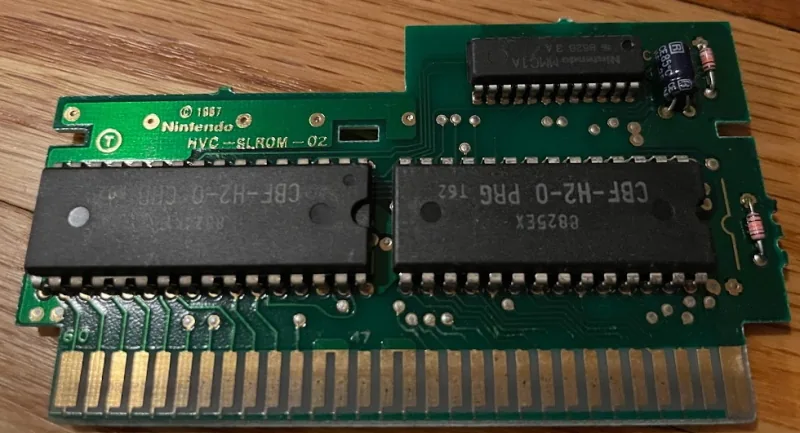
.nes file familiar to later users, the Pasofami ecosystem used separate .PRG, .CHR and .PRM files. The program file contained CPU-visible program ROM, the character file held graphics ROM when present, and the parameter file described information needed to interpret the cartridge. Later iNES conversion documentation explicitly compares the role of the PRM file with the metadata stored in the iNES header.This is one reason Andou's work matters even to people who never used Pasofami. A ROM format is a model of the physical cartridge. Deciding which bytes belong in which file and which hardware facts must be represented as metadata forces an emulator author to define what the software object actually is. Pasofami's answer was eventually displaced by more convenient standards, but later tools still preserve knowledge of it.
The PRG, CHR and PRM Format Outlived the Emulator's Early Era
The Pasofami format survived long enough to become a compatibility target in its own right. The uCON64 documentation still includes explicit options for joining Pasofami split images into iNES files and splitting iNES images back into Pasofami-style PRG, CHR and PRM components. That kind of support is a small but telling form of preservation. Even after another format becomes dominant, old dumps and archives continue to exist, so new tools need to understand the conventions used by older software.This is how infrastructure accumulates around emulation. One developer creates a format to solve an immediate problem. Other programmers write converters because users already have files in that format. Documentation survives because somebody needs to understand the conversion. Decades later, the old format becomes evidence of how emulator authors once conceptualized the hardware.From Emulator to ROM-Dumping Ecosystem
Pasofami did not remain only a program that consumed ROM images. Andou's later website documents a much broader set of tools for obtaining and working with the data in the first place. The surviving Pasofami operating manual includes cartridge ROM dumping, battery-data handling, NES-file creation, Famicom Disk System operations and other functions that blur the boundary between emulator, archival utility and hardware interface.That expansion makes historical sense. In the early days of emulation, there was no universal inexpensive cartridge dumper sitting beside every hobbyist's PC. If users wanted to run software they physically owned, somebody had to solve the electrical and protocol problems involved in reading those cartridges. Andou increasingly treated that task as part of the Pasofami ecosystem rather than as somebody else's responsibility.His official site eventually documented a USB-connected dumping system and adapters for numerous machines. The ROM-dumper service page describes a PIC32-based USB unit whose adapters could be changed for different game systems. Other pages and update notes show support extending far beyond the Famicom toward systems such as Nintendo 64, Game Boy-family hardware, Sega machines, WonderSwan, Neo Geo Pocket and MSX cartridges.
Twenty Thousand Adapters and a Long Shareware Life
One of the most striking claims on Andou's official retrospective concerns the scale of the dumping-hardware service. In the notice marking the project's long life, he wrote that by January 2013 the service had produced more than 20,000 adapters. That number comes from the developer's own site and should be understood as his reported figure rather than an independently audited sales total, but it demonstrates that Pasofami had become much more than an obscure emulator remembered only by historians.The same notice emphasizes another unusual feature of Andou's career: persistence. He contrasted Pasofami with many free emulators that had appeared and then ceased development, pointing instead to years of updates and expanded functionality. The software remained shareware, and its registration model became part of the way Western emulator communities talked about it, especially once free NES emulators became common. Yet from Andou's perspective, paid registration was tied to continuing support, updates and the physical-dumping ecosystem that grew around the software.Pasofami in the Windows Emulation Scene
By the middle of the 1990s, Pasofami was far more visible as a Windows emulator than as an FM TOWNS curiosity. Contemporary archive pages such as Archaic Ruins' NES emulator listings preserve Windows Pasofami releases from 1996 and 1997, while period sites such as NES World documented conversion utilities, compatibility discussion and English-language interest in a program whose primary interface and documentation were Japanese.The Windows versions existed in a rapidly changing competitive environment. Faster PCs and widespread Internet access were turning emulation into a public hobby rather than a specialist experiment. Free projects appeared, compatibility improved quickly, and users increasingly expected full-screen display, accurate sound, easy ROM loading and broad mapper support. Pasofami had helped define part of the early landscape, but the landscape was becoming crowded enough that no single early emulator could control the direction of the scene.
Super Pasofami and the Windows-Directory Controversy
Andou also developed Super Pasofami for Super Famicom/SNES emulation. This later project is where one of the most notorious stories attached to his name appears. Archaic Ruins lists Super Pasofami versions from 1996 and warns that later builds may corrupt the Windows directory. Emulator-scene recollections often describe the behavior as an aggressive response to cracking or unauthorized use.Retro Replay keeps that story in its proper chronological place. It is not evidence about the 1993 FM TOWNS Pasofami artifact, and it should not be used to characterize the earliest program as if the same Windows-specific behavior had existed from the beginning. The exact technical mechanism and the versions affected deserve to be reconstructed separately when the main timeline reaches the Super Pasofami era. What can be said now is that the controversy belongs to Andou's later Windows software and became part of his complicated reputation inside the emulation community.A Developer Whose Tools Crossed the Emulator/Preservation Boundary
The most interesting way to understand Andou's legacy is not simply to ask whether Pasofami was the “first” NES emulator. That title depends on definitions, private experiments and the still-murky chronology of Japanese builds. His more durable contribution is that his project connected several layers of the preservation chain that later communities often treat as separate specialties.Pasofami emulated the Famicom. Its file conventions described dumped cartridges. Conversion utilities allowed those files to move into newer formats. Later Pasofami tools read cartridges and disks directly. Hardware adapters expanded across multiple platforms. ROM-checking and database functions helped identify what had been dumped. Andou's site continued to document this machinery long after the early FM TOWNS context had disappeared from mainstream computing.That combination makes Pasofami historically valuable even where later emulators surpassed it in accuracy and usability. It shows an early emulator developer gradually discovering that preservation is not only about interpreting instructions. Somebody has to extract the data, describe the hardware surrounding it, verify the dump, store it in a usable format and make that format understandable to future software.Why Nobuaki Andou Matters to the History of Emulation
Andou's surviving work sits at the intersection of two eras. The earliest Pasofami material belongs to the obscure Japanese-PC phase of console emulation, when software could circulate in small communities and leave only fragmentary documentation behind. The later Windows project belongs to the explosive public era, when emulator authors dealt with shareware registration, translation, cracking, international users, fast-moving competition and growing concern about ROM distribution.His work also reminds us that emulator history cannot be reconstructed only from famous executables. File formats, hardware adapters, instruction manuals, compatibility tables and developer notices may preserve just as much historical information. The official Pasofami site is particularly valuable because it records a creator's own chronology, long-term update history and cartridge-dumping ambitions, even when those records complicate the dates repeated by later emulation histories.For Retro Replay, that complexity is precisely why Andou deserves a permanent biography. Pasofami was not merely one old NES emulator. It was part of the process by which emulation became a workflow connecting software, files and physical media.Nobuaki Andou in the History of Video Game Emulation
1993: Pasofami, fMSX and the Birth of Portable Emulation
Andou enters the Retro Replay timeline through the early Pasofami lineage. The chapter examines the preserved May 1, 1993 FM TOWNS date alongside Andou's later statement that Pasofami debuted in 1995, then follows the project's PRG/CHR/PRM image format and its growing connection to ROM dumping and cartridge preservation.
Sources & further reading
← Browse all people in the History of Video Game Emulation- Official Pasofami website — Nobuaki Andou
- Pasofami official notice — long-term project history and 1995 debut statement
- Pasofami operating manual — dumping and file-management functions
- Pasofami USB ROM-dumper service
- Emulation General Wiki — early Pasofami chronology
- Preserved FM TOWNS Pasofami demonstration
- uCON64 documentation — Pasofami format conversion support
- Historical iNES format documentation — Pasofami PRG/CHR/PRM conversion
- Archaic Ruins — Windows Pasofami release archive
- Archaic Ruins — Super Pasofami release archive and warning