 Retro Replay Retro Gaming History, Reviews & Emulation
Retro Replay Review
Gameplay
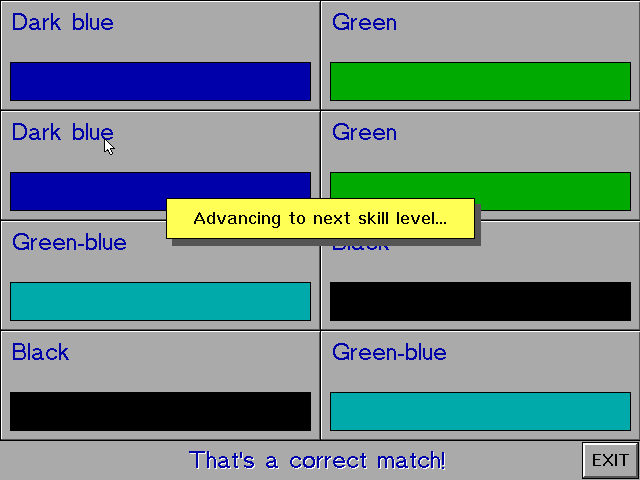
The first few rounds of Teaching Tiles are immediately understandable: pick a square, see what is underneath, then make a second pick and hope your memory holds. A mismatch flips both tiles back over, while a correct pair stays visible and earns a brief congratulatory message. It is concentration in its purest form, which makes it easy for a young child to begin without a long explanation.
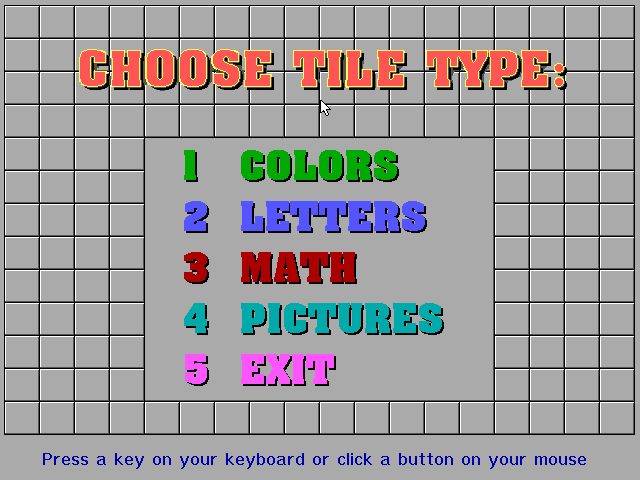
The four modes give that same rule set a useful educational twist. Colors pair matching colored tiles while also putting each color’s name in front of the player. Letters asks for uppercase and lowercase partners, while Pictures strips the task back to visual recognition. These are modest variations, but they suit the format: the player is not only recalling locations, but connecting what each tile means.
Maths is the strongest option once basic matching has clicked. You choose addition, subtraction, multiplication, division, a combined addition-and-subtraction set, or a mixed group of problems, then pair each sum with its answer. Selecting a difficulty helps it grow beyond the simplest drills, though the underlying activity never stops being a deliberate memory game.
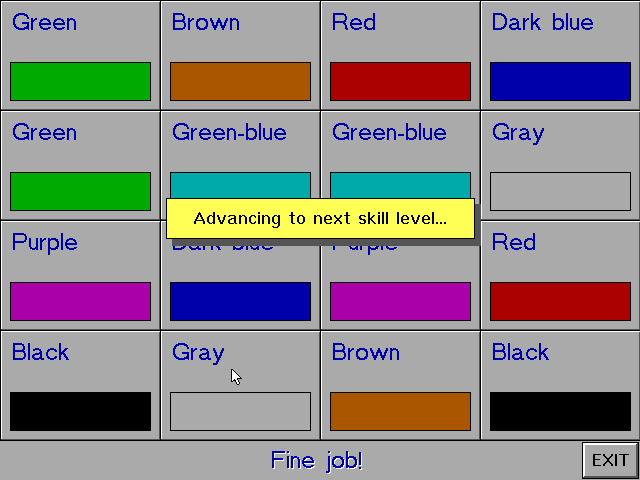
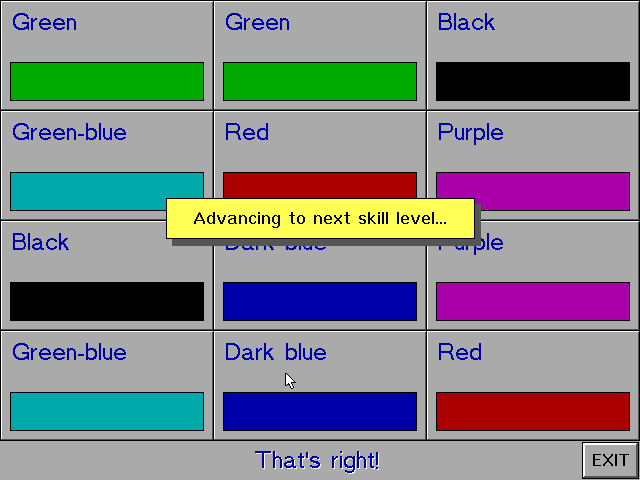
Boards begin at a manageable 2-by-4 and work through larger layouts, eventually reaching 5-by-6 before cycling back to the start. That progression is sensible: children can learn the routine on a small grid before the number of possible locations becomes harder to track. The lack of a timer keeps mistakes from becoming stressful, but it also means there is little reason to replay once the lesson itself is no longer useful.

Graphics
Teaching Tiles keeps everything centered on a plain grid of face-down cells and the items revealed beneath them: colors with written names, letters, numbers and sums, or pictures. The fixed board view makes every choice easy to follow, which is exactly what this kind of learning game needs.
Story
There is no story pushing you from one board to the next. Teaching Tiles is a sequence of self-contained matching exercises, with the next grid serving as its only sense of progress.
That absence fits the intended age group. A child can jump directly into colors, letters, maths, or pictures without needing to follow characters or scenes between lessons.
It also means the game depends entirely on whether the subject matter is useful to the person at the keyboard. If practicing letter cases or simple arithmetic is the goal, the straightforward structure stays out of the way; if you want personality or a larger adventure around the lessons, this will feel very bare.
Overall Experience
Teaching Tiles is more patient than exciting, and that is the right call. Its best quality is how cleanly it turns memory matching into practice: reveal, remember, pair, and try again. Younger children get a low-pressure way to work on recognition skills, while the maths settings offer a little more room to adjust the challenge.
There is not much depth beyond clearing successively larger boards, and the repeated loop can become monotonous quickly for anyone already comfortable with the material. The positive feedback for a match is pleasant, but it cannot create the variety that a dedicated puzzle game would need.
Give it a chance if you want a simple, untimed DOS activity for early reading, color recognition, picture matching, or basic arithmetic. It is not a lasting puzzle obsession, but it is a focused and sensible learning aid whose restrained pace may be its biggest advantage for the right child.


Reviews
There are no reviews yet.