 Retro Replay Retro Gaming History, Reviews & Emulation

Retro Replay Review
Gameplay
Doctor Hauzer earns its tension before it earns your trust. In the first hour, you are likely to move slowly, test a suspicious-looking route, inspect the room again, and still get flattened, dropped, or otherwise killed by something you did not fully understand. The mansion is the main threat, and that is more interesting than it sounds: every corridor becomes a question, every object might be a clue, and every new mechanism carries the possibility that you have just made the room worse.
This is survival horror built around observation rather than combat. Adler collects items, reads clues, examines the surroundings, and works out how to open routes or neutralize obstacles. There is little relief in the form of ordinary enemies you can simply defeat. Instead, progress comes from learning the house’s habits: where not to step, what to activate, and which inventory object belongs with which obstruction. When a solution clicks, the satisfaction is genuine because you have understood a place that initially seemed hostile and opaque.
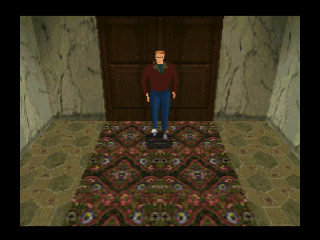
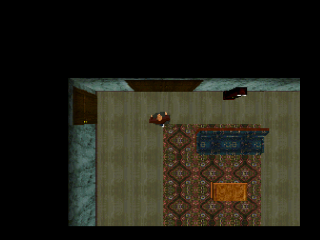
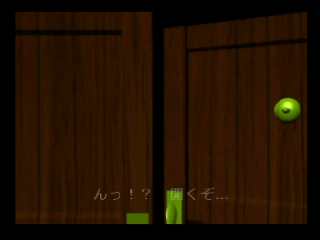
The ability to switch among third-person, first-person, and overhead views is not a novelty bolted onto the adventure. It is central to how you survive. Third-person makes basic movement and positioning easier to judge, first-person lets you inspect spaces from Adler’s eye level, and the overhead camera can clarify room shape, trap placement, and routes across dangerous ground. Get in the habit of changing perspectives whenever a room looks suspicious; it can save you from treating a spatial puzzle as a blind guess.
Still, Doctor Hauzer can be frustrating in a very particular 1994 way. Instant-death hazards mean you will sometimes learn through failure, and the mansion’s puzzles ask for patience rather than momentum. Saving is therefore essential, not optional housekeeping. If you enjoy mapping spaces mentally, revisiting a clue with a newly found item, and accepting a few fatal experiments as the price of discovery, the structure works. If you want fast answers or regular action, its deliberate pace may feel more punishing than scary.
Graphics
The mansion is shown through fully 3D rooms, corridors, stairways, and underground areas, with the camera changing from a view of Adler in the room to his direct viewpoint or an overhead layout. The overhead angle is especially useful visually because it lets you see the relationship between floors, gaps, hazards, and exits that can be hard to judge from ground level.
Story
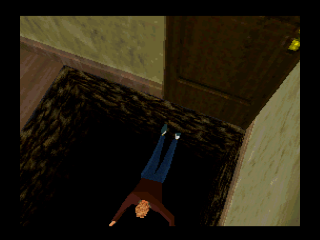
You play Adams Adler, a newspaper reporter searching for Dr. Hauzer, an archaeologist who vanished after building his mansion over an archaeological site. Hauzer’s obsession with the ancient deity Kellbim gives the investigation a fittingly uneasy foundation. The story does not need armies of creatures or constant cutscenes to create a horror hook; the question of what happened to the doctor gives every discovered clue a reason to matter.
The mansion carries much of the narrative weight. Its secret mechanisms, hidden spaces, traps, and underground areas turn Hauzer’s home into evidence of a mind consumed by its discovery. That makes exploration feel less like opening arbitrary locked doors and more like pulling apart a dangerous mystery one room at a time.
The strongest story moments are likely to come from your own cautious progress rather than a rush of plot revelations. You enter a quiet room, hear the building react, find a clue, and realize the house is telling you something about its absent owner. It is a restrained approach, but it suits an investigation where isolation and uncertainty are meant to do the frightening.
Overall Experience
Doctor Hauzer is a fascinatingly focused horror adventure: a lethal mansion, a missing archaeologist, and a player forced to survive through attention rather than force. Its sparse, trap-driven design produces a different kind of fear from combat-heavy horror. You are not wondering whether you have enough ammunition; you are wondering whether the next step is a mistake.
That focus also explains its limits. The game asks you to tolerate repeated attempts, careful saving, and puzzles that may not immediately communicate their logic. Some deaths will feel like useful lessons, while others may feel like the game making you pay for curiosity. The payoff is strongest when you adopt its methodical rhythm instead of trying to rush through it.
Give it a chance if you want an early survival-horror oddity that treats architecture as the monster and makes camera perspective part of the puzzle-solving. The 6.6 score fits: Doctor Hauzer has a memorable central idea and real atmospheric pull, but its old-fashioned trial-and-error design keeps it from being easy to recommend without reservation. For the right patient player, though, its mansion remains a distinctly nasty place to get lost in.



Reviews
There are no reviews yet.