 Retro Replay Retro Replay gaming reviews, news, emulation, geek stuff and more!
Retro Replay Review
Gameplay
The core appeal of Back to the Future Part II lies in its eclectic mix of five distinctly different arcade and puzzle challenges. From the high-speed hoverboard chases to the methodical door-toggling puzzles, each segment pays homage to a memorable scene from the film while offering its own set of mechanics and pacing. Rather than feeling tacked on, these mini-games flow together in a loose narrative that propels you from one timeframe to another.
(HEY YOU!! We hope you enjoy! We try not to run ads. So basically, this is a very expensive hobby running this site. Please consider joining us for updates, forums, and more. Network w/ us to make some cash or friends while retro gaming, and you can win some free retro games for posting. Okay, carry on 👍)
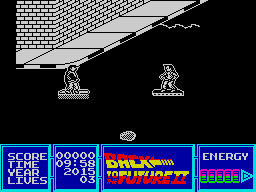
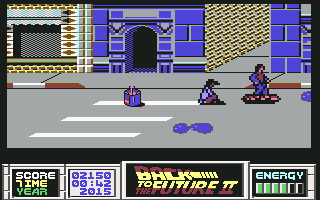
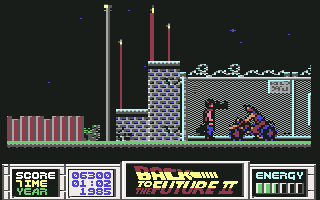
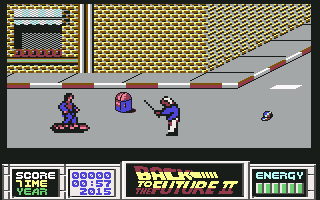
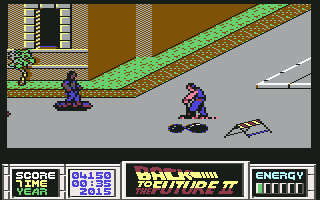
The two hoverboard chase levels bookend the adventure with fast-paced, isometric action reminiscent of classic bike-riding arcade titles. You’ll weave between obstacles, leap over gaps and dodge a relentless horde of enemies in both 1985’s grim streets and the neon-lit lanes of 2015. While the second chase in 1955 introduces slightly slower traffic patterns, it demands even sharper reflexes, ensuring that veteran players won’t find the early portions too repetitive.
Jennifer Rescue and the Band Puzzle take a more cerebral approach. In Jennifer Rescue, you open and close doors in a top-down view to shepherd her safely past suspicious family members, timing each move just right to avoid detection. The sliding-block Band Puzzle then shifts gears entirely, challenging your spatial reasoning as you reassemble a scrambled image against the clock. These pauses for strategy add welcome variety between the adrenaline of hoverboards and the street brawls.
Beat Biff injects a classic side-scrolling beat ’em up into the mix, complete with jumping, kicking and simple combo attacks. The level design keeps you advancing through back alleys and club interiors, dispatching Biff’s goons before facing the boss himself. Though its combat depth is limited by modern standards, this segment captures the gritty atmosphere of a 1985 gone awry and rounds out the gameplay cocktail with a satisfying punch.
Graphics
Graphically, Back to the Future Part II embraces the pixel-art style of late-’80s arcade conversions. Each mini-game sports its own color palette and sprite designs, resulting in a chameleon-like presentation that never feels stale. The isometric hoverboard stages use bold contrasts and simple shading to convey depth, while the top-down puzzle sequences rely on clear, iconographic art to keep doorways and characters instantly readable.
Animation quality varies from one mode to the next but generally holds up well. Marty’s hoverboard movements are fluid and responsive, with convincing tilts and leaps that enhance the sensation of speed. In Beat Biff, enemy attack animations are a bit stiffer, but you can still track hit frames and anticipate incoming strikes. The Band Puzzle’s sliding tiles transition smoothly, though the static nature of the scene limits visual flair.
Despite hardware constraints, the game captures the spirit of each era it visits. The 2015 levels boast brighter neon signs and futuristic hover-cars, while the 1955 sections lean into classic automobiles and pastel storefronts. Even the darker, corrupted version of 1985 is defined by muted hues and cracked sidewalks, reinforcing the game’s narrative stakes through color alone. Overall, the graphics excel at differentiation rather than pushing polygon counts.
Story
Adapted from the second film installment, the game’s narrative unfolds around the simple premise of thwarting Biff’s timeline tampering. Dialogue and exposition are minimal, but each mini-game is introduced with a brief text crawl that sets the scene and your objective. While fans of the movie may miss richer cutscenes or voice acting, the inclusion of iconic scenarios—like rescuing Jennifer or racing down the street—anchors the gameplay in the familiar plot beats.
Because the segments are short and varied, the story always feels like a backdrop rather than a driving force. That said, each chapter’s setting—be it a suburban home, a back alley or a neon future boulevard—reinforces your progression through time. The game trusts you to fill in the plot gaps with your knowledge of the film, a gamble that mostly pays off for players invested in the franchise.
Subtle touches, such as animated title cards and period-appropriate sound effects, help sell the time-travel illusion. You won’t find deep narrative twists or character development here, but the willingness to jump between genres keeps the story moving at a brisk clip. For those seeking a faithful movie conversion rather than an original expansion, Back to the Future Part II delivers the key moments in a compact package.
Overall Experience
Back to the Future Part II stands out as a time-traveling sampler platter, offering enough gameplay styles to pique the interest of arcade enthusiasts and puzzle solvers alike. Its pacing rarely falters, cycling between action and strategy so that no single mode overstays its welcome. While none of the five games are lengthy on their own, the collective runtime provides a solid evening’s worth of entertainment.
Replay value hinges largely on mastering each challenge. Speedrunners will enjoy shaving seconds off the hoverboard sections, while puzzle aficionados can aim for flawless door sequences and perfect band restorations. If you tire of one mini-game, a simple menu return lets you dive into another, making it easy to mix and match based on mood.
Though it lacks the narrative depth and graphical polish of modern titles, Back to the Future Part II captures the charm and energy of its source material. It’s best suited for players who relish quick, bite-sized challenges and have a soft spot for ’80s nostalgia. Fans of the film will appreciate reliving classic moments, and newcomers may find enough variety here to justify a trip through time.


Reviews
There are no reviews yet.