 Retro Replay Retro Gaming History, Reviews & Emulation
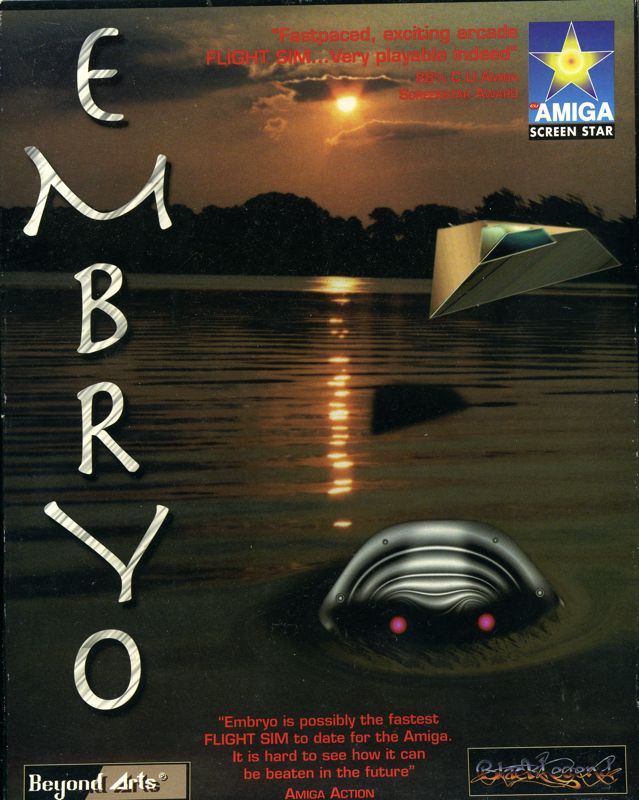
Retro Replay Review
Gameplay
Embryo gets moving quickly: you are in a futuristic fighter, the radar identifies the main objective, and the route there is full of targets worth destroying. That simple rhythm makes a good first impression. You are not managing a complicated aircraft; you are flying toward trouble and turning hostile craft into debris before they do the same to you.
The open locations give the missions a little more room than a tightly scripted shooting gallery. Rather than being pushed down one obvious lane, you have to use the radar and keep your bearings while deciding what to engage on the way. It is still a pure shooter beneath the cockpit view and the information prompts, so do not expect the careful procedure of a full flight simulation. The controls and goals serve a direct, combative pace.
Power-ups are the main incentive to stay aggressive. Destroyed enemies can leave extra ammunition or weapon upgrades, and collecting them adds a welcome escalation as a mission develops. Locational damage is the feature that gives the action its edge: damage can cause a ship component to malfunction, so taking hits has consequences beyond a shrinking sense of safety. That makes clean flying matter, even when the temptation is to charge into every encounter.
Twenty missions is a respectable stretch for this formula, though the basic loop does not radically change. Embryo works best in the moments where you are balancing navigation, incoming fire, and the chance to improve your weapons. If you want deep simulation systems, its shooter-first design will feel light; if you want fast cockpit combat with just enough pressure to punish sloppy runs, it has a sturdy core.
Graphics
The view stays inside the cockpit, with relatively detailed status information framing the action and a radar helping you track the objective. The locations are open enough to make flying and orientation part of the image rather than simply locking you into a narrow combat corridor.
Story
The setup is classic science-fiction pulp: aliens planted offspring in Earth’s oceans long ago, atomic testing wakes them, and humanity is suddenly at war. It is a clean excuse to put you in a fighter and send you against an alien threat, and it fits the game’s no-nonsense mission structure.
Embryo does not need its premise to carry much emotional weight because the focus is squarely on flying sorties. The alien awakening gives the conflict a larger backdrop, but the immediate stakes come from the target on the radar, the enemies in your path, and whether your damaged craft can finish the job.
That straightforwardness suits the game. You are not here for a tangled interstellar drama; you are here because an old menace has surfaced and somebody needs to fly toward it. The story does its job without getting in the way of the shooting.
Overall Experience
Embryo is an enjoyable middle-ground shooter: more atmospheric and spatially open than a simple arcade blaster, yet far more immediate than a demanding flight sim. The cockpit framing, mission radar, weapon pickups, and component malfunctions all pull in the same direction. You get a game that asks for attention without burying you in aviation homework.
Its limitations are tied to its strengths. The mission flow remains fundamentally direct—find the objective, fly there, shoot what intervenes—and the alien-war premise is mostly functional. When that loop clicks, though, it is easy to appreciate the clean momentum of pushing forward while trying to preserve a fighter that can be damaged piece by piece.
Give Embryo a chance if you enjoy Amiga-era science-fiction action and like the idea of cockpit combat with consequences for taking hits. It is not a landmark reinvention of either shooters or flight games, but it is a capable hybrid with enough mission length and mechanical tension to make its 20 sorties worthwhile.


Reviews
There are no reviews yet.