 Retro Replay Retro Gaming History, Reviews & Emulation

Retro Replay Review
Gameplay
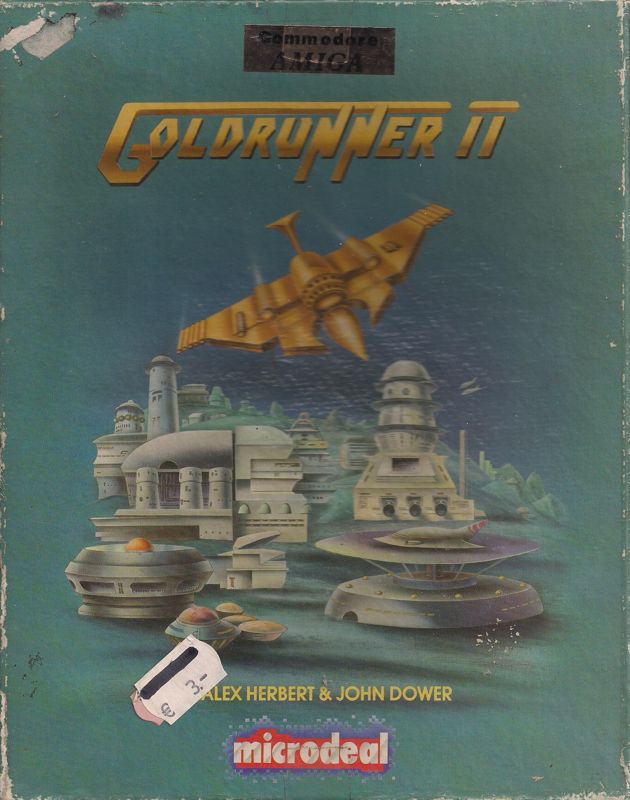
Goldrunner II gets moving immediately. You fly through vertically scrolling platforms hunting transporters that carry captured robot pilots, and every successful hit creates a new problem: recovery ships arrive as hostile fighters and mines. That makes each kill feel less like a routine target and more like a decision to stir up the next wave.
The strongest idea is the work you do after the shooting. Robots can be collected and carried to a teleporter station, but your ship holds only five at a time. You are constantly deciding whether to turn back with a useful load or stay out longer and risk getting boxed in. Clearing every robot by capture or destruction gives each level a concrete finish line, which helps the action feel more purposeful than a pure endurance shooter.
Frustration is built into that loop, though. Dust clouds blocking your fire can turn a clean attack into a messy scramble, and the enemies generated by destroyed transporters mean progress actively raises the danger. Smart bombs are the release valve, wiping every enemy currently on screen, but they work best when you resist wasting them on a merely uncomfortable moment. If you enjoy arcade games that ask you to manage a small objective under escalating pressure, Goldrunner II has a sharp hook. If you want relaxed shooting, its tendency to punish momentum may grate.
Graphics
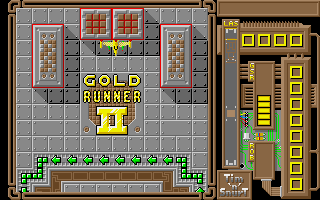
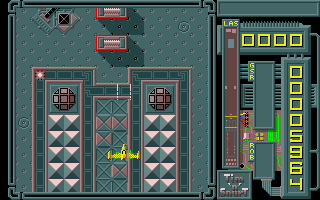
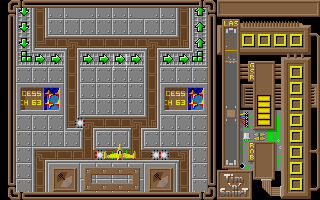
The game uses a top-down view with vertically scrolling playfields, keeping your ship, transporters, recovery ships, and mines in the same busy lane of attack. Dust clouds are especially important on screen because they visibly interrupt your firing line, forcing you to react to more than enemy positions.
Story
The setup is clean sci-fi pulp. Fifty years after the first Goldrunner, humanity has adopted robot pilots for defense, only for space pirates to seize them. You take control of the original hero’s grandchild and head out to recover the robots—or destroy them before they can be turned against their makers.
That premise gives the retrieval mechanic a little urgency. Bringing robots safely to the teleporter feels like the preferred outcome, while destroying them reads as the necessary fallback. It is not a story-heavy game; the narrative mainly supplies a sensible reason for the repeated sorties and the grim choice at the center of each platform.
The familial link to the earlier hero is a nice bit of continuity rather than a major dramatic engine. Goldrunner II keeps its storytelling where an arcade shooter needs it: enough context to make the mission matter, then back to flying, firing, and getting out alive.
Overall Experience
Goldrunner II is at its best when its systems collide: you destroy a transporter, new threats pour in, a dust cloud ruins the easy shot you expected, and your hold is already filling with robots that need to get home. The game turns a simple scrolling-shooter format into a tense series of short risk assessments.
Its 16 platforms give that central loop room to work, but the experience depends on whether you enjoy repeating it under increasing stress. The game does not let target destruction be uncomplicated, and its rescue capacity ensures you are rarely free to simply chase enemies. That friction is the point, but it can make the action feel demanding rather than breezy.
For fans of late-1980s Amiga or Atari ST arcade shooters, Goldrunner II is a solid, focused follow-up with a more involved mission structure than its basic shoot-first surface suggests. Give it a chance if you like learning disciplined routes and saving smart bombs for genuine emergencies. Its payoff comes from mastering the chaos, not from overpowering it.


Reviews
There are no reviews yet.