 Retro Replay Retro Gaming History, Reviews & Emulation
Retro Replay Review
Gameplay
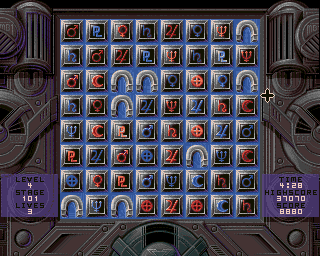
The first few moves in Neuronics feel comfortably familiar if you have spent time with swap-based matching games. You trade two neighboring tiles, look for identical colours and symbols touching horizontally or vertically, and watch the match disappear. The immediate twist is that you are not building toward a high score on an endlessly renewing board. You are trying to erase every tile.
That goal becomes much tougher because cleared positions remain empty and unusable. There is no convenient refill to repair a poor decision, and no diagonal connection to rescue a near-match. You need to consider not only the pair you can clear now, but whether that removal leaves enough adjacent tiles to solve the remaining clusters. It turns a modest-looking matching game into a compact spatial-planning puzzle.
The clock supplies the other half of the pressure. Early difficulty choices differ through their time limits and the points awarded for completion, so you can begin with more breathing room before testing yourself under sharper conditions. The fourth difficulty mode changes the routine by bringing stages in random order. That is a sensible challenge for players who already understand how quickly an innocent-looking swap can make a board impossible to finish.
Frustration is part of the deal. A board can reach a state where the remaining tiles no longer offer the adjacent matches you need, and the lack of diagonals or reusable gaps makes the mistake feel final. Still, Neuronics is at its best when you stop treating it like a reflex game and start reading the whole field before touching anything. If that kind of deliberate pressure sounds satisfying, the payoff of clearing a stubborn board is worth the occasional restart.
Graphics
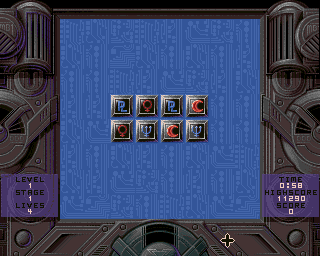
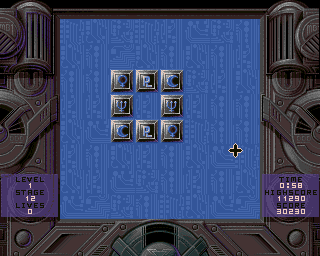
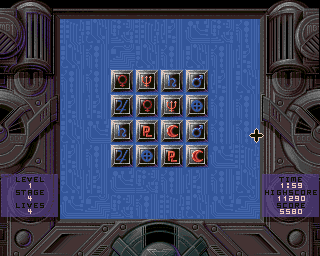
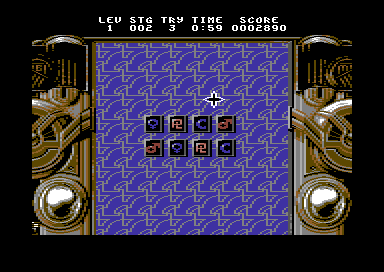
Neuronics is built around a top-down field of symbol-and-colour tiles. The important visual information is direct: you can inspect neighboring pieces and identify the matches that count, which matters when the board starts breaking into separated groups and the timer is pushing you onward.
Story
There is no story carrying you from stage to stage here. Neuronics puts all of its energy into the board in front of you: assess the layout, make the swap, and try to leave yourself a route to a clean field.
That stripped-down approach suits the game. Instead of pausing for narrative context, each stage creates its own little arc of confidence, doubt, and either relief or defeat as the available matches disappear.
If you need characters or a larger premise to stay invested, this will feel austere. If you are happy to let the puzzle itself provide the drama, the absence of story keeps the focus exactly where it belongs.
Overall Experience
Neuronics is a focused early-1990s tile puzzle that earns its tension through strict rules rather than a pile of extras. Matching identical tiles is easy to understand; clearing a whole board while permanent holes accumulate is not. That contrast gives it a sharper bite than its basic setup first suggests.
Give it a chance if you enjoy puzzlers that punish short-term thinking and reward patient board reading. The timed modes ensure you cannot deliberate forever, yet success depends more on recognizing the consequences of a swap than on speed alone. The hard random-order option also makes it a better long-term test than a one-and-done set of fixed stages.
It will not suit everyone. Anyone wanting relaxed matching, forgiving recovery from mistakes, or diagonal combinations will likely find its restrictions severe. But for a player who likes compact rules, mounting pressure, and the clean satisfaction of leaving nothing behind, Neuronics is a demanding little puzzle worth wrestling with.


Reviews
There are no reviews yet.