 Retro Replay Retro Gaming History, Reviews & Emulation
Retro Replay Review
Gameplay
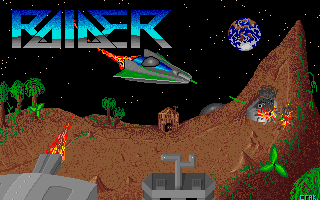
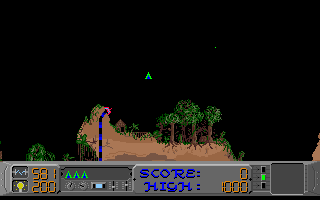
Raider starts with a simple objective—collect a cog from each planet—but it quickly makes that task feel dangerous. Your ship has to survive close to the terrain under the pull of gravity, and the rocket thruster is both your lifeline and your greatest source of trouble. Tap it too lightly and you sink into the surface; hold it too long and you can send yourself into a wall. That constant correction gives the game its nervous energy.
The controls have real bite because you rotate the craft rather than merely point it where you want to go. A safe route demands that you think about angle, speed, and where gravity will pull you after the next burst of thrust. Turrets add pressure without changing the basic problem: you can fire back, but a firefight is risky when your attention also needs to stay on the ground beneath you. When it clicks, slipping in for a cog and climbing away cleanly feels earned rather than automatic.
The four-planet cycle leads to a run through a power plant to dispose of the collected cogs, which gives the otherwise level-by-level structure a useful finish line. Across 40 levels, variable gravity and tractor beams stop the game from resting on one exact flight pattern. That is welcome, though the increased complications also magnify the harshness of a game where contact with terrain or walls is unhealthy.
Expect setbacks. Raider is not the kind of action game that lets you muscle through every problem with fast reflexes alone; it rewards controlled inputs and a willingness to learn the shape of a dangerous space. If you enjoy the pressure of old-school physics flight, the challenge is compelling. If repeated crashes make you impatient, the friction arrives early and stays there.
Graphics
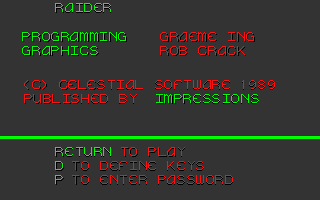
Raider uses a side-on view of a small spaceship flying over planetary surfaces, with gun turrets positioned as immediate threats around the terrain. The clear, compact layout suits a game where you need to judge your ship’s angle and distance from the ground in a hurry.
Story
There is little narrative to slow the action down. You are a pilot collecting cogs from planets, then carrying them through a power plant to get rid of them. It is a functional sci-fi excuse for the missions rather than a story you will dwell on.
That sparseness fits the game’s focus. Raider wants your attention on the next controlled thrust, the next approach to a pickup, and the next turret rather than on characters or plot turns.
The small objective does at least give the levels a purpose beyond simple survival. You are not merely flying from left to right; every risky descent is tied to bringing back another cog and eventually clearing the load.
Overall Experience
Raider is a solid but stern Thrust variant whose best moments come from mastering a ship that initially feels like it wants to betray you. The physics are the whole point, and they create a satisfying sense of improvement when you start anticipating gravity instead of reacting to it.
Its limits are equally clear. The game’s challenge can feel more punishing than inviting, especially when a minor error ends a careful attempt. The growing obstacles give the 40 levels more variety, but they do not soften the fundamental demand for precision.
Give Raider a chance if you enjoy deliberate, gravity-heavy space flight and can appreciate a game that makes every safe landing feel like an achievement. It is less likely to win over anyone looking for breezy shooting or a rich sci-fi adventure, but patient pilots will find a respectable test of control here.


Reviews
There are no reviews yet.