 Retro Replay Retro Gaming History, Reviews & Emulation
Retro Replay Review
Gameplay
The Final Battle earns your attention by putting its heroes at their lowest point. You begin as one member of the group while the rest sit captive in Suzar’s dungeon, so escaping and freeing them gives the early game a concrete, satisfying direction. Rather than merely collecting objects for arbitrary locks, you are gradually restoring a team that can tackle more of the island’s problems.
The puzzle design leans on three connected ideas: your inventory, the surrounding environment, and the abilities of the comrades you rescue. That creates a stronger sense of place than a chain of detached item puzzles. A situation can depend on who is available, as well as the island’s day/night cycle and weather, so solutions ask you to consider conditions instead of only rifling through your possessions.
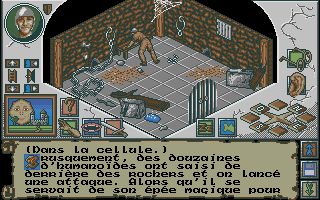
Unfortunately, the interface puts friction between you and that thinking. To use anything, you first select the appropriate icon, then click the object or person in the playfield. It is a deliberate routine that can make trial and error feel slower than it needs to be. If you enjoy patiently testing a puzzle game’s logic, the structure starts to click; if you want quick, direct adventure-game interaction, this is where frustration is likely to set in.
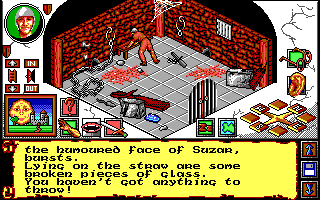
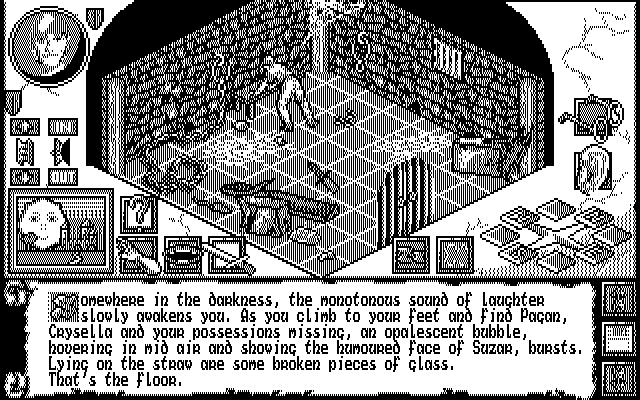
The isometric perspective is an interesting change from Legend of the Sword, though it comes with an unusual twist: the current party leader is absent from the screen because you see through that character’s eyes. That keeps the focus on the space and the people around you, but it also makes this less like steering a visible party across a board and more like navigating a puzzle world from inside the leader’s viewpoint.
Graphics
The move to an isometric view gives the island and dungeon exploration a more spatial feel than a flat adventure layout. You look across the environment diagonally, while the leader remains off-screen and the rest of the action is framed through that character’s point of view.
Story
This is a direct sequel with a clean revenge-and-rescue premise. The five heroes thwarted the wizard Suzar in Legend of the Sword, but he has returned, captured them, and scattered their hopes in his dungeon. It is familiar fantasy material, yet it works because the plot immediately turns into the game’s first objective.
Freeing your comrades is more than a narrative checkbox. Their different abilities matter to puzzle solving, which means the story’s rebuilding-the-party arc feeds directly into how you progress. Each rescue has the potential to change what you can attempt, lending practical weight to the mission.
The larger journey takes you beyond the dungeon to explore the island and confront Suzar’s renewed threat once and for all. There is no need for a complicated mystery here: the game knows its villain, its stakes, and the destination. That straightforwardness suits an adventure whose real drama lies in working out how to get past the next obstacle.
Overall Experience
The Final Battle is a modestly compelling fantasy puzzle adventure with a better central structure than its score suggests at first glance. Its day/night cycle, weather, and ability-based party puzzles make the island feel like a set of interlocking problems rather than a backdrop for inventory busywork. When you connect those pieces, the game offers the particular satisfaction of old adventure games that expect you to notice conditions and remember possibilities.
The catch is that its interface demands patience at every turn. Selecting an icon before selecting a target is not difficult to understand; it is simply an extra step repeated often enough to wear on you. That makes the game easier to recommend to someone who enjoys careful, methodical puzzle solving than to anyone hoping for a breezy fantasy quest.
For fans of Legend of the Sword, the sequel’s new viewpoint and expanded environmental angle make it worth investigating. Newcomers can also find a solid challenge here, provided they accept the slow interaction pace as part of the bargain. It never fully escapes its awkward controls, but the rescue-driven progression and interconnected puzzle ideas give the effort a real payoff.

Reviews
There are no reviews yet.